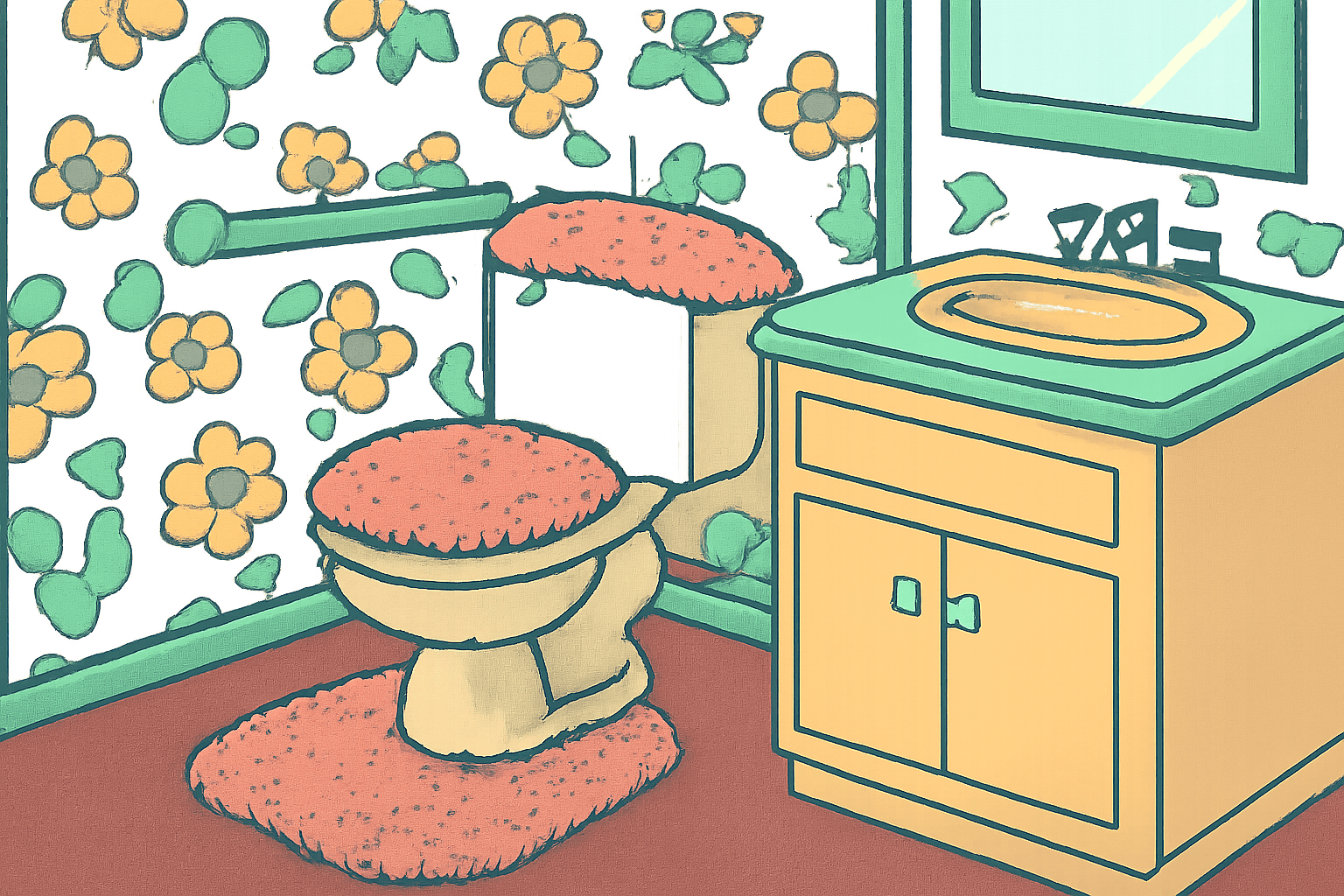
The carpet was mauve. It was always mauve. Or dusty rose, or seafoam green, or a shade of blue that existed nowhere else in nature or in any paint swatch book. It started at the bathroom door and went everywhere - up to the base of the tub, around the toilet, right up against the vanity where the sink dripped a little from the cold handle that never fully turned off.
This was the carpeted bathroom. Millions of American homes had one. Maybe yours did. Maybe your grandma's did. Maybe your friend Tyler's house had one and you noticed it every single time you went over but never said anything because you were nine and hadn't yet developed the language for this is architecturally insane.
Nobody questioned it. It was just there. Like wood paneling or popcorn ceilings or the floral border that ran along the top of every wall in the house. The bathroom had carpet. The carpet was damp. Life went on.
The Full Matching Set
The carpet was only the foundation. The true commitment was the ensemble.
There was the fuzzy toilet lid cover - a plush, oval-shaped thing that sat on top of the lid like a little toupee. It was always the same color as the carpet. It attached with elastic and it never stayed centered. You'd sit down and it would slide. You'd put it back and it would slide again. It was locked in a war with gravity that it was always losing.
Then there was the contour rug. Not a bath mat - a contour rug. Shaped like a U, designed to wrap around the base of the toilet, with a rubber backing that gripped the carpet that was already there. Carpet on carpet. Redundant softness. This was a room that wanted desperately to be a living room and almost pulled it off except for the toilet.
The contour rug was carpet on top of carpet, which is either a design philosophy or a cry for help.
And the tank cover. A rectangular piece of fuzzy fabric draped over the back of the toilet tank, sometimes with a little embroidered seashell or flower on it. This served no purpose. None. The tank was porcelain. It didn't need a sweater. But there it was, dressed for company, coordinated with its friends, part of the set that came in a plastic zippered bag from Sears or JCPenney or wherever bathroom fashion happened.
- Wall-to-wall carpet (mauve, seafoam, or dusty rose)
- Fuzzy toilet lid cover (matching)
- U-shaped contour rug (matching)
- Tank top cover (matching, possibly embroidered)
- Seashell-shaped soap dish (clear resin, decorative only)
- Potpourri in a basket on the back of the toilet
- A framed cross-stitch that says "Bless This Mess"
- Tissues in a crocheted tissue box cover
The Moisture Situation
Let's talk about what everyone was thinking and nobody was saying.
Carpet. In the room where all the water lives. The room with the shower, the bathtub, the sink, and the toilet. The room that generates more ambient moisture per square foot than any other room in any house. Someone looked at this room and said, "You know what this needs? The same material we put in the bedroom."
The carpet near the tub was always a slightly different shade than the rest. Darker. Heavier. It had absorbed years of post-shower drip and the occasional splash-over from a bath that got too enthusiastic. If you stepped on it barefoot right after someone showered, it squelched. Not dramatically. Just a little. Just enough to make you think, briefly, about what was happening under the carpet. About the pad. About what the pad had seen.
You didn't think about it for long. You couldn't. Because if you really thought about it - really sat with the reality of what was growing in the carpet pad of a room that was humid six hours a day - you would never set foot in that bathroom again. And it was the only bathroom. So you didn't think about it.
If you really thought about what was living in the carpet pad, you'd never enter that bathroom again. So you simply didn't think about it.
The Smell
Every carpeted bathroom had a smell. It wasn't a bad smell, exactly. It wasn't good either. It was a specific smell - a cocktail of Glade PlugIn (Country Garden), damp carpet fiber, the ghost of a hundred showers, and whatever soap was in the seashell dish that nobody ever used because it was decorative.
The potpourri was doing its best. A little wicker basket on the back of the toilet, full of dried flower petals and wood shavings and those little star anise pods that looked like they came from another planet. It had been there since 1993. It smelled like dust and cinnamon and the general concept of trying. Your mom would shake the basket sometimes, like she was panning for gold, redistributing the scent that had vacated years ago.
Sometimes there was a candle. A Yankee Candle in a glass jar - Autumn Leaves or Macintosh Apple - sitting on the counter with a ring of soot around the inside of the jar. It got lit when company came over. The rest of the time it just sat there, a decorative promise of a scent that would never arrive.
The Installations Were Permanent
Here's the thing about bathroom carpet. It wasn't a rug. It wasn't something you could roll up and throw in the wash or replace on a whim. It was installed. Glued down or stretched over a pad and tacked at the edges, just like the carpet in the hallway and the bedrooms. A professional - or more likely your uncle - had put this in. With tools. On purpose.
Which meant removing it was a project. Not a weekend project. A real project, with a trip to Home Depot and a rented floor scraper and the grim discovery of what the original floor looked like underneath. Sometimes it was tile. Sometimes it was linoleum in a pattern that explained why someone had carpeted over it. Sometimes it was just plywood, which raised more questions than it answered.
Most families never removed it. The carpet stayed for the life of the house, or at least for the life of the ownership. It became part of the bathroom's identity, as permanent as the fixtures. You grew up with it. You showered above it. You did everything you do in a bathroom, on carpet, for years, and it simply never occurred to you that this was optional.
Every Other House Had One
The truly wild thing was how universal it was. This wasn't a quirk of one weird family. This was a movement. Carpeted bathrooms were everywhere in the eighties and nineties - in split-levels and ranches and colonials, in apartments and condos, in the houses of people who otherwise made completely reasonable decisions about home design.
You'd go to a friend's house and their bathroom had carpet. Different color, same energy. You'd visit your aunt in another state and her bathroom had carpet. You'd go to a restaurant and even their bathroom had carpet, which was somehow more disturbing in a public context, like seeing a dog wearing shoes.
It was the default. Tile was for rich people. Linoleum was for kitchens. Carpet was for everywhere else, and "everywhere else" included the bathroom, and nobody had the conversation about whether that made sense because it was just how houses were.
The Moment It Became Weird
At some point in the late nineties or early 2000s, the consensus shifted. Home renovation shows started appearing on television. Trading Spaces. This Old House. People began looking at their homes with new, critical eyes. And one by one, across the country, a generation of homeowners looked at their bathroom floors and said, out loud, for the first time: "Wait, why is there carpet in here?"
An entire generation of homeowners looked at their bathroom floors and said, for the first time, "Wait. Why?"
It was like a spell breaking. Suddenly the carpet wasn't invisible anymore. It was wrong. It had always been wrong. How had nobody noticed? How had millions of adults walked into Home Depot, looked at carpet samples, and said, "Yes, this one. For the bathroom." How had the carpet installer not paused, just for a second, and said, "You sure?"
The rip-outs began. Tile went in. Vinyl plank. Anything that could handle water without becoming a biome. The fuzzy toilet lid covers went into trash bags. The contour rugs followed. The matching tank covers were retired to the same limbo that claimed decorative soap and toilet tank potpourri. An era ended, not with a bang but with the sound of carpet tack strips being pried off a subfloor.
But For a While There
For a while there, though, it was kind of nice. Not nice in a way that made sense. Nice in a way that didn't need to. The carpet was warm in the morning. Your bare feet hit the floor at 6 AM on a school day and instead of cold tile shocking you awake, there was this soft, slightly dubious warmth. It was like the bathroom was trying to be gentle with you. Like it knew you didn't want to be up yet.
And late at night, padding to the bathroom in the dark, no lights because you didn't want to wake up all the way - the carpet was the thing that told you where you were. Not tile. Not wood. Soft. Warm. Bathroom. You were half asleep and navigating by texture, and the carpet was a landmark.
It was never a good idea. Everybody knows that now. But standing in your bathroom at midnight in 1996, the carpet soft under your feet, the seashell soap untouched, the potpourri pretending, the fuzzy lid cover sliding gently off-center for the thousandth time - it didn't feel like a mistake. It felt like someone had tried to make a small, wet, necessary room into something that wouldn't make you flinch. And for a while, in a way that defied all logic and most building codes, it worked.