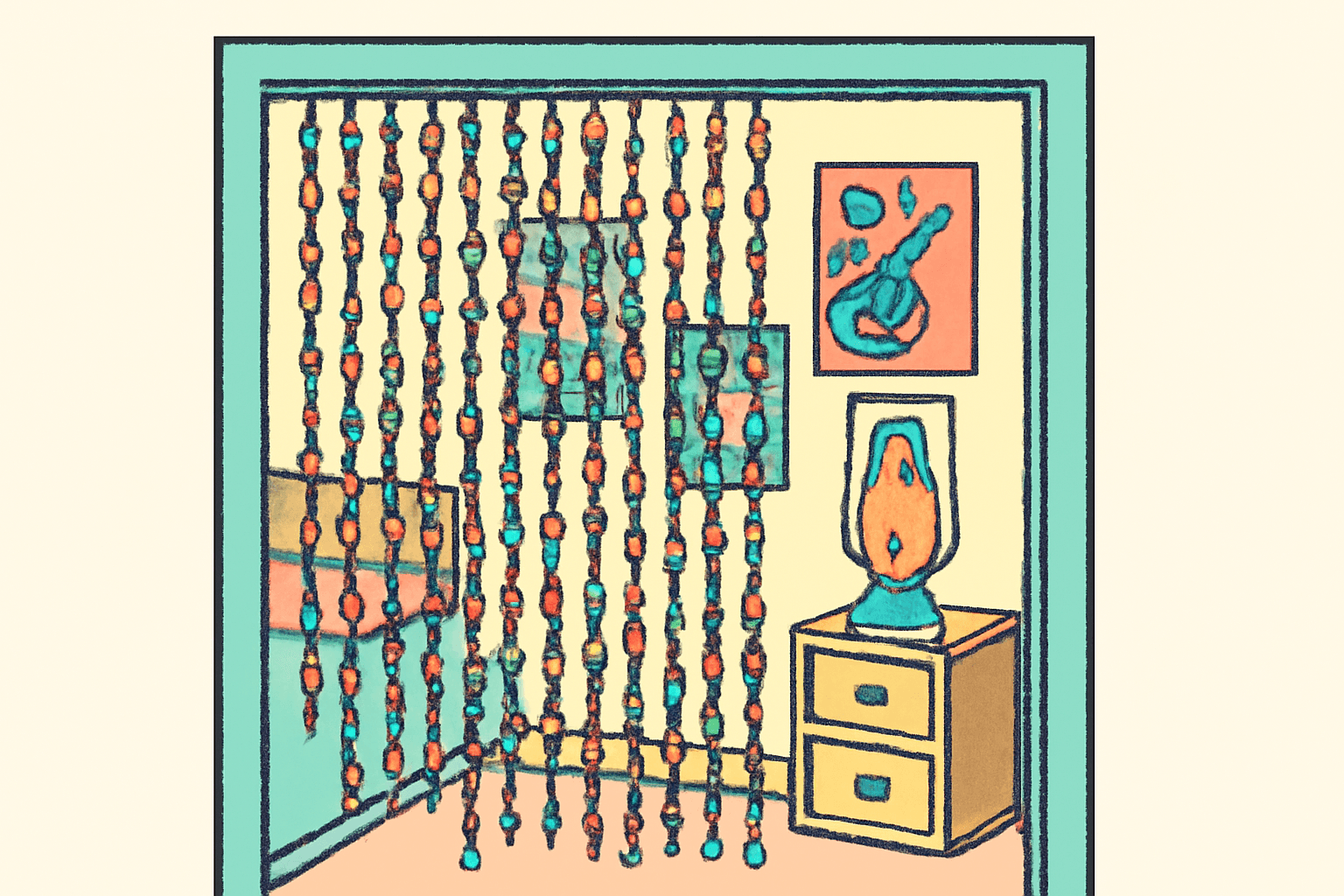
The first time you walked through it, you did it slowly. One strand at a time, pushing the beads apart with both hands like you were parting some kind of sacred veil. They were wooden, or maybe bamboo, painted in alternating colors that didn't quite match anything else in the room. You'd hung them that afternoon with two small hooks your dad drilled into the door frame, grumbling the whole time about holes in the molding. But now they were up. And your room had a sound.
You walked through again. And again. Back and forth, just to hear the clatter.
The Announcement
That's what a bead curtain really was. Not a door. Not a privacy barrier. Not decoration, exactly. It was a noise. A clatter - hollow and wooden and deeply satisfying - that said someone is entering or someone is leaving. It turned the simple act of walking into your bedroom into an event. Every entrance had a soundtrack.
A real door just swung open. Boring. Silent, mostly. A bead curtain made you feel like you were walking into a record store in Greenwich Village or the back room of some shop you weren't old enough to enter. It was theatrical in a way that felt effortless, even though you'd spent forty-five minutes at Spencer's Gifts picking the right one.
A bead curtain wasn't a door. It was a statement that said this room is different from the rest of the house, and the statement made noise every single time.
Spencer's Gifts. That strange, dark cavern in the back corner of every American mall, half lava lamps and half stuff you weren't supposed to look at. You'd walk past the gag gifts and the shot glasses and the posters of women on motorcycles, eyes forward, heading straight to the section with the blacklights and the bead curtains and the door-length curtains made of those little metal chains. Your mom waited outside. She always waited outside Spencer's.
The Bedroom as Declaration
The bead curtain was never just the bead curtain, though. It was the first thing you encountered on the way into a larger project. Because a 90s teenager's bedroom wasn't just a room where you slept. It was your first curated space. Your first real attempt at saying, through objects and arrangement and weird aesthetic choices, this is who I am.
And who were you? Based on the evidence, you were someone who needed a lot of stuff on the walls.
The door itself - the real door, the one behind the beads - was covered. Magazine cutouts. Band posters. Photos from disposable cameras. That one Nirvana poster everyone had, or the Bob Marley one, or the Scarface one the guys all thought was deep. Everything held up with sticky tack - those little blue rectangles of adhesive putty that promised to be removable and were lying. When you eventually took the posters down, they left blue smears and pulled-up paint and tiny craters in the drywall. Your security deposit on self-expression was nonrefundable.
- Painted drywall: Blue residue, minor paint pull. Fixable if you cared. You didn't.
- Wood doors: Permanent greasy circles that darkened over time.
- Popcorn ceiling: Chunks removed. No recovery possible.
- That one poster you stuck directly to the wallpaper: Your mom is still mad about this.
The walls beyond the door were just more of the same. Layers and layers, like geological strata of your evolving taste. The Spice Girls poster from sixth grade half-covered by the Korn poster from eighth grade, which was itself partially obscured by a blacklight poster of a mushroom you bought because it looked cool and absolutely not because of any other association you definitely didn't understand yet.
The Altar of the Stereo
Every 90s teen bedroom had a center of gravity, and it was usually the stereo. Not a speaker, not a soundbar, not a phone on a nightstand. A stereo system - a chunky shelf unit with a CD player on top, double tape deck in the middle, and a radio tuner you never touched. Maybe it was a Sony, maybe an Aiwa, maybe a JVC your uncle gave you when he upgraded. It sat on your dresser or your desk, and it was the most important piece of furniture in the room.
The speakers were disproportionately large. Always. Two detachable boxes that you placed on either side of the unit, angled slightly inward like they were addressing the room. The bass wasn't good, but it was present. You could feel your burned CDs in your sternum. That was the point.
The stereo wasn't furniture. It was the room's heartbeat, and every burned CD was a blood cell.
You'd lie on your bed - or your beanbag chair, if you were committed to the aesthetic - and just listen. Not while doing something else. Not as background. Just lying there, staring at the glow stars on your ceiling, letting a whole album play front to back while the lava lamp on your nightstand did its slow, blobby work.
The lava lamp. Another Spencer's purchase, or maybe a gift from someone who knew you only well enough to know you were a teenager. It sat on whatever surface was closest to an outlet, its orange or purple goo rising and falling in shapes that meant nothing but felt significant. It gave the room a glow. Between that and the blacklight you'd clamped to your bookshelf - the one that made your white socks look radioactive and revealed every stain on every surface in ultraviolet judgment - your bedroom had lighting that a real estate agent would describe as moody and your parents would describe as depressing.
The Phone Cord Under the Door
If you were lucky, you had a phone in your room. Your own line was the dream - a number that rang only for you, printed carefully on notes you passed in class. But most of us weren't that lucky. Most of us had the family phone, the cordless if we were fortunate, the corded if we were not.
The corded phone meant the cord. And the cord meant negotiation. You'd carry the handset as far from the kitchen or the hallway as the coiled wire would allow, stretching it around corners, under doors, across thresholds. The cord would go taut against the bottom of your bedroom door, and you'd close the door on it, and there you were - technically in your room, technically private, with a telephone cord pinched flat in the door gap like a lifeline to the outside world.
You'd sit on the floor with your back against the bed, knees up, talking for an hour about nothing. The bead curtain swaying slightly from the draft. The lava lamp glowing. The stereo on low. This was the room. This was the whole world.
- Bead curtain (Spencer's Gifts, $12.99)
- Lava lamp (Spencer's Gifts, $19.99)
- Blacklight bulb or clamp lamp (Spencer's Gifts - you see the pattern)
- Glow-in-the-dark stars on the ceiling (CVS, $2.99)
- Beanbag chair slowly leaking tiny white pellets into the carpet
- Stereo system with detachable speakers
- Door covered in magazine cutouts, sticky tack, and regret
- At least one dELiA*s catalog under the bed or on the desk, dog-eared to oblivion
- A Hot Topic bag repurposed as decoration, hung from the doorknob
The Catalog of Who You Wanted to Be
There's a reason I mention dELiA*s. If you were a girl in the mid-to-late 90s, that catalog was a blueprint. Not just for clothes but for a whole vibe - the bedroom spreads in the background of the photos showed rooms that looked like yours but better. Cleaner. More intentional. They had platform shoes by the door and butterfly clips on the dresser and bedding that actually matched. You'd tear pages out and tape them to your wall, not because you wanted the clothes - though you did - but because you wanted the room. The life. The curated effortlessness of being a teenage girl who had it all figured out.
Hot Topic did the same thing from a different angle. You'd walk out of that store with a bag full of patches and pins and a poster of a band you'd listened to exactly once, and you'd bring it all home and add it to the layers. More stuff on the walls. More identity, tacked up and overlapping, a collage that said everything and nothing at the same time.
The First Draft
Here's what I think about now. Your bedroom was a rough draft. The first time you ever tried to make a space that reflected something internal - some version of yourself that you were still figuring out. And it was messy and contradictory and loud. The beanbag chair next to the desk chair. The blacklight next to the desk lamp. The Backstreet Boys poster three feet from the Smashing Pumpkins poster, because you contained multitudes and also because you hadn't yet learned that taste was supposed to be consistent.
None of it matched. All of it mattered.
You were thirteen and you were curating. You were arranging objects in space and making choices about color and light and sound, and you didn't call it design or self-expression or identity construction. You called it your room. You called it mine.
The bead curtain came down eventually. Maybe you took it down yourself, embarrassed by it suddenly. Maybe your parents remodeled. Maybe it just broke - one strand at a time, beads scattering across the carpet like tiny wooden refugees. But somewhere in your body, you still know that sound. That hollow, clattering announcement. The noise a room makes when it's trying to tell you who you are.