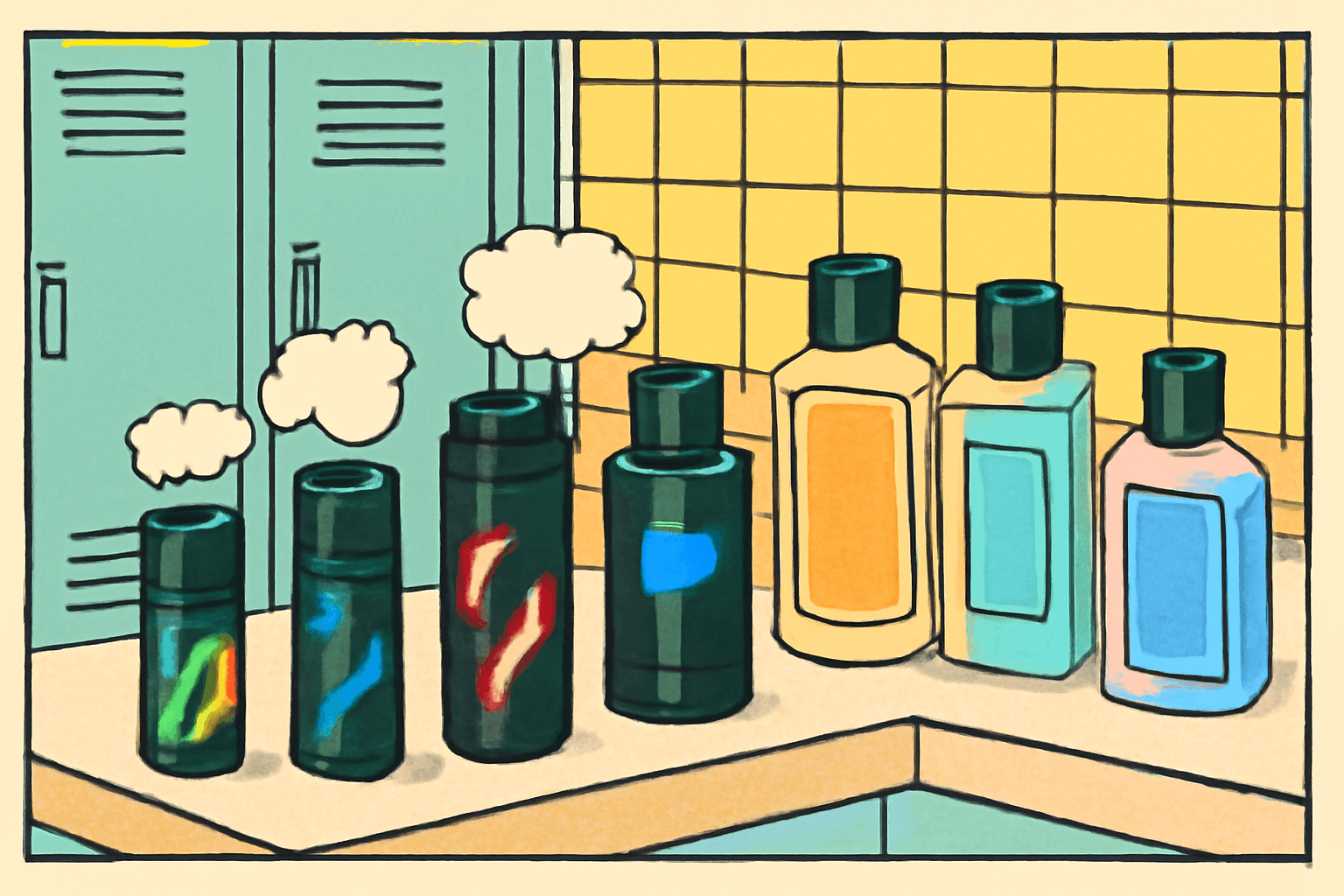
The boys' locker room at Garfield Middle School had a visible haze by 7:45 AM. Not steam. Not dust. Axe Phoenix. A gray-blue cloud that hung at chest height and didn't so much dissipate as relocate - drifting into the hallway, the gym, the cafeteria - like a slow-moving weather system with notes of musk and teenage desperation. You could taste it. You could taste it on your sandwich at lunch.
Nobody sprayed a reasonable amount. That was the whole point.
The Promise
The Axe commercials were, in retrospect, genuinely insane. A perfectly average-looking dude would spray himself with Axe and suddenly women - plural, always plural - would sprint toward him from every direction. They'd emerge from the ocean. They'd climb over fences. They'd parachute in. Hundreds of them, drawn by scent alone, like he was a flower and they were bees, except the flower was a sixteen-year-old in cargo shorts and the bees were supermodels.
The Axe commercials promised that scent was a cheat code. We were twelve. We believed in cheat codes.
And we watched these commercials on MTV, on Comedy Central, during SportsCenter, and we absorbed their message with the same uncritical enthusiasm we brought to everything else at that age. The message was: the thing standing between you and girls is a can of body spray. That's it. Not confidence. Not hygiene. Not emotional maturity. A three-dollar aerosol can from CVS.
So we bought it. We bought all of it. Phoenix. Kilo. Voodoo. Touch. Apollo. Each one had a name that sounded like either a nightclub or an 80s action movie, and each one promised a slightly different version of irresistibility. You'd stand in the deodorant aisle at Walgreens, popping caps off cans and sniffing like a sommelier, trying to determine which scent would finally unlock the mystery of seventh-grade romance.
The Application
The recommended amount of Axe body spray, according to the can, was probably a two-second burst. A light misting. A suggestion.
We did not follow the recommendation.
The standard middle school application was a solid five to seven seconds of continuous spray, moving the can in a slow figure-eight across the chest. Some kids sprayed their necks. Some sprayed their wrists, like it was cologne. The truly committed sprayed the inside of their shirt, their backpack, their locker. I watched a kid named Derek spray Axe directly onto his math homework once. He wasn't joking. He wanted his homework to smell good. For who? For Mrs. Patterson? Nobody asked. Nobody needed to. The logic was airtight: more spray equals more attractive. There was no upper limit.
- Phoenix - The default. If you didn't know what you wanted, you wanted Phoenix. Vaguely fruity, aggressively present.
- Kilo - For the kid who wanted to seem "edgier." Still smelled like a candle in a locker room.
- Touch - Supposedly more "subtle." It was not subtle.
- Voodoo - The name alone sold a million cans to boys who thought "voodoo" sounded mysterious and cool.
- Apollo - Arrived later but became a staple. Named after a Greek god, worn by kids who couldn't find Greece on a map.
The locker room was ground zero. After gym class, thirty boys in a concrete room with no ventilation would simultaneously deploy their aerosol cans, creating a chemical event that probably violated the Geneva Convention. Your eyes would water. You'd cough. You'd walk out into the hallway smelling like you'd been marinated in a Bath & Body Works dumpster, except worse, because it was thirty different scents layered on top of actual sweat. The Axe wasn't replacing the smell of gym class. It was joining forces with it.
Teachers would prop the door open. Some banned it entirely. One substitute teacher at my school had an asthma attack. We felt bad about that. We did not stop spraying.
The Other Side of the Aisle
The girls had their own arms race, and it was headquartered at Bath & Body Works.
If you went to any American mall between 1997 and 2004, you walked past that store. You didn't have a choice. It announced itself from forty feet away - a wall of scent so dense it functioned as a physical barrier. Inside, teenage girls were stockpiling body splash like it was currency. And in a way, it was. Your scent was your identity. Your brand.
Cucumber Melon wasn't a scent. It was a personality type.
Cucumber Melon was the safe choice. The vanilla of body splash. Everyone had it. It was the starter scent, the one you got at your first sleepover or in a gift set from your aunt at Christmas. It smelled clean and green and vaguely like a spa, which was aspirational for a twelve-year-old who still used L'Oreal Kids shampoo.
Plumeria was for the girls who wanted to seem more mature. Slightly floral, slightly tropical, like they'd just returned from a vacation they definitely hadn't taken. Japanese Cherry Blossom came later and immediately took over - sweet and pink and everywhere, the Phoenix of the Bath & Body Works lineup. You could walk into any eighth-grade classroom in America and identify at least three distinct clouds of Japanese Cherry Blossom before you sat down.
The body splash was just the entry point. There was the lotion. The shower gel. The body butter. The little pocket-sized hand sanitizer that somehow also smelled like Warm Vanilla Sugar. Girls would layer these products - the same scent, four different formats - creating a fragrance so thorough it had structural integrity. You could smell them coming around a corner. You could smell where they'd been.
The Sophisticated Option
And then there was CK One.
Calvin Klein's CK One existed in a completely different category. It came in a frosted glass bottle, not a plastic can. It was unisex, which in the late 90s felt revolutionary, like the fragrance itself had transcended gender. It cost real money - not three dollars at CVS but thirty or forty at Macy's, which meant it was usually stolen from an older sibling or received as a birthday gift from a parent who didn't know what else to get you.
The kid who wore CK One was making a statement. The statement was: I am better than Axe. And honestly? They might have been right. CK One smelled clean and citrusy and adult in a way that Axe Voodoo absolutely did not. It was the difference between a kid wearing a clip-on tie and a kid whose dad taught him a Windsor knot. Same general idea. Completely different execution.
But CK One kids were rare. Maybe one or two per grade. The rest of us were out there fumigating hallways with three-dollar body spray and drugstore body splash, convinced we were doing something sophisticated, creating scent profiles so aggressive they preceded us into rooms by a full ten seconds.
Mutually Assured Fragrance
Here's what nobody talks about: the boys and the girls were doing the exact same thing. We were all just dumping chemicals on ourselves in absurd quantities, hoping it would somehow translate to attraction. The boys had Axe. The girls had body splash. Both sides were deploying weapons-grade fragrance in enclosed spaces - classrooms, school buses, movie theater lobbies - and neither side could smell the other through their own cloud.
Think about that. Thirty boys soaked in Phoenix sitting across from thirty girls drenched in Japanese Cherry Blossom, in a classroom with the windows closed, in September, in a building with no central air. The teacher at the front of the room, a grown adult just trying to explain the Missouri Compromise, slowly dying inside. The air itself was confused. The air didn't know what it smelled like anymore.
It was an arms race with no winner. Just escalation. You'd spray more because everyone else was spraying more, and they'd spray more because you were spraying more, and by the end of the school year the janitor was probably filing workers' comp claims.
The Fade
I don't remember when I stopped. That's the thing about these phases. They don't end with a moment of clarity. You don't wake up one day, look at the can of Axe on your dresser, and think what have I been doing. You just gradually start using less. Then you switch to actual deodorant. Then one day you're in college and someone walks by trailing a cloud of Axe and you think, oh, that kid's fourteen, and you realize you've crossed some invisible line.
The cans are still out there. Axe still exists. Bath & Body Works still has Japanese Cherry Blossom. But something shifted. Maybe we all just collectively developed a sense of smell. Maybe the EPA intervened. Maybe we grew up and realized that attraction is more complicated than aerosol, that no amount of Phoenix was going to make anyone chase you across a beach.
Or maybe we just ran out of spray. Those cans were smaller than they looked.