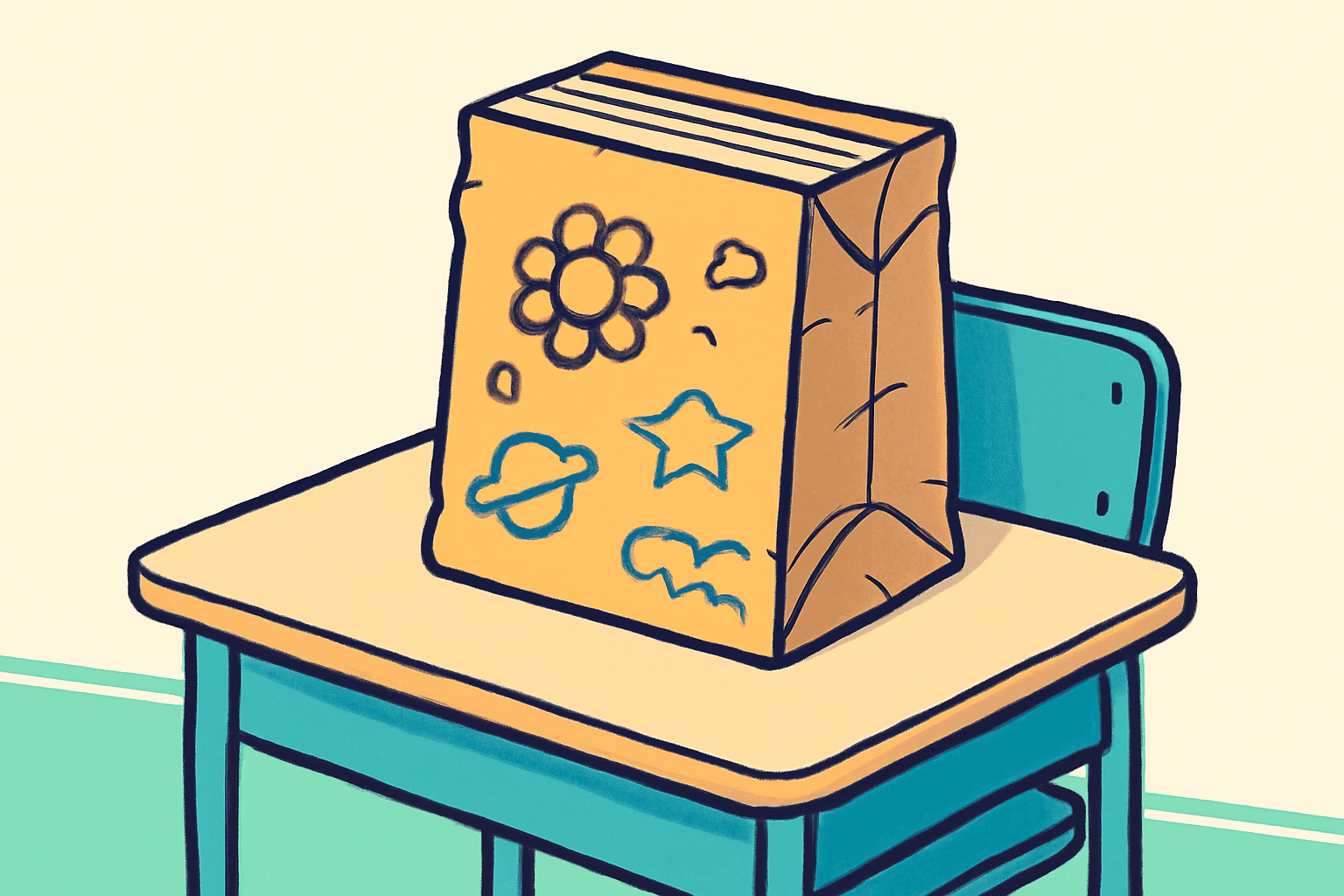
The paper bag was already on the kitchen table when you got home. Flattened out, still creased from the groceries it carried twenty minutes ago. Your mom had already cut it down the back seam with the kitchen scissors, and she was standing there with your social studies textbook, showing you once - once - how the whole thing worked. Fold here. Crease there. Tuck this flap under the cover. Pull it tight. She made it look effortless, the way parents make everything look effortless the one time they show you before leaving you to figure it out alone for the rest of your life.
You had maybe six textbooks that needed covering. She did the first one. You did the other five. And they looked like it.
The Technique
There was a method, and it was passed down not through any instruction manual but through a kind of oral tradition - parent to child, older sibling to younger sibling, that one kid in class who was weirdly good at it to everyone else at his table. You laid the bag flat, cut side up. You placed the textbook in the center and folded the top and bottom edges in so the paper was the same height as the book. Then you opened the front cover, folded the paper around it, and creased. Same for the back.
The crease was everything. A good crease meant the cover fit snug, stayed put, slid on and off the book like it was meant to be there. A bad crease meant the whole thing was baggy and loose and would slide off by second period, leaving your textbook naked and exposed while you tried to shove it back on during a filmstrip.
There was a method, and it was passed down not through any instruction manual but through a kind of oral tradition - parent to child, older sibling to younger sibling, that one kid in class who was weirdly good at it to everyone else at his table.
The trick was using a fingernail or the edge of a ruler to really press the fold. You ran it back and forth along the edge until the brown paper held its shape. Some people used tape. Tape was cheating, technically, but everyone did it after the first cover slipped off and you realized that pride doesn't hold paper to cardboard.
Some kids' dads did it with them at the kitchen counter while the news was on. Some kids did it themselves on the living room floor, the night before school started, surrounded by a small disaster of paper scraps and that slightly panicked energy of a summer ending. The point is everyone had a version of this scene. Everyone had the bag, the book, the kitchen table.
The Canvas
Here's the thing nobody talked about when they handed you that assignment: they were giving you a blank canvas. A full, beautiful, empty rectangle of brown paper wrapped around every single one of your textbooks. And you were a kid with pens and markers and time.
Within the first week, the front of your math book had your name on it. In bubble letters. Outlined in blue pen, maybe filled in with colored pencil if you were serious about it. By the second week, there were doodles. That S thing everyone drew but nobody taught anyone. Stars. Spirals. Band logos copied from CD inserts with varying degrees of accuracy.
- Your name in bubble letters (mandatory)
- That weird S made of six lines (universal)
- Your crush's initials, tiny, in the corner, deniable
- Band logos (Nirvana smiley, Green Day grenade, Metallica lightning)
- "Mrs. [Crush's Last Name]" written and then scribbled out
- Tic-tac-toe games played during class
- A surprisingly detailed eyeball
- The lyrics to a song you didn't fully understand
And then there were the initials. Your crush's initials, written small, tucked into a corner or hidden inside a larger doodle so that if anyone asked you could say it was just a design. It wasn't just a design. Everyone knew it wasn't just a design. But the plausible deniability was part of the contract.
By October, the cover of your history textbook was basically a journal. A record of every boring class, every daydream, every brief obsession. You could read it like a timeline. Here's where you were into drawing flames. Here's where you discovered that you could write in a weird runic alphabet. Here's where you just wrote "I'm bored" in letters so tiny you needed to squint.
The Alternatives
Not everyone used the brown bag. Some kids - and you knew exactly which kids - showed up with Book Sox. Those stretchy fabric covers that came in solid colors or patterns, sold at Waldenbooks or the Target school supplies section. They slid over the textbook like a sock over a foot, hence the name, and they looked clean. Professional. Like those kids' textbooks had been to a tailor.
Book Sox kids were a different breed. Their parents bought name-brand cereal too. They had the Crayola 64-pack. Their backpacks were Jansport, not the off-brand from Kmart that had one strap sewn slightly crooked. You didn't resent them, exactly. But you noticed.
The brown bag cover was democratic. Everyone had access to grocery bags. It was the great equalizer of the American public school system - a piece of trash repurposed into something functional, and then turned into folk art by a bored twelve-year-old.
Then there was the contact paper crowd. Clear adhesive plastic, stuck directly to the book itself. This was more of a private school move, or a very particular parent move. It protected the book but killed the canvas. No doodling on contact paper. No bubble letters. No secretly writing "KORN" in the margin during English class. Contact paper was effective but joyless, like a lot of things adults preferred.
The brown bag cover was democratic. Everyone had access to grocery bags. It was the great equalizer of the American public school system - a piece of trash repurposed into something functional, and then turned into folk art by a bored twelve-year-old.
The Decay
No brown paper bag book cover survived the year intact. That's not a failure of the design. That's just the reality of being a material object in the hands of a child who shoves things into a backpack like they're packing for an evacuation.
The corners went first. Soft and rounded from being dropped on the floor, stuffed into lockers, used as a makeshift plate during lunch when you needed something flat to put your pizza bagel on. Then the edges started tearing - little rips along the spine that you'd try to tape over with Scotch tape that turned yellow and brittle within a week.
By February, the cover was more tape than paper. The folds had loosened. The whole thing had a softness to it, almost like fabric, from being handled and crumpled and smoothed out thousands of times. Your doodles were faded, rubbed down by the friction of a hundred backpack trips. The book inside was fine - that was the whole point - but the cover had taken every hit.
Some kids replaced them mid-year. New bag, new cover, fresh start. Most didn't. Most just let the decay happen, let the cover become a tattered second skin on the textbook, let it ride out the year in whatever state it reached. There was something honest about that. The cover was supposed to get destroyed. That was its job.
The smell is what I remember most. That specific brown paper bag smell - dry and slightly sweet, like cardboard's more interesting cousin. You'd press your face into the cover during a boring lecture and just breathe it in without thinking about why. It smelled like grocery stores and kitchen counters and the start of something.
Every August, for years, that same ritual. The bags on the table. The scissors. The textbooks stacked up, each one a different size so you had to adjust every single time. Your hands learning the folds, getting better at it, your creases sharper by seventh grade than they were in fourth.
I don't know when I covered my last textbook. I don't think anyone remembers the last time they do a thing like that. It just stops happening and you don't notice until years later, when you're at the grocery store and they ask if you want paper or plastic, and you say paper, and for a second you're not sure why it matters. But it does. It smells right. You fold it flat and carry it home and it sits on the counter and it's just a bag. It's always been just a bag. But your hands remember.