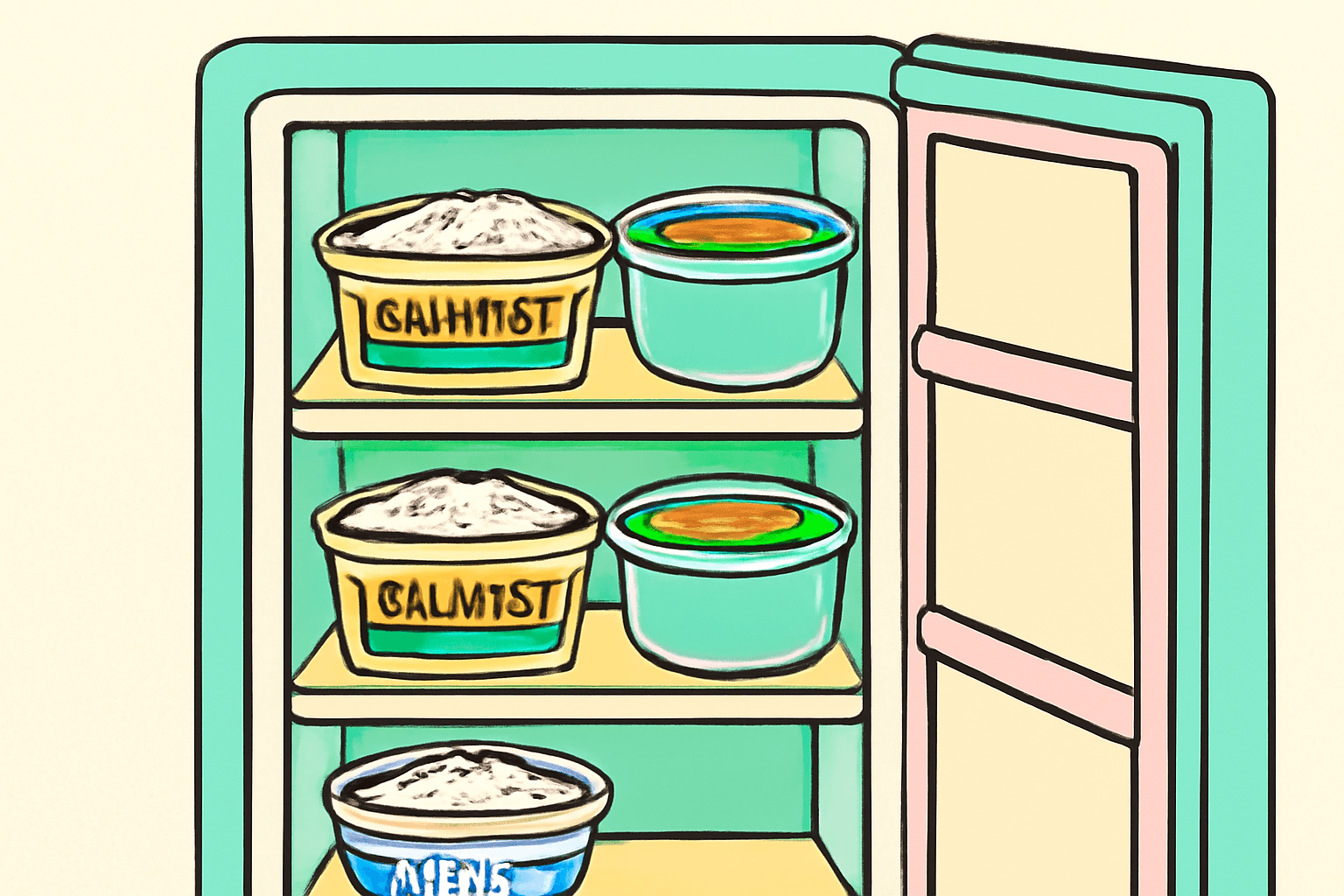
The Country Crock tub was yellow. A warm, optimistic yellow, like sunlight on toast. It sat on the second shelf of the refrigerator, right next to the ketchup, exactly where you'd expect butter to be. You were maybe eight years old. You were making toast. You popped the lid with your thumb, already anticipating that smooth, golden spread, and instead you found three-day-old arroz con pollo staring back at you like it had every right to be there.
It did. It had been there for years. You just kept falling for it.
This was the foundational betrayal of every American kitchen in the 1990s. The container said one thing. The contents said another. And nobody in your family saw a problem with this arrangement except you, standing in front of the open fridge with a piece of toast going cold in your hand, learning for the fifteenth time that trust is a myth.
The System
Here's the thing nobody talks about. This wasn't a quirk. It wasn't a one-off. It was an entire organizational system built on deception.
Your mom had a whole taxonomy going. The large Country Crock tub was for leftover rice. The medium I Can't Believe It's Not Butter tub was for beans. The small one - the really old one with the lid that didn't quite snap anymore - that was for mystery broth of indeterminate origin. You didn't ask what was in the small one. You didn't want to know.
The Cool Whip container was its own special category of heartbreak. Because Cool Whip was a treat. Cool Whip meant somebody had made a pie, or somebody was about to make a pie, or at the very least somebody had purchased something worth putting Cool Whip on. You'd see that tub in the freezer and your whole day got a little brighter. Then you'd open it and find frozen pinto beans. Just a solid brick of frozen pinto beans in a container that once held joy.
Every time. Every single time.
The Danish Butter Cookie Tin
We need to talk about the Royal Dansk tin. The blue one. You know the one.
That round, blue tin was, technically, manufactured to hold Danish butter cookies. Those flat, crunchy, vaguely floral cookies that came in four shapes but basically two flavors. They showed up at Christmas, usually at your grandmother's house, and for about thirty-six hours that tin contained actual cookies.
After that, it was sewing supplies for the rest of eternity.
The Royal Dansk tin was a one-way door. Cookies went in at the factory. Needles, thread, and those little silver scissors came out at your abuela's house. There was no return trip.
Every grandmother in America had one. It didn't matter if she was from Guadalajara or Manila or Tuscaloosa. The blue tin lived in the living room, or next to the recliner, or in that weird cabinet by the TV, and it contained exactly the same things: a pincushion, a spool of white thread, a spool of mysterious dark green thread, a pair of scissors so small they seemed made for a doll, and a button collection that could outfit every coat in North America.
You'd open it hoping for a cookie. You'd find a thimble. And your grandmother would look at you like you were the unreasonable one.
The Archaeology of the Fridge
Opening the refrigerator in a 90s household was an archaeological expedition. Every shelf was a stratum. The deeper you went, the older the containers, the more mysterious the contents, the less certain you were about what year you were in.
The front of the fridge was current events. Last night's dinner. This morning's leftovers. Recognizable, dateable, safe. The middle shelf was recent history - a few days old, still edible, probably. The back of the fridge was the ancient world. There were containers in the back of my mother's refrigerator that predated my ability to form long-term memories.
Nobody threw anything away. That was the rule, even though nobody ever said it out loud. Throwing away food was not something that happened in our house. You saved it. You put it in a butter tub. You put the butter tub in the fridge. You forgot about it for eleven days. Then you found it again, felt guilty, put it back, and forgot about it for another eleven days. The cycle continued until someone - usually your mom during one of those aggressive Saturday cleaning moods - finally opened it, made a face, and threw the whole thing away, container and all. A tiny funeral with no mourners.
Why We Did This
I used to think the container reuse thing was just my family being weird. Then I went to a friend's house and opened their fridge and found spaghetti in a margarine tub and realized it was everyone. This was universal. This crossed every line - ethnic, economic, geographic. Whether your family came from Oaxaca or Ohio, someone in your kitchen was putting leftovers in a Cool Whip bowl and calling it storage.
But it wasn't random. It was resourceful. Your parents grew up in houses where you didn't throw things away because things cost money. A perfectly good container with a perfectly good lid? That's Tupperware. That's free Tupperware. The actual Tupperware - the real stuff, the branded stuff with the matching lids your mom got from a Tupperware party in 1991 - that was for company. For potlucks. For food that left the house. The butter tubs were for us. For the everyday. For the behind-the-scenes work of feeding a family without wasting a single container or a single grain of rice.
The butter tub was never about butter. It was about not wasting anything, including the thing that used to hold the thing you couldn't afford to waste.
There's something in that I didn't appreciate when I was eight, standing in front of the fridge with my cold toast. My mom wasn't being chaotic. She was being efficient in a way that came from somewhere deep - from her mother's kitchen, and her mother's mother's kitchen, from places where containers were not disposable and food was not casual and you saved what you could because you remembered what it felt like to not have enough.
The butter tub was an heirloom dressed as trash.
The Modern Betrayal
I have a set of matching glass containers now. Twelve of them. They came in a box from Target. They have snap-lock lids and little silicone seals and they're microwave safe and dishwasher safe and they stack neatly in the cabinet like responsible adults.
I hate them a little.
Not because they don't work. They work great. Everything is visible. Everything is labeled. Everything is honest. You can see the leftover soup through the glass and you know it's soup before you open it. There's no mystery. No betrayal. No trust fall with a container.
But last week I made too much rice and I looked at the pot and I looked at the glass containers and then I looked at the empty Country Crock tub sitting next to the recycling bin, not yet rinsed, not yet thrown away. And I washed it out. And I put the rice in it. And I put it on the second shelf of the fridge, right next to the ketchup.
My daughter opened it this morning looking for butter.
The cycle holds. The containers change hands. Somewhere, right now, a kid is opening a tub expecting one thing and finding another, and learning - without anyone teaching them - that the people who fed you didn't always label what they gave you, but they never once let the container go empty.