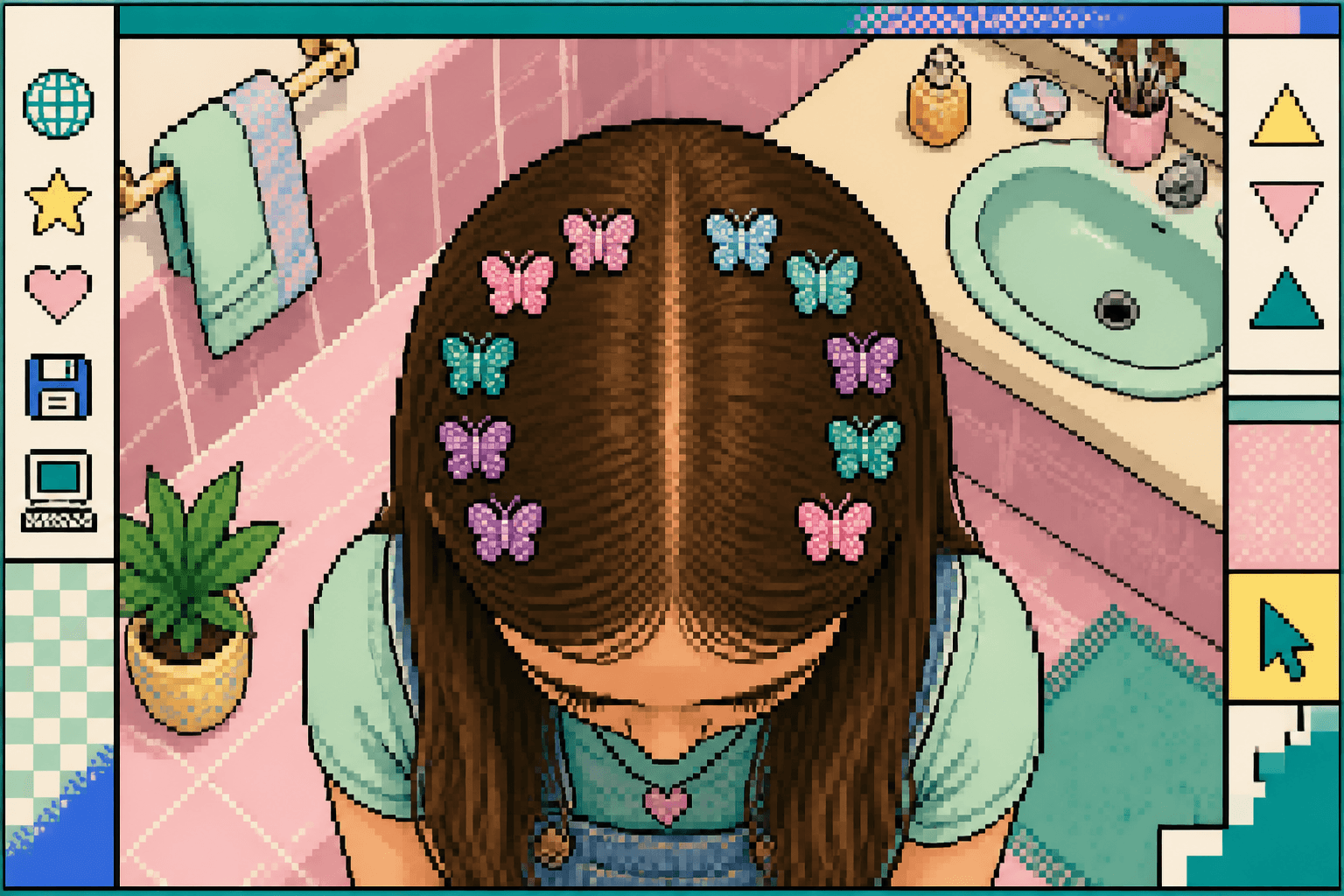
The pack came from Claire's. Or Icing at the same mall, if the Claire's had been shopped out. It was a plastic clamshell the size of a paperback, and through the front you could see twelve of them, or twenty, or thirty if you were the kid with the mom who understood that this was a legitimate purchase. Sparkle pink. Sparkle purple. An iridescent teal. One weirdly yellow one that nobody ever wanted. They cost about four dollars. You were going to use them to hold nothing at all.
You brought them home and immediately parked yourself in front of the bathroom mirror. This was not a hair accessory. Not really. A hair accessory holds hair back. A butterfly clip held a small tuft of hair off of the side of your head where the hair was already exactly where it needed to be. It was decoration in the costume of a tool. You took a piece of hair - maybe a lock, maybe a wisp, maybe seven strands and a little bit of scalp - pinched it in the little plastic teeth, and let go.
Click.
The Click
The mechanism was two pieces of colored plastic joined at the top by what was supposed to be a spring but was actually a small piece of bent metal doing an impression of one. You pressed the wings together at the base, which forced the teeth apart, which is the opposite of how you would expect a hair clip to work. Most hair clips grip harder when you press. Butterfly clips let go when you press. This was subtle enough that if you didn't already know, you could stand in front of the mirror pinching a butterfly clip for a full minute wondering why it wasn't doing anything.
The teeth themselves were the wrong shape. They were flat little combs that met at the tips, which meant they held onto hair mostly through friction and hope. If your hair was thick, the clip would slowly walk itself out of the strand over the course of the afternoon and end up on the classroom floor and Kevin would step on it. If your hair was thin, the clip fell out immediately, and you spent the day retrieving butterflies from the little wire pencil basket underneath your desk.
But then there was the click. The click sounded like nothing else. It sounded like plastic against plastic in exactly the right pitch. It sounded like now something is happening. If you had twelve of them in your hair and you turned your head fast, they all clicked together in a small chorus, and this was, in some way that nobody could articulate but everybody understood, the entire point.
Most hair clips grip harder when you press. Butterfly clips let go when you press. If you didn't know this, you could stand in front of the mirror pinching one for a full minute wondering why nothing was happening.
The Arrangement
You did not wear one butterfly clip. Ever. That was a scandal.
You wore six. You wore twelve. On a truly committed day, you wore all thirty. There were rules to the arrangement that nobody ever wrote down and that shifted from one lunch table to the next, but everybody knew them by mid-October of fourth grade.
The first clip went above your ear. The second one went above the other ear, and it either matched (safe, uncool) or slightly contrasted (correct). The next two went on the crown of your head on either side of your part. From there, the correct move was a diadem - clips fanning around the top of your skull like a small plastic tiara. You could see the arrangement clearly from a bird's-eye view, which was important, because a butterfly clip crown was really only fully visible from angles that no one in your life was ever going to occupy: a person standing on a chair above you, a girl on the swing set going higher than you, or your own reflection in the bathroom mirror at the exact right tilt.
Nobody worried about this. The point of the crown was not that it would be seen. The point of the crown was that it existed.
You did that in about twenty seconds. You did the actual version in about forty-five minutes, standing on tiptoe on the bath mat with your neck at an angle, holding a hand mirror behind your head at a rotation your body was not designed for, trying to figure out if the back looked the way the front thought it should.
The Colors
The colors had a hierarchy that nobody codified but everybody agreed on.
Sparkle pink was the base state. Every pack had at least three. It was the vanilla ice cream of butterfly clips - always fine, never wrong, but not a statement in itself. If you showed up with only pink, people would look at you with a small, patient disappointment.
Sparkle purple was better. Sparkle purple was, in the specific sensibility of a nine-year-old, elegant. Sparkle purple went with everything, especially with the sparkle pink that was already in the pack. Sparkle purple was the color of Tuesday.
Iridescent teal was where things started to get real. Iridescent anything was more expensive per unit and always came in smaller quantities. Iridescent teal was harder to find and it caught the bathroom fluorescent light in a way that made you feel like the clip itself was participating in the day.
Sun yellow was the outcast. Every pack had one. Nobody wore it. Sun yellow was the clip you traded away, or lost on purpose, or gave to your younger sister to placate her. Sun yellow had done nothing to deserve this. Sun yellow was a color humans have chosen to celebrate for thousands of years. Fourth grade did not care.
Hologram clear was the flex. You could see through it, which meant it looked like a butterfly made of ice. It was almost impossible to spot in your hair from more than four feet away, which was fine, because you knew it was there and your best friend knew it was there and if anyone else missed it that was on them.
Glow-in-the-dark was the mythical option. Every pack claimed to include one. Every pack that actually did include one was disappointing. The glow was faint, the color when un-glowed was a strange olive sadness, and you had to hold it under the bathroom lamp for thirty seconds before turning off the light to see anything. Which you did. Every time.
- Sparkle pink - baseline. safe. bulk.
- Sparkle purple - the go-to. always in.
- Iridescent teal - a statement. traded carefully.
- Coral - transitional. controversial.
- Ice blue - the winter color.
- Sun yellow - unloved. gifted away.
- Hologram clear - the flex nobody could see.
- Glow-in-the-dark - the promise. rarely delivered.
The Backpack
Butterfly clips did not stay on your head all day. They fell out. That was in the contract.
By second period, one had loosened. By recess, two had dropped somewhere in the hallway between the bathroom and the water fountain. By the time you got home, you were down to maybe seven of the original twelve. This was normal. The lost clips were paid to the school. It was a small tribute. Somebody would find them on the carpet in the library and put them in the lost-and-found bin, which was actually a plastic tote that had been sitting on the office counter since 1994, and nobody ever went to reclaim a butterfly clip because you couldn't prove which one was yours.
The clips you did keep track of ended up on your backpack. Not in your backpack. On it. You clipped them to the zipper pull. You clipped them to the mesh water-bottle pocket. You clipped one to the top loop where the handle was. This was, functionally, a status display. Your backpack said I have twelve butterfly clips at all times and I am willing to keep them where you can count them. Anyone else's backpack that had similar clips was, briefly, a friend. Anyone whose backpack had better clips was a threat.
The lost clips were paid to the school. It was a small tribute. Somebody would find them in the library and put them in the plastic tote on the office counter, and nobody ever went to reclaim a butterfly clip because you couldn't prove which one was yours.
The Argument For
The butterfly clip was, in retrospect, a genuinely democratic accessory.
It cost four dollars. Every kid in fourth grade could afford a starter pack. The customization was infinite - shuffling twelve clips into different arrangements gave you a wardrobe of infinite Tuesday. The look was easy to enter and easy to exit. There was no styling authority. There was no butterfly-clip expert kid at your school telling you which arrangement was correct. Every morning, in every bathroom, in every district, thousands of nine-year-olds were making it up on the fly, and the result was a distributed aesthetic invented by children with almost no adult input.
And it was tactile. It was hands-on. Doing your own butterfly-clip crown before school was, technically, a self-care practice. You looked at your face in a mirror and you made a decision about how you wanted to be perceived and you executed the plan with your fingers, in real time, using twelve small tools. If you botched it, you started over. If it worked, you carried it with you into the world. Millions of small girls learning quietly that they were allowed to have an opinion about how they looked.
The Argument Against
The butterfly clip did not work.
The teeth were the wrong shape. The spring was the wrong spring. The clips fell out constantly. The little plastic teeth got tangled in fine hair in a way that could not be undone without a small yell and a couple of casualties. The metal spring rusted if you got them wet, which happened routinely, because you were nine and you were near water. The plastic snapped at the joint after about a month of daily use. Some of the sparkle pink ones, if left in a sunny window, faded to a color that could only be described as hospital.
They also hurt to sleep in, which you learned by sleeping in them, which you did anyway.
And the actual stated function of a hair clip - to hold hair back so you could see - was never achieved. The clip did not hold hair back. It held maybe a strand and a half. Your hair was still in your face. Your fringe was still doing whatever it was doing. The butterfly clip was ornamental in a category that was supposed to be functional, which is a specific kind of consumer betrayal that, if it happened to an adult, they would file a complaint about.
None of this stopped anyone. That is worth sitting with.
The After
Somewhere in your parents' house, right now, there is a butterfly clip.
It is in the couch. Or it is in the car - probably in the shoulder well of the back seat where the seatbelt lives, wedged into the plastic in a spot nobody has cleaned since the Clinton administration. It is between two pages of the fifth-grade yearbook that got shoved onto a shelf and never opened again. It is in the drawer of the built-in bathroom vanity, faded from sparkle-pink to hospital, spring rusted, one wing snapped off. Nobody put it there on purpose. Nobody is going to remove it on purpose. The house has decided, at a low level, that the butterfly clip is a permanent structural feature now.
I saw one last year. My niece, who is eight, had a pack. Not the same pack. The clips were different - smaller, plusher, aggressively sanded on the plastic edges the way modern toys are, no cheap sharp seam anywhere. The colors were muted. The sparkle was tasteful. There was not a single sun yellow among them. Somebody at the factory had made the pack safer, smoother, better.
She put one in her hair, above her ear. Just one. Then she looked at me for approval, and I said it looked nice, because it did.
But I wanted to hand her eleven more, and stand her in front of the bathroom mirror, and put them around the crown of her head one at a time - sparkle pink, sparkle purple, iridescent teal, on and on, until her scalp hurt and half of them fell out on the way to the car. I wanted her to know what the crown was supposed to feel like when it was full. Loud, brittle, clicking against itself when she turned her head. A stupid, uncomfortable, deeply specific version of being nine.
I did not say any of that. She is going to invent her own version. She is going to look at her own reflection in her own bathroom mirror and make her own decision, and it is not supposed to look like mine.
I just watched the one clip catch the light for a second, and I heard the small plastic sound it made when she snapped it in, and I thought - okay. Okay. It's still doing what it does.