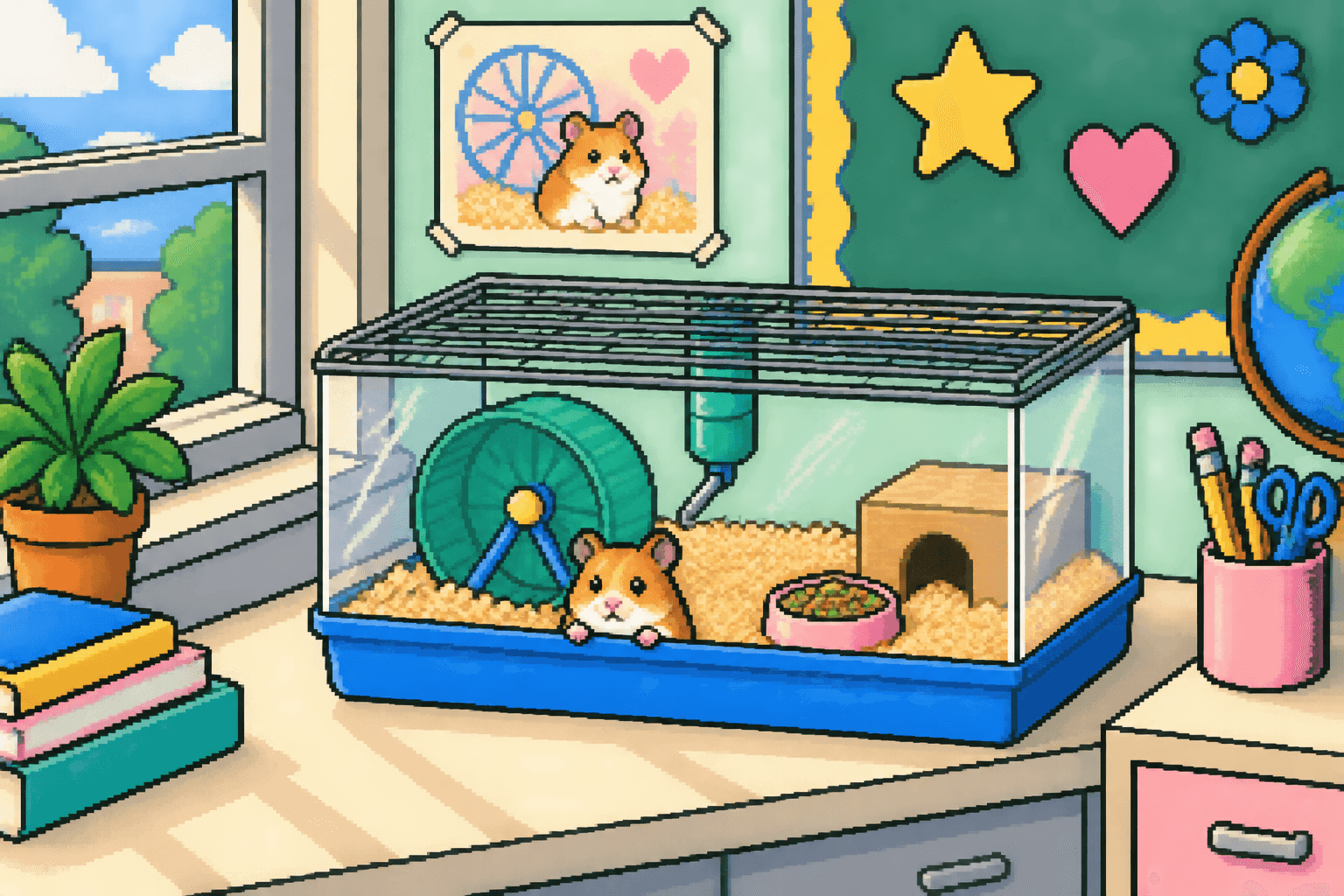
Her name was Peppy. She was a Syrian hamster the color of a caramel candy, she lived in a ten-gallon aquarium with a wire lid held down by two bricks, and every Friday afternoon Mrs. Colangelo would stand at the front of the classroom and say, in the same neutral voice she used for spelling tests, "Who wants to take Peppy home this weekend."
Every hand in the room went up. Every single one. We had never wanted anything so badly in our lives.
The sign-up sheet was a piece of yellow legal paper with each weekend of the school year written down the left side in Mrs. Colangelo's handwriting. The kid whose turn it was got their name written next to that Friday's date. Some kids were on there twice already. Some kids weren't on there at all. Nobody ever asked why, but we all had theories.
The Tank
The tank sat on top of the low bookshelf under the window, in the corner where the aloe plant lived and the class snake plant had died the year before. It was a real ten-gallon aquarium. Someone's dad had donated it. The water lines were still faintly visible along the inside of the glass from when it had held fish, which felt like a small piece of history.
Inside was a specific ecosystem. Cedar shavings on the bottom, three inches deep, which we now know were probably terrible for a hamster's respiratory system but which smelled incredible - like a lumberyard on a warm day, warm and dry and slightly medicinal. There was a green plastic water bottle clipped to the wire lid, with the little metal ball at the tip that Peppy would lick and lick until droplets beaded up and fell into the shavings. There was a ceramic food dish that always had one specific piece of dried corn Peppy would not eat. There was a Habitrail tube going nowhere, capped at both ends. There was a wheel.
The wheel squeaked. Everyone in the room knew the sound. You could be in the middle of a math worksheet and hear that soft skee, skee, skee start up from the corner, and thirty heads would swivel at the same time.
The tank was always slightly foggy on the inside. There was always some condensation on the glass near the water bottle. There were always exactly six or seven sunflower seed shells scattered around the food dish, which Peppy had opened one at a time with her tiny teeth, and which nobody was tasked with cleaning up.
The Sign-Up
The sign-up sheet was a spreadsheet built for a life-and-death decision, kept on notebook paper.
Some weekends were premium. Your birthday weekend. The weekend before winter break. The three-day weekend for Presidents' Day. If your name was next to one of those dates, you had won something. If your name was next to a random Tuesday-to-Wednesday because Mrs. Colangelo was going to a wedding, you had also won something, because a weeknight was a rare bonus round.
Other weekends were dangerous. The weekend of the big cold snap. The weekend your family was doing that thing at your grandma's. The weekend your dog was there. Every kid in the class had, at some point, put their name down for a weekend they later regretted, because they hadn't thought it through, because they had wanted it so badly on Friday and had not considered any of the operational complexity.
The transfer happened in the last five minutes of the day. Mrs. Colangelo would lift the wire lid off the tank, take out the water bottle so it wouldn't leak, hand you the tank with two bricks stacked on top of the lid, and then hand you a Ziploc bag with a small paper cup inside for the sunflower seeds. You walked out to your mom's car holding a ten-gallon aquarium with a small caramel-colored animal running around inside it, and every kid you passed in the hallway looked at you with envy and mild fear.
The Weekend
The weekend followed a predictable arc.
Friday afternoon: euphoria. You put the tank on the kitchen table. You showed Peppy to your brother. You held Peppy in the wrong way and got nipped. You put Peppy back and cried for two minutes and then decided to hold her the right way. You fed her a sunflower seed by hand and she took it with her tiny paws and it was the most incredible thing you had ever seen a small animal do.
Saturday morning: procedure. You changed the water. You added seeds. You watched her run on the wheel for forty minutes without doing anything else. You explained to your dad, correctly, that hamsters are nocturnal, which is why she was mostly sleeping in the little hollow she had dug in the corner. Your dad said "huh" in the voice he used when he didn't care but also didn't want to be rude.
Saturday afternoon: adventure. You put Peppy in the plastic ball. This was the entire reason you had signed up. The plastic ball was Peppy's, and it lived in the tank, and it was clear plastic with tiny air holes and a little screw-on cap. You put her in it, screwed it shut, and then she was suddenly powered. She would run and the whole ball would roll across the linoleum. Under the coffee table. Into the dining room. Into the dog. The dog wanted to eat the ball. You screamed. Your mom yelled. Peppy went back in the tank shaking, and you swore, silently, that this had not happened and you would not tell anyone at school.
Sunday: dread. On Sunday you started noticing things. Peppy was slower. Peppy was hiding more. Peppy had eaten fewer seeds than yesterday. Was Peppy sick? Was Peppy dying? Was Peppy going to die on your weekend? You didn't sleep well Sunday night. You checked her at 2 a.m. She was fine. She was just sleeping. Because she was a hamster and it was 2 a.m. and that's what hamsters do.
Monday morning: transport. You carried the tank back to school with your mom driving very slowly and carefully in a way she never did at any other time. You walked her back into the classroom. You handed her to Mrs. Colangelo. You went to your desk. And you spent the whole first period looking over at the tank to make sure Peppy was still moving.
She always was. Until, one time, she wasn't.
The Incident
Not every class pet died on someone's weekend, but every class had a story. Ours was Kyle Marchetti's weekend, third grade, and it wasn't Peppy. It was the class pet before Peppy. Nobody said her name after because we were told not to, but she was a dwarf hamster and she was very old and she had, apparently, gone to sleep in her little hollow on Sunday night at Kyle's house and simply not woken up.
Kyle brought the tank in on Monday morning with the wire lid on and a small hand-drawn sign taped to the front that said, in blue marker, "I'M SO SORRY." His mom had helped with the sign. His mom walked him in. She was crying more than he was.
Mrs. Colangelo took the tank very gently and set it on her desk. She told us we could talk about our feelings if we wanted to. Nobody wanted to. We all just looked at Kyle like he had come back from a war.
We had a small ceremony. There was a shoebox. We wrote things on index cards. Kyle read his card and started crying again, and then everyone was crying, including two kids who had never met the hamster because they'd transferred in that fall. It was, I understand now, actually a beautiful moment. It was the first funeral most of us had been to. It was compressed and gentle and low-stakes in the way that only a classroom event can be, and it made a real thing survivable.
Two weeks later Peppy was in the tank. The tank had been washed. Life went on.
Every kid was sent home with a variation of the same items in a plastic grocery bag:
- A paper cup with one weekend's worth of sunflower seeds
- The little green water bottle (screwed shut, wrapped in a paper towel)
- A folded photocopy of "Caring for Your Class Pet"
- The two bricks. Always the two bricks.
- Sometimes: the plastic ball. Sometimes not. Depended on the teacher.
Nobody read the photocopy. Everyone knew someone whose parents did.
The Ecosystem
Here is the thing I didn't understand until I was much older.
The class pet was not really an animal-care program. It was a responsibility program disguised as an animal-care program. It was Mrs. Colangelo, and every teacher like her, deciding that the best way to teach nine-year-olds about responsibility was to hand each of them a small mortal being for forty-eight hours and let them figure it out. Not a plant. Not a video game pet. A warm thing that ate and drank and could die.
And it worked. It worked in a way that a lecture about responsibility could not have worked, and in a way that no adult should have trusted an eight-year-old with, and in a way that we would never do now.
We would not do this now because we know a lot more than we did in 1994. We know cedar shavings are bad for hamsters. We know constant environment changes stress them. We know classroom lighting cycles and the temperature swings of a school building are hard on a small nocturnal mammal that would prefer a stable dark burrow. We know handling by twenty-eight different sets of unwashed hands, over and over, across a school year, is not what a Syrian hamster's nervous system was built for. Peppy, in retrospect, was probably having a bad year.
Peppy was doing her best in a situation she had not consented to, which is what every class pet in America was doing, and what a lot of the kids caring for her were doing too.
But she was also, and I want to say this without qualifying it: an incredible experience. She was the first animal I ever fed by hand. She was the first thing I was responsible for that wasn't a homework assignment. She was the first mortal creature I understood as small and separate and not mine. When I put my ear near the tank at night in my bedroom, in the guest room, I could hear her breathing, and it was slower than I expected, and I could feel my own breath match hers for a minute, and then I fell asleep.
The Sign-Up Sheet, Reconsidered
I think about that yellow legal pad sometimes. Mrs. Colangelo's handwriting going down the left side, the dates neatly printed, the names of thirty small people written next to weekends in a Wisconsin school in a Wisconsin winter. The names written in twice belonged to the kids who were desperate for it. The names not written at all belonged to the kids whose parents had said no, or who had a cat at home, or who had asked and been told the class hamster would be too much for them, and who had absorbed that information privately and never mentioned it.
I signed up for six weekends that year. I got three. Two of them were fine. One of them was the ball-and-the-dog incident I still haven't fully processed. Peppy lived through the year. She went home with Mrs. Colangelo over the summer, which we all thought was unfair but also correct, and she was still there in the tank when we all filed by on the last day of school and said goodbye.
I don't know what happened to her after that. I hope she got a quiet retirement in Mrs. Colangelo's dining room, on a shelf where no children were allowed to touch her, with fresh water and the right kind of bedding and a wheel that didn't squeak. I hope she got to be a hamster instead of a curriculum.
The classroom is different now. The tanks are gone. The sign-up sheets, if they exist, are for lower-stakes things - the class plant, the class rock. Which is probably better for the animals and probably worse for the kids, in the specific narrow way that everything safer is a little worse for the kids.
I don't want to argue for going back. Peppy deserved better. But there was something about walking into a classroom on a Monday morning and looking over at the tank and confirming she was still there - still running the wheel, still nibbling a sunflower seed, still doing her small important business - that told a nine-year-old something about the world. That living things need to be checked on. That you can be responsible for something you don't own. That a weekend can be measured in whether someone else made it through.
Peppy made it through most of them. That was more than enough.