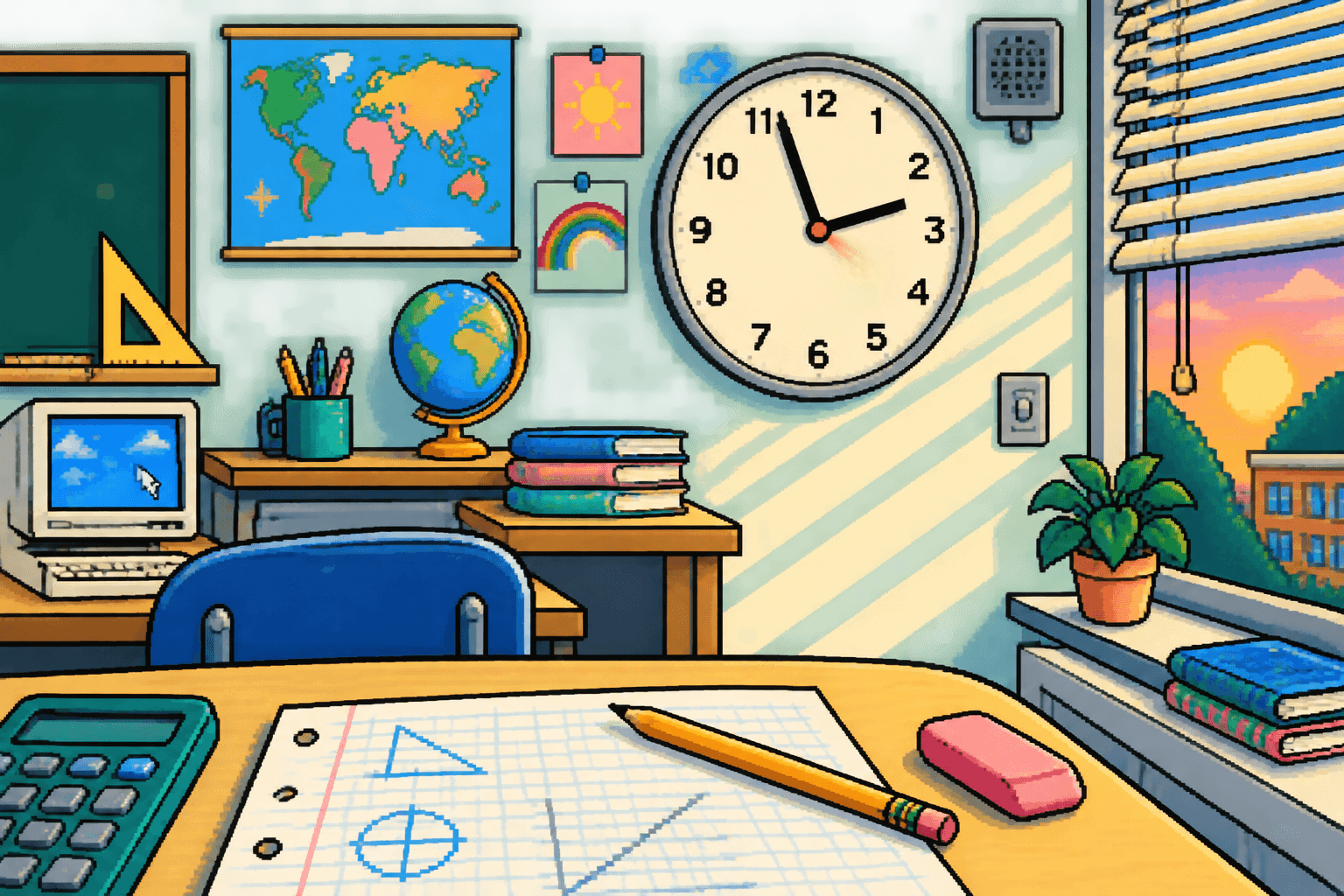
It was mounted above the whiteboard, off-center by about six inches, and it was the same clock in every classroom in America. Off-white plastic housing. Black hour marks. Two black hands. One red second hand. A dome of scratched acrylic over the face. A cord that trailed down the cinderblock wall to an outlet nobody could reach without a stepladder.
Every kid learned, at some point, that this clock was a liar.
The Object
The clock was made by a company called something like General Electric or Simplex or Peter Pepper and it cost the district twelve dollars in 1982 and it was still on the wall in 1998. It was industrial. It was correct. It was not decorative. It was the same clock they had in the DMV and the courthouse and the back room of every auto parts store in the country, which is why, later in life, walking into any of those places would send a specific shiver down your spine.
The face was maybe fourteen inches across. The numbers were serif and boring. There were sixty tick marks around the edge. The red second hand made a small audible tick every time it advanced, which you could hear from anywhere in the room if the class was quiet enough, and which you could hear even when the class wasn't quiet if you were the kind of kid who had learned how to hear it.
The red second hand didn't sweep. It ticked. Each tick was a discrete event, one heartbeat closer to freedom, and it was on you to count them.
The Physics
At 2:15 in the afternoon, the clock ran at normal speed. This was verified by the fact that class had been going for a while, and stuff had been happening, and the clock had somehow gotten from 1:45 to 2:15 without you noticing, which is the correct behavior of a clock.
At 2:45, the clock ran slightly slower. Not enough that you could prove it, but enough that if you looked up at the clock, then looked back down at your worksheet, then looked back up at the clock, the minute hand had not moved. You would swear to a court that it had not moved.
At 2:55, the clock stopped.
Not literally. The tick was still happening. The mechanism was fine. But time itself had become taffy, and the last five minutes of the day were now going to take approximately forty-five subjective minutes to complete. This was a physical property of American schools that we all agreed on but nobody could explain. The bell rang at 3:00. That was a fact. Getting to 3:00 was a marathon.
Try it. Stare at the second hand. It knows.
The Rules
There were rules about watching the clock. Nobody wrote them down. We all knew them.
You could glance at the clock. A glance was fine. Adults did it. Teachers did it. A quick flick of the eyes to the wall, a quick assessment, back to your work. Nobody could stop you from glancing.
You could not stare at the clock. Staring was the problem. Staring at the clock made the clock slow down. This wasn't superstition, this was observable science. Any nine-year-old who had ever done a math worksheet in the last ten minutes of the day had verified this experiment personally, repeatedly, under controlled conditions. The results were clear. Watched clocks moved slower. It was a variant of a general law of physics that also applied to microwaves and printers and the phone waiting for a boy to call.
Mrs. Colangelo knew about the rule. That's why she would say, without looking up, "eyes on your paper, please." Not because your eyes were doing anything wrong. Because your eyes on the clock were slowing down the clock, and she wanted to go home too.
- 12:00 to 1:15: Normal.
- 1:15 to 2:00: Slightly fast, because there's math.
- 2:00 to 2:30: Normal.
- 2:30 to 2:55: A little sticky, but manageable.
- 2:55 to 2:57: Aggressively slow.
- 2:57 to 3:00: The tick has become a taunt.
- 3:00: BELL. Chairs scrape. Backpacks are already on.
None of this is a bit. Every kid in America agreed on this timeline.
The Countermeasures
You developed strategies. Not because they worked, exactly. Because doing something was better than not doing something.
The Look-Down Strategy: eyes glued to the worksheet, no matter what. You were going to not check the clock for a full three minutes. Then you'd let yourself look up, and the whole thing would be over, and you'd have skipped time entirely. You could get through eleven seconds of this before you looked up and it was 2:56 and one second and you wanted to die.
The Bathroom Break: you asked to be excused at 2:52. You walked to the bathroom slowly. You washed your hands with the pink powdered soap that never fully rinsed off. You walked back slowly. You slid into your seat. You looked up. It was 2:53.
The Pack-Up Ritual: you started putting your things in your backpack at 2:57. Very quietly. Trying to look like you weren't packing. Mrs. Colangelo said, without looking up, "we don't pack up until the bell." You froze mid-motion. You unpacked one thing. You looked at the clock. Still 2:57.
The pack-up ritual was the closest thing kids in the 90s had to premeditated crime. You planned it. You knew the risks. You did it anyway.
The Fake Focus: pretending to read your book. Actually just staring at a word and counting how long you could hold your eyes there. Trying to trick the clock. The clock was not tricked.
The Nod-Off: some kids just let themselves get sleepy. They put their head down on their arm. Time did not pass faster for them. Time did not exist. Their teacher would tap them on the shoulder at 3:00 and they'd sit up with a red mark on their forehead and no memory of the interval.
The Trance
The best kids, the elite kids, achieved the actual clock trance.
The clock trance was a state you could enter, sometimes, by staring at the second hand for a really long time without blinking. It was like a magic-eye poster except the reward was that time seemed to un-hook itself from your body. You would be staring at the red hand as it ticked past the 3, then past the 4, then past the 5, and you would be watching it and also not watching it, and your mouth would fall slightly open, and the rest of the room would become background noise, and then Mrs. Colangelo would say your name and you would jolt back into your body with the confused sense that you had just been somewhere else.
I do not know what the clock trance was. I know I could enter it. I know I have not been able to enter it since I was eleven. I know that whatever brain state let a fifth grader lose forty seconds of subjective consciousness by watching a piece of red plastic tick around a circle is no longer available to me as an adult, which is fine, because as an adult I have other things going on, but which was, at the time, the closest thing I had to meditation, and it was more effective than any meditation app I have downloaded since.
The Bell
And then the bell rang.
It didn't ring the way you'd think a school bell would ring. It wasn't a gentle chime. It wasn't a triumphant sound. It was an industrial bzzzzzt, a rasping electric buzz that came out of a metal box screwed to the wall above the door, and it was ugly and loud and it was the best sound in the world.
Nobody waited. The teacher didn't get to finish her sentence. Kids were already standing before the sound finished. Backpacks were already on shoulders. Chairs were already halfway out. The pack-up ritual you had been forbidden from executing was now being executed by everyone simultaneously in three seconds. The room went from thirty kids sitting quietly to thirty kids sprinting for the door, and it happened so fast you'd swear it was rehearsed, which it kind of was, because we had been rehearsing it every day for the last three years.
The Cost
Here is the thing I did not understand at the time.
The clock was teaching us something. It was teaching us that time is not a fixed thing. Time is a felt thing. Five minutes at 2:55 is not the same length as five minutes at 12:15. Five minutes of doing something you want to do is not the same length as five minutes of waiting. This is a real fact about how the human brain works, and we knew it in our bodies at nine years old, and we knew it without ever having a word for it.
We do not talk about this fact much as adults, because as adults we mostly try to manage our time - schedule it, calendar it, block it, timebox it. We treat time as a resource. The clock told us the truth about it. Time is a feeling. The clock is a shape. The two are only loosely connected.
The wall clock was our first honest teacher. It never lied about how long a minute was. It just let us watch a minute be however long it was going to be.
Now I have a phone. My phone tells me the time in a number, cleanly, without any ticks. There is no second hand. There is no red thing to stare at. When I want to know how long is left until something, I look at the number and it just says. I do not have to sit with the shape of the wait.
I don't miss the classroom clock, exactly. I don't miss the last five minutes of the school day. I don't miss the pink powdered soap or the pack-up prohibition or the specific full-body ache of a nine-year-old who cannot leave a chair. But I miss the sit. I miss knowing what a minute felt like when there was nothing to do but be inside it. I miss the trance.
My phone is faster than the wall clock. That was the point. That was also the price.
Somewhere in every closed school building in America, the wall clock is still on the wall. It's plugged into an outlet nobody has unplugged. It's ticking. The red hand is going around. It is 2:57 and it will always be 2:57 in that room, in that building, in that specific afternoon, forever, and no bell is going to ring, and the kids are all somewhere else, and the tick continues, patient, correct, waiting for nobody in particular.
That is how a real clock works. That is how time actually is.
The bell was our idea.