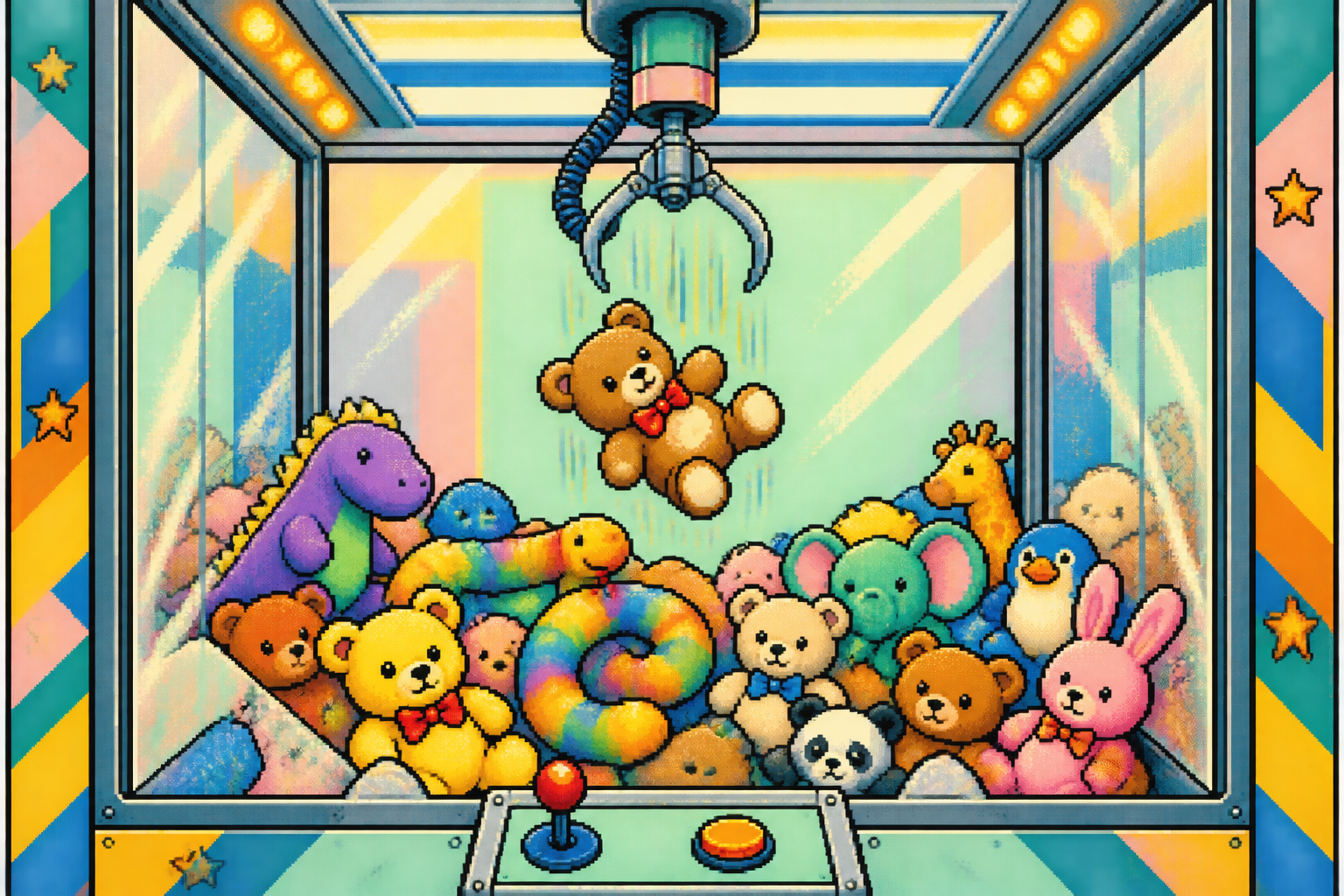
You are nine. Your mom is in the checkout line at the Giant Eagle with a full cart and a coupon envelope and roughly six minutes of patience left. She has given you three quarters and said go play the thing but do not ask me for more. You have walked the fifteen feet from the register to the vestibule, past the newspaper rack and the automatic doors, and you are standing in front of a glass box.
Inside the glass box are plush toys. A purple dinosaur. A yellow bear with a red bow. A rainbow snake. A pile of no-name teddies in the back corner that have been in there since spring. Hanging above the pile, on a track, is a small metal claw with three prongs, currently open, currently doing nothing, currently waiting for one of your three quarters.
You put in the first quarter.
The Glass
The glass had specific properties.
It was thick. It was slightly cloudy in the corners, where the operator had wiped it with a rag every three weeks since 1994. There were smudges at kid-height on every side, because every kid who ever passed the machine had put their hands on the glass to look inside, and no cleaning solution invented can fully remove the oils from a nine-year-old's palm.
Through the glass, the plush toys looked closer than they were. This was the first lie of the machine. The perspective was slightly wrong. The claw looked bigger. The prizes looked reachable. The pile looked shallow. The truth was that the box was deeper than it read, the claw was smaller than it looked, and the bottom of the pile was two feet down and packed as tight as a mattress.
The best prizes were on top. This was the second lie. The best prizes were on top because the operator put them there on the morning restock, arranged specifically so that they looked like they could be grabbed but were actually leaning against the wall or wedged behind a jumbo plush that would not move. If a prize looked like it was sitting easily on the pile with nothing holding it down, that prize was going to leave with you exactly zero percent of the time, and the operator knew this, and had, in a real sense, staged it.
The best prizes were on top. This was the second lie. They were on top because the operator put them there on the morning restock.
The Coins
The tithe was three quarters. Sometimes fifty cents. In one deeply exotic case at a Pizza Hut in 1996, it was one dollar, which was so much money you couldn't imagine anyone paying it.
You slid the quarters in one at a time. Each one made a specific shunk-tick sound as it dropped into the counting mechanism inside the cabinet, and after the last one there was a small chime, and a fluorescent light above the claw brightened by about ten percent, and text on a little LCD panel scrolled that said either PLAY NOW or SKILL CRANE or, in one case, TRY YOUR LUCK, which was itself a violation of truth-in-advertising because it was not, in fact, luck.
The Joystick
You had, in most cases, one joystick and one button.
The joystick moved the claw. Left, right, forward, back. It was a big red plastic ball on top of a stiff metal stem, and the stem had two positions for each direction: engaged, and not engaged. There was no analog. There was no partial. You could not nudge the claw two inches. You could only move the claw a lot or move the claw not at all, and the moving-a-lot had a delay before it stopped, which meant every claw was overshot by about the width of a fist.
You lined the claw up over the purple dinosaur.
You pushed the button.
Try It
Feed it your quarter. Line the claw up. Drop. Watch what happens.
The Descent
The claw dropped. Not fast, and not slow. It dropped at a specific speed that had been tuned by an engineer at a factory in Illinois in 1988 to feel deliberate. The cable unspooled from the trolley in a straight, patient line. The three prongs stayed open, spread wide like a spider trying to be nice.
You watched it come down. You knew, in the back of your head, exactly where it was going to land relative to the purple dinosaur, because you had been watching it for the whole descent, and it was going to miss by about an inch, but only about an inch, and an inch was survivable.
The claw hit the pile. The prongs closed. There was a little mechanical chunk. And for a second - one full second - the claw was around the purple dinosaur.
You were about to win.
The Grip
Here is where the machine did the thing.
The claw lifted. And in the first two inches of lift, while the whole rig was still low in the box, the prongs went slack. Not open. Not dramatic. Just slack. The pressure came off. The purple dinosaur, which had been briefly clenched between three metal fingers, slid out from between them and fell back onto the pile with a soft, indifferent thump, and the claw continued upward, empty, and returned itself to the top of the rail on the left side of the box like nothing had happened.
The little LCD scrolled PLAY AGAIN.
You looked at your two remaining quarters. You looked at the purple dinosaur, which was now lying on its side in a slightly different spot than before, with one arm sticking up like it was hailing a cab.
You put in the second quarter.
The claw returned itself to the top of the rail on the left side of the box like nothing had happened. The little LCD scrolled PLAY AGAIN.
The Rigging
I want to be exact about this, because the specifics matter.
The claw machine did not fail to grab the dinosaur because the dinosaur was heavy, or because you had positioned the claw wrong, or because a plush arm was caught under another plush's leg. The claw machine failed to grab the dinosaur because the claw was told, before the drop, not to grab it.
The industry-standard skill crane, sold by companies like Smart Industries and Elaut and Betson, ships with a setting labeled something like PAYOUT PERCENTAGE or WIN RATIO. The operator sets this. It is, functionally, how many quarters the machine needs to have eaten before the claw is allowed to grip at full strength. If the setting is 1 in 15, then fourteen out of every fifteen drops send a low-voltage signal to the claw's grip motor: enough to make the prongs close around a prize, enough for the plush to briefly ride the lift, and not enough to actually hold on. On the fifteenth play, a stronger signal is sent, and the claw grips hard, and the prize goes up cleanly, and a kid walks out with a purple dinosaur, and the operator has made three dollars and seventy-five cents on that dinosaur, which cost him one dollar and ten cents in bulk from a wholesaler in Guangzhou.
This is not conspiracy theory. It is written into the manuals. You can, right now, find them online. The exact phrase you're looking for is gripping strength percentage. There are FCC filings. There are trade publications. There was, in 2013, a Journal article about it that used the phrase skill with an asterisk.
The exact phrase you're looking for is gripping strength percentage. There are FCC filings. There are trade publications.
You put in the third quarter.
The Argument
I want to give the counter-argument, because it's not small.
The counter-argument is that the claw machine was a gambling device pointed at children, run in unregulated grocery-store vestibules and pizza-place foyers for thirty years, and that the ethical status of the whole enterprise is somewhere between state lottery and pull-tab bingo at the VFW, except with a nine-year-old holding the wallet.
The claw was operant conditioning in a cabinet. The variable-ratio reinforcement schedule that runs a slot machine is the same schedule that ran the claw. You didn't know when the win was coming. You knew, based on the machine's internal counter, that a win was coming eventually. The nine-year-old who put in the third quarter did so for the same reason a person at a slot machine feeds a fifth twenty into it: because the machine had trained them that this was how the reward worked. It was designed by the same behavioral psychologists, sold by the same companies, and regulated, in most states, by nobody at all. In some jurisdictions the claw machine was legally classified as a skill game to skirt gambling law, which was a nice technicality if you had never watched a nine-year-old exhaust the last quarter from a Sunday allowance in the vestibule of a Giant Eagle.
I am not going to pretend I didn't participate. I put in a lot of quarters. Some of them were my mom's. Some of them were from the couch cushions. Some of them were pilfered from the tip jar at the ice cream place, which is not something I am proud of. The claw took them all, and it gave me exactly three prizes in twelve years, and one of those prizes was a fake Beanie Baby knockoff called something like Purpz the Hippo that lost its stuffing in the wash.
The Other Side
But here is the thing I want to hold onto.
The claw was a promise.
Nine-year-olds do not have access to a lot of promises. Nine-year-olds are told what to eat, when to sleep, which show to watch, which soccer team is theirs. The world is a lot of adults deciding a lot of things. And here, in the vestibule of a grocery store, was a small transparent box that said: I have prizes. Here is exactly what they look like. Here is exactly where they are. Here is the tool for getting one out. If you can operate the tool correctly, the prize is yours.
That was a lie. But the lie had a specific shape. It said: your skill matters. Your aim matters. Your patience matters. If you are careful, and you look at the pile, and you understand which plush is on top and which is wedged, and you position the claw with attention, you have a chance. You are being asked to think, and to plan, and to try. This is not something a nine-year-old was being asked to do in most parts of the store, or the school, or the house.
And, once in a while, an actual prize actually came out. Not often. But once. And on that once, the machine was not the machine. On that once, it was you. You had lined it up. You had timed it. You had earned the purple dinosaur, and the fact that you had earned it approximately in the same statistical sense as a slot machine payout did not, at nine, register. What registered was that you had walked into the store with three quarters and were walking out with a plush, and your mom looked over from her groceries with genuine surprise, and the world had briefly said your skill matters and had produced the object to prove it.
You knew, later, that this was a rigged bargain. But you also knew, later, that most bargains were rigged. And that was, in its way, an early lesson worth having, even if it cost you six dollars in quarters and one Beanie Baby knockoff to learn it.
- The purple dinosaur: never once, don't lie
- The teddy in the back corner: sometimes, if it was tag-up
- The generic snake: two feet long, no eyes, weirdly heavy
- The fake Beanie Baby: Purpz the Hippo, Bluey the Fish, some abomination
- The wrapped candy bracelet: consolation prize on kid-friendly cabinets
- Nothing: the honest answer, most of the time
- A grip on a prize the machine then dropped six inches from the chute: the worst possible outcome, remembered forever
The Cruel Version
There was a worse version of the machine. I have to name it.
The worse version was the one where the claw did grip, and the claw did lift the prize, and the claw did traverse across the box to the chute, and then, three inches above the chute, the claw opened, and the prize fell, and it did not fall into the chute.
It fell next to the chute.
The plush landed on the tiny plastic lip that separated the drop area from the pile, teetered, and rolled the wrong way back onto the pile. The claw returned to the top rail. The LCD scrolled PLAY AGAIN.
That was the machine also. That was designed. The chute was too small. The lip was too narrow. The machine had been programmed to release the prize at exactly the right moment for most prizes to fall into the chute, and the operator had, deliberately, moved the chute slightly, or oriented the prize wrong, or done nothing at all, because sometimes the geometry just worked out that way, and the manufacturer's default position for the chute was, itself, a slight betrayal.
I saw a kid cry over this once. His mom held him and said it's just a game, honey. His mom was wrong. It was not just a game. It was a small machine designed by adults to make a child feel he had won and then, immediately after, that he had not.
The plush landed on the tiny plastic lip that separated the drop area from the pile, teetered, and rolled the wrong way back onto the pile. That was the machine also. That was designed.
What Replaced It
The claw is still there.
Go to any grocery store in the country and there is a claw machine in the vestibule. It might have moved to the back wall of a laundromat, or into the food court of the mall, or into the entryway of a Round1 arcade next to a bank of Japanese import cabinets. It is not gone. It is, if anything, worse: the plush inside are now knockoffs of characters from streaming shows, the payouts are the same, and the machine now takes a card instead of quarters, so the child does not even get the tactile feedback of the shunk-tick to know how much they have spent.
The counter has moved to an app on a parent's phone. The receipt shows up in the family budget three days later. The child has, in the meantime, put twelve dollars of tap-to-play into a machine that gave them, at best, a plush of a cartoon dog whose name the child now already knows because the whole ecosystem is one closed loop of licensing.
The specific claw machine of my childhood - the grocery-store vestibule, the paper LCD scroller, the three-quarter tithe, the plush that was a generic bear with a red bow and no branding at all - is mostly gone. Not all the way. But mostly. It has been replaced by a version of itself that has, if anything, tightened the operator's margin and loosened the child's understanding of what has just been extracted.
The machine got faster. The machine got cleaner. The machine got exactly no less rigged.
The Purple Dinosaur Is Still In There
The last claw I played was in 2019. I was in a Kroger in Ohio waiting for a friend to finish an inside errand and I saw the machine and I put in a dollar because I had a dollar and it accepted a dollar as four credits, which was itself a slight con because the historic rate was three-for-a-dollar and nobody had told me the rate had changed. I lined up on a plush that looked like it was sitting on top of the pile. I dropped. The claw closed. The claw lifted. The plush rode about eight inches into the air. The claw went slack. The plush fell back. I put in another dollar. I did it again. I did it a third time. On the fourth try, the fifth quarter or the sixteenth credit or the fourth dollar, something in the machine said okay, and the prongs bit hard, and the plush came up clean, and it traveled to the chute, and it fell in, and I opened the little metal door at the bottom and pulled out a knock-off Squishmallow that was labeled, in embroidery, PLUSHIE. I looked at it. My friend came out. He said, oh nice, is that for someone? I said no. I put it on the dashboard of my car. It sat there for six months and got sun-faded, and then I threw it out. I still, sometimes, think about it. It cost me, best I can remember, about ten dollars. That is exactly what a purple dinosaur is worth, when you are thirty-six and you did not need a purple dinosaur, and the machine let go on purpose four times before it let you have one.