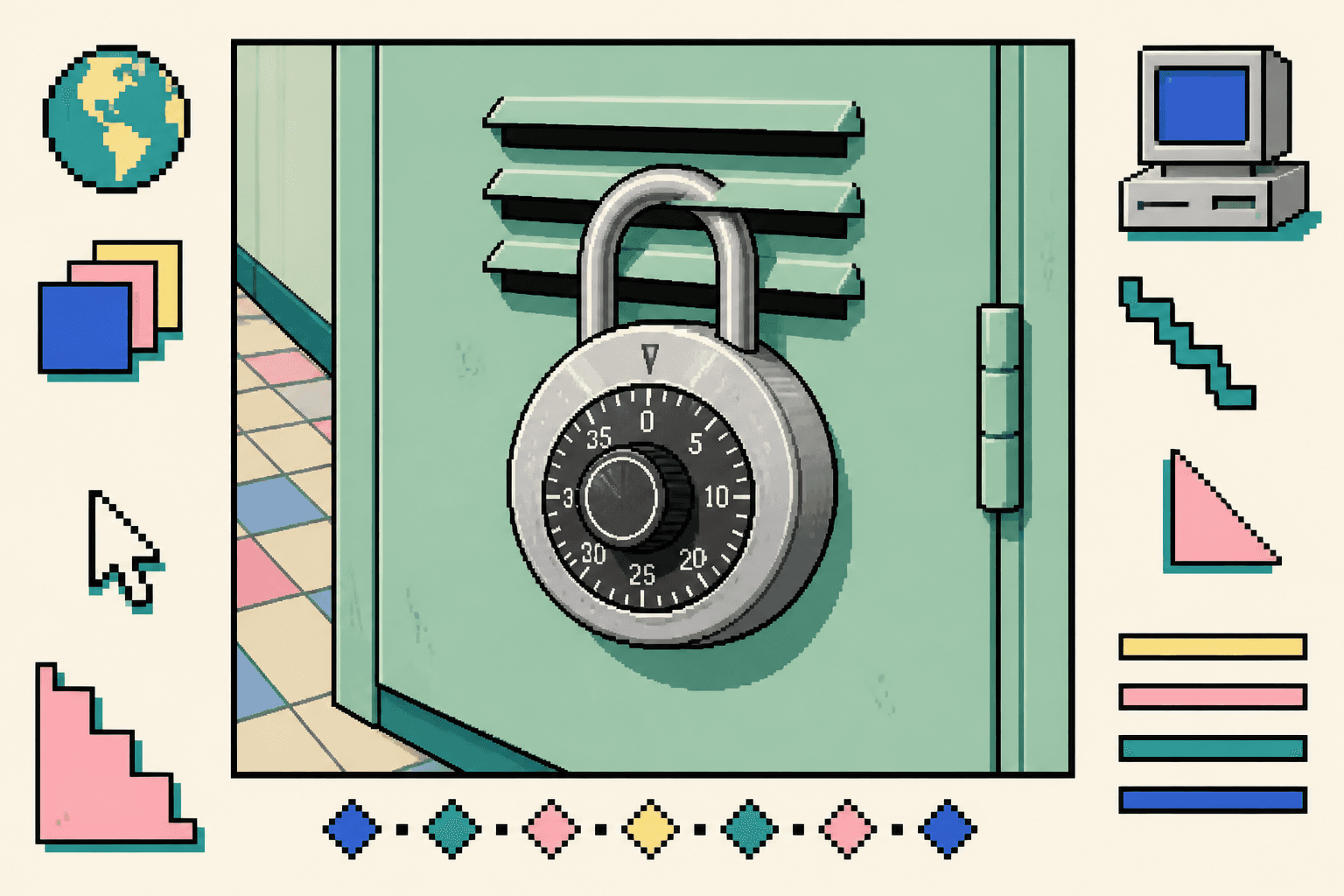
They handed it to you in a plastic baggie with a slip of paper. Master Lock, black dial, silver shackle, the number 1500 or 1525 stamped on the back of the body. The slip of paper said something like 24 - 18 - 32. There was a locker number. There was a hallway. There was a bell about to ring.
You went to find the locker. You spun the dial a few times to clear it, which someone had told you to do and you did not know why. You put the shackle to the thing. You turned right to 24. You turned left past 24 and landed on 18. You turned right to 32.
You pulled.
Nothing.
The Dial
The dial was knurled at the edge so your thumb and finger could grip it. It had tick marks for every number from 0 to 39, with the fives in bigger numerals. The pointer was a tiny notch at the top of the body, machined into the metal, with a dot of white paint that was already chipped on half the locks they handed out.
The dial was heavy. Not heavy like a dumbbell. Heavy like something inside it was moving - which, mechanically, it was: three wheels stacked on top of each other, each with a notch, and when all three notches lined up with the shackle's hook, the shackle came up. You did not know this at eleven. At eleven you knew that if you turned the right numbers in the right order, the lock would open, and if you did not, it would not. The physics of it was indistinguishable from magic. The magic required three decimal digits to perform. Three decimal digits that someone had decided were your three decimal digits, assigned to you by a database you did not know existed, printed on a slip of paper that you were already losing.
The Rules Nobody Explained
There was a kid in your orientation group who already knew how. He had an older sibling. He said it fast, like a child who had been taught the Pledge of Allegiance and did not know what allegiance meant.
Turn right past zero three times then stop on your first number. Turn left past your first number one full turn then stop on your second number. Turn right to your third number. Pull.
He said it once. You did not catch it.
Three turns right. Past the first number once. Direct to the third. The directions had a direction and the directions had a count and nobody had written them anywhere you could find.
You tried it with half-remembered rules. Right to 24. Left to 18. Right to 32. Pull. Nothing. Right to 24. Left past 24, back around, land on 18. Right to 32. Pull. Nothing. Reset the dial. Clear it. Try again. The bell was ringing. Kids were leaving. You were still at your locker, turning a dial, in a hallway that had emptied out around you.
The hallway after the bell is a specific feeling. The lights are the same. The floor is the same. The sound is different. It is quiet in a way that announces that you are late.
Try It
Right to the first number. Left past it to the second. Right to the third. If you turn the wrong way, the dial clunks and you start over. The slip of paper is in your pencil pouch, which you also cannot find.
The Slip Of Paper
The slip of paper was the entire problem.
It was a quarter sheet from a dot-matrix printer, cut by a secretary with a paper cutter, folded in half, with your name written in pencil above the three numbers. The combination was something like 24 - 18 - 32. The format was unforgiving. The dashes were small. If you misread an 8 as a 3 you would stand at your locker forever.
You were supposed to memorize it. You were, in fact, supposed to memorize it the first day, destroy the slip, and move on with your life. Nobody memorized it the first day. Everyone had the slip of paper in their wallet, in their pencil pouch, in the inside pocket of their jacket, folded and refolded until the pencil writing was smudged.
If you lost the slip, you went to the office. The office had a binder. The binder had every combination in the school. If you were twelve, this did not strike you as strange. Of course the office had a binder. The office had binders of all kinds of things. You did not yet think about what a locked locker is for, if its combination is on file with the person who is going to open it when you can't.
- Week 1 - clean, folded, pencil crisp. Pinned to the inside of your binder with a thumbtack.
- Week 2 - the fold is softening. You have unfolded it fifteen times.
- Week 4 - the pencil writing is smudged. You redo it in pen. You smudge the pen.
- Week 8 - you have the combination memorized. You keep the slip anyway.
- Week 14 - you lost the slip. You do not need the slip. You know it.
- Week 40 - the combination is in your hands, not your head. Your hands know.
The Three Weeks
Learning the combination took about three weeks.
Not the memorization. The memorization took a day. The hands took three weeks. For three weeks you looked at the slip, read the first number, dialed it, read the second number, dialed it, read the third number, dialed it. Then one morning you walked up to your locker and your hand went to the dial and did the thing without you reading anything, and the shackle came up, and you had not thought the numbers at all. The numbers had moved from the slip of paper to your head to your fingers. The fingers knew. The head could be elsewhere. The head could be thinking about the kid in third period who had or had not noticed you.
The combination was a sequence your body learned to perform without you. It was the first thing you ever had that was like that. It would not be the last.
The numbers moved from the slip of paper to your head to your fingers, and the fingers kept them. You could open your locker without thinking of a single digit.
The Clunk
The lock had a sound.
If you did it right, the shackle rose with a smooth metallic tink and a little resistance at the top where the spring was. If you did it wrong, you got the clunk. The shackle moved up a quarter inch and stopped. You felt the clunk in your fingers. It said you turned past the number, or you went the wrong way, or you got the second number but you got the third number by one tick. The clunk did not tell you which. The clunk only said no.
The clunk ended the attempt. You spun the dial a few times to clear it. You started over. Right to 24. Left past 24 to 18. Right to 32. The shackle rose. The locker opened. There was a Lisa Frank folder in there with a stain on it. There was a half-eaten granola bar from Tuesday. There was a note from someone that said do you still like him check yes or no. You had forgotten about the note. The note was its own problem. You closed the locker and walked to class.
Breaking The Lock
Everybody in your grade knew somebody who could break into the lock without the combination.
This was a lie, mostly. The method people described was you shim the shackle with a pop can tab, which worked on some cheap luggage locks and did not work on a Master. The other method was you listen for the click when you turn the dial very slowly, which was true but required thousands of iterations and a tool and a quiet room and twelve-year-olds have none of those. Nobody in your grade actually broke into anybody's locker. The lock was functionally secure against the student population because the student population had other things to do.
The lock was not secure against the janitor. The janitor had a key. The lock had a tiny slot on the back for a bypass key that only the vice-principal and the janitor had copies of. If the vice-principal wanted to open your locker, your locker was open. The lock on the front, which required three numbers in three directions in a specific sequence, was a theatrical gesture at ownership. It kept your classmates out. The adults were in whenever they wanted.
The Thing We Weren't Supposed To Notice
Here is the counter-argument.
The counter-argument is that this was fine. The lockers were not for anything serious. They held a jacket, a pack of pencils, a Trapper Keeper, a yearbook you were going to pass around at lunch, and occasionally a note from somebody that was going to make your week or ruin it. The real security was that nobody cared. The lock was not protecting cash. The lock was protecting the pack of gum you were hiding from a teacher.
I agree with most of this. Nothing was in there that mattered. The lock was not a vault. The lock was a handshake. It said: this little square tin box is yours for a year, you have a sequence that makes it open, nobody but you knows the sequence, and that is the arrangement.
But it was also the first time somebody put a cryptographic token in your hand and said this is yours, don't lose it. Not even really cryptographic. Three digits in base 40 is 64,000 combinations, which is about the number of three-letter airport codes, and that is not very many. A patient person with a lot of time could brute-force your locker in an afternoon. But a patient person did not care about your locker. The threat model was another sixth grader, and another sixth grader did not have an afternoon.
So the lock worked. Not because it was strong. Because the system around it did not test its strength. Because middle schoolers, broadly, respected a lock. We did not know yet that most locks are a social contract and not a physical obstacle. We thought locks were serious. We thought the lock is on meant the thing is safe. We were being trained, without realizing it, to equate a lock with security, and that training would last us a long time, through car doors we trusted and apartment deadbolts we trusted and passwords we reused across sixteen websites because the little lock icon in the browser bar said we were fine.
We thought a lock was security. It was mostly a social contract: a theatrical gesture of ownership, in a system where nobody really wanted to look. The training was in equating one with the other.
The combination lock on your locker was a very small lesson in a very big habit. The lesson was three numbers in the right order means the thing opens. The habit was when the thing opens, it was supposed to. Neither of these is wrong. One of them was not quite the whole story.
What Your Fingers Still Know
I asked a friend a few weeks ago if he remembered his middle school locker combination.
He did not pause. He said 28 - 4 - 16. He had not opened a locker with that combination in twenty-eight years. He was not sure he could remember his wife's phone number without checking his phone. The combination to a tin cabinet in a hallway in a building he had not entered since 1998 was still right there, intact, in his fingers.
I asked another friend. Different combination. Immediate. She did a little twist of her wrist, unconsciously, while she said the numbers. Her hand remembered the direction.
The numbers do not go away. The directions do not go away. The clunk, if the clunk happened to you a lot, does not go away. You can walk up to a Master padlock today, at a hardware store, and your hand will know what to do, even if the numbers are wrong, even if the lock does not open, even if you are not twelve anymore and nobody is handing you a slip of paper and a baggie and sending you down a hallway to find a tin cabinet with your name on the inside.
The slip of paper is in a landfill. The lock is in a bin at the school where new sixth graders are being handed it on the first day. The numbers are different now - the office issued a new combination. But the dial is the same. The clunk is the same. And somewhere in a hallway in a building you have not been in for a long time, there is a tin cabinet that you could still open, in the dark, with your eyes closed, if you only had the right three numbers in the right three directions, and if somebody would just hand you back the lock.