The cursor would stop going sideways.
You'd be in the middle of something - a Solitaire game, an AOL window, trying to drag a file into the trash - and the mouse would just stop responding on one axis. You could still move it up and down. You could not move it left and right. Or sometimes it was the other one. Or sometimes it would only move diagonally, which is the most upsetting movement a cursor can make, because nothing on a computer screen is laid out diagonally and your hand was trying to draw a straight line and the cursor was answering you in a language you did not speak.
You knew what this was. Everyone knew what this was.
You flipped the mouse over.
The Ring
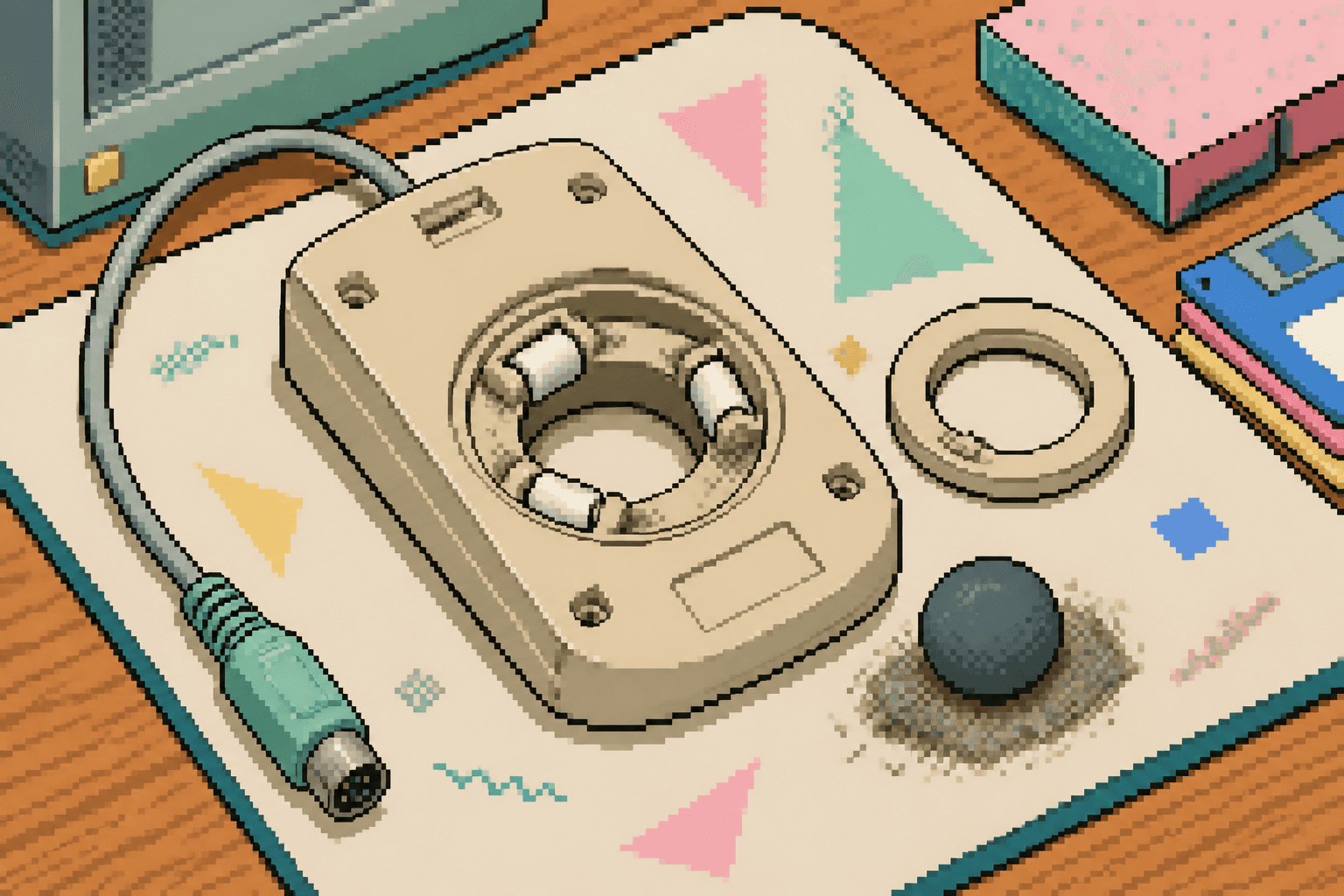
On the underside of the mouse was a circular plastic ring. About an inch and a half across. It had two little nubs on it - small textured grips, on opposite sides - that you'd put your thumb and middle finger on, and you'd twist. Counterclockwise. The way Nintendo cartridges and pickle jars and child-safety caps had taught you to twist.
The ring would resist for a moment. Then it would give. There was a small click, a small pop, and the ring would lift away in your hand, and behind it was a circular opening, and inside the opening was the ball.
The ball was rubber-coated. About the size of a marble but heavier. Black, usually, sometimes gray. The rubber was a kind of soft, slightly tacky compound that picked up everything - skin oil, dust, eraser shavings, lint from your mouse pad, the salt on the chips you had been eating while you played Roller Coaster Tycoon. It was, by design, sticky. It had to be sticky. The whole apparatus only worked because the ball had enough friction to grip the desk and turn the rollers inside.
You'd tip the mouse and the ball would fall out into your palm. It would be warm. It would be slightly soft. It would have a thin coating of something on it that looked like felt and was not felt. You'd put it down on the desk.
The ball was warm. It was slightly soft. It had a thin coating of something on it that looked like felt and was not felt.
The Rollers
Then you'd look into the cavity.
Inside the round opening, three small white plastic rollers were arranged in a triangle. Two of them were perpendicular to each other - one tracked left-right, one tracked up-down - and the third was a spring-loaded idler whose only job was to push the ball against the other two. The first two were the real ones. They were the eyes.
And every one of them was wearing a small black donut of gunk.
That was the problem. The rollers, over the course of three or four weeks of use, would accumulate a hard, ringed crust of dust and skin oil and table grime, deposited there by the ball every time it rolled over them. The crust would build up in narrow bands - one band per roller, right where the ball touched. And once those bands were thick enough, the rollers couldn't turn. The ball was still rolling. The rollers were not.
So your cursor only moved on the axis where the gunk hadn't quite reached critical mass yet.
The Thumbnail
You scraped it off with your thumbnail.
That was it. That was the technique. There was no tool. There was no manufacturer-approved cleaner. There was nothing for sale at CompUSA that you needed to buy. You used the fingernail of your dominant thumb, and you pressed it against the white plastic roller, and you scraped, and a little curl of black-gray crud would lift off in a strip, and you would feel a satisfaction that very few other things in computing have ever delivered.
The crud came off in a piece. Not in flakes. In a band. A single continuous ring of compacted finger oil and dust, peeling off the roller like the rind off an orange. You'd watch it lift, you'd flick it onto the desk, you'd rotate the roller a quarter turn with your fingertip - the roller would spin freely now, easily, like a tiny lathe - and you'd scrape the next quarter. Then the next. Then you'd do the second roller. Then you'd do the idler, even though the idler didn't strictly need it.
You'd blow into the cavity. (You'd been told not to do this. You did it anyway. The same logic that powered the Nintendo cartridge.) You'd wipe the ball on your shirt. You'd drop the ball back in, twist the ring back on, flip the mouse over, and the cursor would move perfectly. Smoothly. Like a new mouse. Like the mouse it had been a month ago when you stopped paying attention to it.
- Dead skin cells from your fingertips
- Sebum (the oil your skin secretes)
- Dust from the air in your house
- Lint from the mousepad
- Cookie crumbs
- Eraser shavings
- A small percentage of cat
- A very small percentage of you
The Ball
I want to talk about the ball.
The ball was a small, heavy, rubber-coated steel sphere. The weight is the part I keep thinking about. It was not light. It was not a ping-pong ball. It was steel. Inside the rubber there was actual ball bearing-grade metal, and the rubber was vulcanized onto it, and the whole thing had the heft of a fishing weight. You could feel it when you picked the mouse up. The mouse was heavier than it should have been because of the ball.
This is not how computer hardware works anymore. Modern peripherals are hollow. They are aluminum shells and plastic membranes and lithium polymer pouches that weigh nothing. The mouse on your desk right now weighs about three ounces. The mouse in 1997 weighed half a pound, half of which was a steel ball, and you could feel that steel ball moving inside the mouse when you mousepad-tapped it on the desk to wake the screen up. The mouse had inertia. The mouse had a center of gravity. You knew exactly how hard you had to push it.
I miss this slightly. I'm not going to pretend it was better. The optical mouse on my desk right now is more accurate, more reliable, has fewer moving parts, never needs cleaning, and weighs nothing, and these are real and good things. But the ball mouse felt like a thing. Like a small machine. Like an object that had been engineered to do a job, and you could feel the engineering in your hand, and when it stopped working you could open it up.
The Cleaning Was A Genre
Cleaning the mouse ball was a whole little ritual, a maintenance task that fell into the same category as winding the clock or changing the smoke detector battery or unscrewing the salt shaker to refill it.
There were classes of computer user who did it regularly - every couple weeks, on a schedule, the way you'd dust a bookshelf. There were classes who only did it when the cursor failed. There were classes who didn't know it was an option, and who simply lived with a mouse that only moved on the Y-axis for months on end, until a friend or sibling or IT-adjacent uncle came over and said give me that for a second and twisted the ring and scraped the rollers and handed it back, and the friend's mouse was suddenly a new mouse, which felt like sorcery.
There were classes of computer user who didn't know it was an option, and who simply lived with a mouse that only moved on the Y-axis for months on end.
The act itself was small. Maybe ninety seconds, end to end. But it was a physical interaction with a computer peripheral, and there are not many of those left. We do not open our computers anymore. We do not service our keyboards. We do not deroller our mice. The mouse, in 2026, is a sealed black puck that either works or doesn't, and when it doesn't you don't take it apart - you throw it away and buy another one for twelve dollars on Amazon. There is no thumbnail involved.
The End
The optical mouse killed the ball mouse around 2000.
There was no announcement. It just started showing up. Microsoft made the first one that was any good - the IntelliMouse Optical, with a glowing red LED on the underside instead of a ball - and within about three years, no new mouse you could buy had a ball in it anymore. The ball mouse went from the mouse to the old mouse to the mouse your school still has in a span of approximately eighteen months.
I want to say I noticed. I did not notice. The transition happened so smoothly that the only marker I have for it is the moment, a few years later, when I picked up a friend's optical mouse and instinctively flipped it over to see the ball, and there was no ball, and I had to sit with the small surprise of having forgotten that the ball was ever there.
The maintenance ritual evaporated. There was nothing to replace it. There was no scheduled monthly grooming of the optical sensor. The optical mouse simply worked, indefinitely, until you spilled coffee on it, at which point it stopped working and you threw it away. There was no diagnosis. There was no cure. There was no thumbnail.
The Argument
The ball mouse was not a better mouse.
I want to be clear about that, because I'm about to be sentimental in a moment and I want to head it off. The ball mouse was, by every measurable criterion, worse. It tracked badly on glass and on shiny wood. It skipped on textured surfaces. It needed a mousepad. It accumulated grime at a rate that made it unusable within weeks. It had moving parts that wore out. The whole apparatus was a mechanical translation of a physical motion into an electrical signal, and that translation was inherently lossy, and the lossiness got worse the longer you used the thing.
But.
But the ball mouse made you interact with the machine. It made you flip the mouse over, twist a ring, take the ball out, scrape some crud off three small rollers, blow into a hole, put the ball back, twist the ring back, and feel the cursor track smoothly again. The machine asked something of you. You gave it ninety seconds. It gave you another month of work in exchange.
The relationship was legible. You understood what was wrong, you understood the fix, you could perform the fix yourself, and the fix worked. There was no diagnostic screen. There was no error code. There was no driver to reinstall. There was a ball, and the ball was sticky, and you cleaned the rollers, and the mouse worked again.
We do not have many relationships like this with our computers anymore. They are mostly black boxes now. When something goes wrong, you Google a string of words that you do not understand, you copy a command from a Stack Overflow answer that was written in 2014, you paste it into a terminal you do not normally open, and something happens that you cannot describe. Or it doesn't, and you give up, and you buy a new computer. The thumbnail is not on the table.
The last ball mouse I used was in 2003, at the library where I had a part-time job shelving books. The library's computers were all Dells from 1998, and they all had Logitech ball mice, and all of the ball mice were filthy, because library patrons are not in the habit of maintaining peripherals that do not belong to them. I'd come in for my shift and the cursor on the catalog computer would only move diagonally, and I'd flip the mouse over, twist the ring, and the ball would fall onto the desk in a small puff of fine library dust. I'd scrape the rollers with my thumbnail. I'd blow into the cavity. I'd put it back together. I'd check it out and the cursor would move smoothly, and I would feel a small, private satisfaction that I could not have explained to anyone, because nobody was watching, and nobody would have cared if they had been.
I think about that sometimes. The small private competence of fixing the mouse. Knowing exactly what was wrong and exactly how to fix it. Holding a ball in your hand and a ring in your other hand and feeling, for ninety seconds, like a person who understood the machine.
The optical mouse on my desk has been there for two years. I do not know who made it. I have never flipped it over. I would not know what to do if I did.