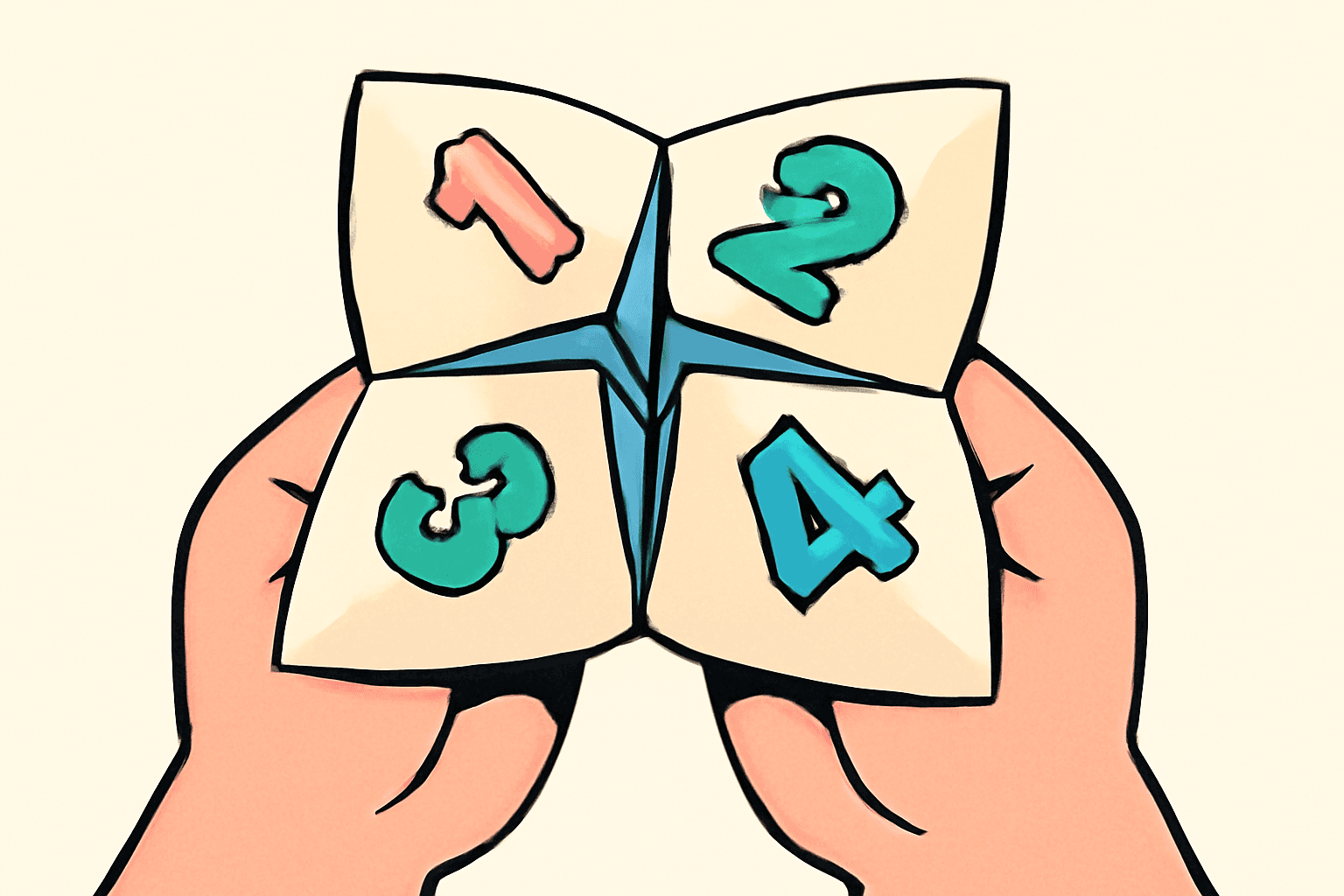
Somebody taught you. That's the thing I keep coming back to. Nobody learned to fold a cootie catcher from a book. Nobody figured it out alone. Somebody - an older cousin, a kid at the lunch table, a girl in your class who seemed to know everything two weeks before everyone else - sat down with a square of paper and showed you. Fold it in half. Now the other way. Now bring the corners to the center. Flip it. Corners to the center again. Fold it in half, slide your thumbs and index fingers into the pockets, and push them together until it bloomed open like a little paper mouth.
And then you had power.
The Protocol
The cootie catcher - also called a fortune teller, also called a chatterbox if you were from certain parts of the country and liked being wrong about what things are called - had a strict protocol. It was a ritual, and rituals don't work if you skip steps.
The operator held the device with both hands, fingers pinched together so it was closed. The client stood across from them, usually at recess, sometimes in the back of the classroom when the teacher wasn't looking. And then the script began.
"Pick a color."
The colors were written on the outside flaps - usually four of them. Red, blue, green, yellow. Sometimes purple if the maker was feeling ambitious. The operator spelled out the color, opening and closing the cootie catcher with each letter. R-E-D. Three moves. The paper gaped open in one direction, then the other, then the first again, revealing a set of numbers.
"Pick a number."
The numbers were written on the inner triangles. You'd pick one. The operator would count it out - open, close, open, close - and then you'd pick again. One more number. And then, finally, the operator would lift the flap and read your fortune.
The cootie catcher didn't predict the future. It created a moment where someone could say something they'd been thinking all along and blame it on a piece of paper.
This is where it got interesting.
The Fortunes
The fortunes were where the whole operation revealed itself. Because the person who made the cootie catcher had written them. By hand. In advance. With full knowledge of who would probably be playing.
The range was enormous. On the mild end, you had stuff like "You will be rich" or "You will get an A on your next test." Generic. Safe. Fortune cookie energy.
But most cootie catchers were not playing it safe.
"You will marry Josh." "Danielle likes you." "You smell like feet." "You will kiss someone behind the portable." These were not predictions. These were messages. Encoded in origami and delivered through a game that gave everyone involved just enough distance to pretend it was all random.
The kid who opened the flap and read "You will marry Tyler" out loud to a group - that kid was performing a public service. Or committing a public execution. Depending on the fortune, depending on the day, depending on whether Tyler was standing right there.
Common Cootie Catcher Fortune Categories:
- The Crush Reveal: "You will marry [name]" or "[Name] likes you" - devastating in either direction
- The Insult: "You eat boogers" or "You smell" - always written in someone else's handwriting for deniability
- The Prophecy: "You will be famous" or "You will have 12 kids" - weirdly ambitious
- The Filler: "You will have a good day" - what you wrote when you ran out of gossip
- The Chaos Agent: "You still wet the bed" - designed purely to destroy
The Architect
Every school had one kid who took it further than everyone else. While the rest of us were folding notebook paper into basic four-color models, this kid was making elaborate ones. Double-layered. Color-coded with gel pens. Fortunes that were full sentences instead of three words. Sometimes they'd add extra folds, bonus rounds, sub-menus of fate. You'd be standing there for five minutes going through the process while a line formed behind you.
These kids were consultants before consulting existed. They had a product. They had a process. They had clients waiting. Some of them charged - a fruit snack, a Gushers pack, a turn on the swings. They understood supply and demand at age nine. The cootie catcher wasn't a toy to them. It was a practice.
Then there were the knockoffs. Kids who watched the process, went home, tried to make one themselves, and came back the next day with something that looked like a crumpled napkin with "BLUE" written on it in crayon. The folds were wrong. The flaps didn't open right. The fortunes were just their own name over and over. These were the off-brand fortune tellers, and they got the reception they deserved - which was a polite "no thanks" and a return to the kid who knew what they were doing.
The Social Technology
Here's what I think about now, as an adult who has paid actual money to actual therapists to learn how to say difficult things directly to other people's faces: the cootie catcher was a social technology. It solved a real problem. The problem was that you were ten years old and you had feelings and observations that were way too big and way too dangerous to just say.
You couldn't walk up to someone at recess and say "I think you like Matt." That was an act of war. But if a cootie catcher said it? If a piece of folded paper with the word YELLOW on the outside and the number 7 on the inside said it? Well. That was just the game. Don't blame me. Blame the fortune.
We built a divination system out of notebook paper and used it to do the thing humans have always needed to do - tell each other the truth sideways.
It was plausible deniability in origami form. A way to say "I like you" without saying it. A way to say "everyone thinks you're weird" without owning it. A way to test the waters of a crush, a conflict, a secret - all filtered through the theater of a game that pretended to be random but was, obviously, completely rigged from the start.
The person who made it chose the fortunes. The person who made it knew who would play. The person who made it could steer the whole thing - "no, pick the other number" - until the right flap opened for the right person at the right time.
And everyone knew this. That was the magic. Everyone knew it was rigged and everyone played along anyway, because the game was the point. The game was what made it possible.
The Spread
Cootie catchers moved through a school the way everything moved through schools in the 90s - fast, mysterious, and without any identifiable origin. One Monday nobody had them. By Wednesday every kid at every lunch table was hunched over a piece of paper, folding. By Friday the teacher was confiscating them.
There was always a confiscation phase. Teachers treated cootie catchers like contraband, which only made them more powerful. Getting yours taken away was almost a badge of honor. It meant your fortunes were good. It meant you were running a real operation.
And then, just as quickly as they'd arrived, they'd fade. Something else would take over. Friendship bracelets. MASH. That S thing everyone drew on their notebooks. The cootie catcher would retreat underground, waiting to resurface next semester when someone would fold one at lunch and the whole cycle would start again.
I found one last year, tucked inside an old yearbook in a box at my parents' house. It was made of wide-ruled notebook paper, the folds soft and brown at the edges. The colors on the outside were barely legible - written in a pen that had been running out of ink even then.
I opened it carefully. The paper almost tore at the creases.
Under the number 3, in handwriting I didn't recognize, it said: "You will be happy."
I don't know who wrote it. I don't know who it was meant for. But I stood there in my parents' garage holding this little paper machine and thinking about how someone, thirty years ago, folded a piece of paper into a mouth and used it to say something kind to somebody. Wrapped it in a game. Hid it behind a number. Made it safe enough to say out loud.
I folded it back up and put it in my pocket. I don't know why. It just felt like it still had one more fortune left in it.