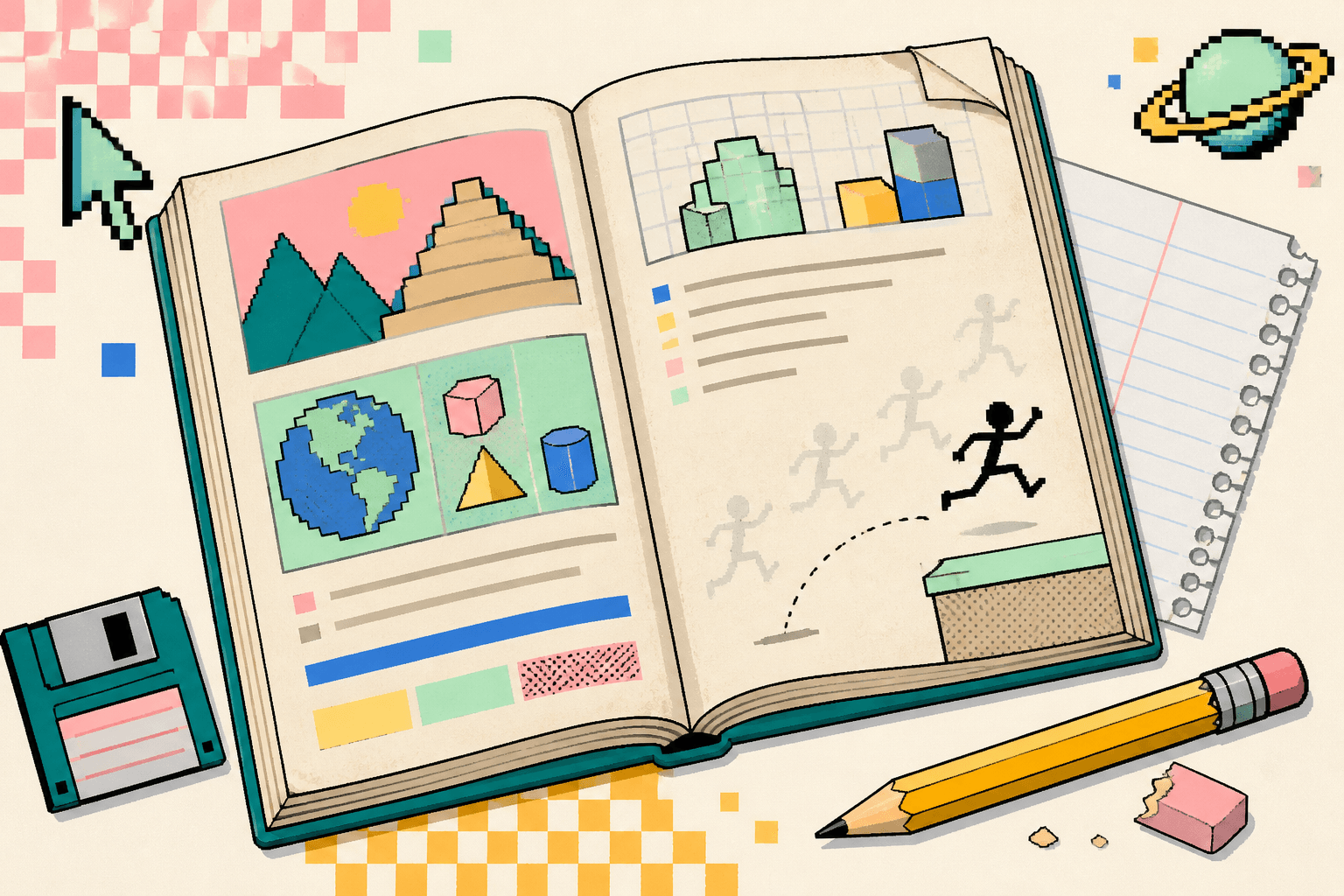
You are twelve. It is Tuesday. You are in Mr. Haney's social studies class. The chapter is on the Articles of Confederation. Mr. Haney is at the board, writing something about Shays' Rebellion. You have been looking at Shays' Rebellion for nineteen minutes and you have another twenty-six minutes of Shays' Rebellion to go.
The textbook on your desk is olive green. It has a label on the inside front cover with the names of six other kids who had it before you, going back to 1991. Yours is the seventh name. You wrote it in ballpoint. The spine is cracked at page 94. There is a nickel-sized dark stain on page 158 that might be chocolate milk and might not be.
You open to page 212. You find the lower right corner. You take out a pen.
You draw a stick figure.
The Thumb
The flipbook had to go in the lower right corner. This was not negotiable.
The reason was simple: when you held a textbook open with your left hand and flipped the pages with your right thumb, the pages pivoted around the top of the spine and spread open from the bottom right. Your thumb, in a single motion, could ride across every page in a stack and release them one at a time at a predictable rate. If the drawings were in the lower right corner, your thumb would reveal them in order, each one visible for a precise fraction of a second as the page curled away.
This was fluid, under your control, and reversible. You could flip forward or back. You could flip slow. You could flip fast. You could stop halfway. The physics of the paperback textbook had, by complete accident, implemented every control a professional animator would have paid for in 1996.
Nobody taught us this. We just knew. If you were right-handed, the flipbook went in the lower right. If you were left-handed, you flipped left-handed and the flipbook went in the lower left, and your animation ran in reverse through the chapter, which was, in its way, a legitimate artistic choice.
The physics of the paperback textbook had, by complete accident, implemented every control a professional animator would have paid for in 1996.
The Figure
The figure was always a stick figure. There was no second option.
The head was a circle. The body was a line. The arms were two lines coming off the body somewhere around the shoulders. The legs were two more lines, longer, coming off the bottom. That was it. If you were ambitious, you added hands as little starbursts of three lines. If you were extremely ambitious, you added hair, which was six quick vertical slashes on top of the head. If you were showing off, the stick figure had a hat, usually a baseball cap, drawn as a half-circle with a brim sticking out the front.
Nobody drew a face. The face was the one thing that was impossible to do consistently across twelve pages, because small faces diverge wildly across small drawings, and a face that was slightly different in each frame produced a figure that looked like it was being possessed in slow motion. The flipbook figure had no face. He had a head. The two were not the same.
Girls, in my experience, drew the same figure. There was no gendered flipbook. The flipbook was a universal pictograph. He was everyone and no one. He was called, if he was called anything, the guy.
Try It
Draw a stick figure in the corner. Click Next. Nudge him. Repeat. Hit Flip.
The Keyframes
I did not know, at twelve, that I was learning animation.
I thought I was drawing a guy who was about to get hit by a bus. In fact, I was learning the fundamental principle of frame-based animation, which is: the eye perceives motion when a series of still images is shown in rapid succession, and the illusion is more convincing when the differences between frames are small, consistent, and in the direction of a predictable arc.
The way I learned this was by failing it.
My first flipbooks were disasters. I would draw the guy standing on page 212, then draw the guy mid-air on page 213, then draw the guy flat on the ground on page 214. The flipbook, when flipped, looked like a strobe light on a car accident. There was no motion. There was just a sequence of three unrelated poses, each belonging to a different story.
Then, slowly, I figured out tweening - the industry term I would not learn for another ten years. If I wanted the guy to jump, I needed to show him bending his knees first, then rising, then at peak, then falling, then landing, then recovering. The jump needed to be stretched across pages, with each page showing a small, consistent shift from the one before. The guy needed to be at the same horizontal position across all the frames or he would appear to teleport. His head needed to stay the same size or he would appear to be inflating. His legs needed to actually bend, not just change position.
I was figuring out keyframes and in-betweens. I was figuring out squash and stretch. I was figuring out that the hardest frame to draw was never the first or the last, but the one in the middle, because the one in the middle was the one that controlled whether the whole thing looked like a jump or a seizure.
I was figuring out that the hardest frame to draw was never the first or the last, but the one in the middle. The middle controlled whether the whole thing looked like a jump or a seizure.
The Content
What did the guy do?
A survey of my own textbooks from grades six through nine suggests the following, in rough order of frequency.
- Got hit by a bus: the single most common narrative, roughly 40% of all flipbooks
- Jumped over a canyon: 20%, often ending in success, sometimes not
- Fell off a cliff: 15%, with optional splat
- Fought another guy: 10%, usually inconclusively
- Got crushed by an anvil: 5%, directly imported from Looney Tunes
- Shot a basketball: 3%, usually missing
- Did a kickflip on a skateboard: 2%
- Just stood there and waved: 2%, this was the one you drew when you were tired
- Transformed into a dinosaur: 1%, hugely difficult, mostly failed
- Other: 2%, including, in one specific case, a stick figure teacher being thrown off a building, which caused a parent-teacher conference
The violence was universal and strangely abstract. The guy, having no face, could not express pain. He could only express impact. A splat, by convention, was a horizontal line of ovals radiating outward from a central mess, usually with the stick figure's head still visible to the side, looking at the splat like it was somebody else's problem. There was always a little curl of smoke. There were always two or three teardrop shapes to the side, representing debris. There was never blood. Blood would have been a step too far, somehow.
The flipbook was violent in exactly the register of a 1991 cartoon: the guy fell off a cliff, hit the ground, got up, dusted himself off on frame twelve, and the whole thing started over on the next page. He was eternal. He died a lot. He never left.
The Theft
Here is the part that, as an adult, I think about.
The textbooks were not ours.
The textbook had been assigned to you at the beginning of the year. Your name went on a label inside the front cover. There was a space to indicate the book's condition when you got it: Good, Fair, Poor. Your teacher wrote one of those three words. At the end of the year, the book came back. The teacher checked it. The condition at the end was supposed to be no worse than at the beginning. If it was worse - if a page was torn, if the cover was ripped, if there was a drink stain - you got a bill, usually fifteen dollars, which your parents paid, usually angrily.
The flipbook was, strictly speaking, defacement of school property.
The administrator who had purchased these textbooks had paid, with public money, about thirty-four dollars a copy for an olive-green hardbound social studies text that was supposed to last ten years in a district that could not afford to replace them. You, twelve years old, had taken a pen to the corner of twenty-eight consecutive pages of that book and had drawn a stick figure getting hit by a bus. The next year, a seventh-grade kid you had never met was going to open that textbook on the first day and find your flipbook, and he was going to watch your stick figure get hit by a bus, and he was going to think, that's awesome, and he was going to add his own on the following chapter.
The flipbooks compounded. By the time a textbook had been through its ten-year life cycle, the back half of the book was flipbooks in different pens by different hands, each one someone else's twelve-year-old afternoon. There were stick figures that spanned multiple chapters. There were sequences that had been started by one kid and finished by another. There were, in some cases, elaborate crossovers where one kid's guy was fighting another kid's guy in a flipbook that had been serialized across two owners.
By the time a textbook had been through its ten-year life cycle, the back half was flipbooks in different pens by different hands, each one someone else's twelve-year-old afternoon.
I feel bad about this now, and I didn't then. The teachers knew. The teachers had, themselves, in their own junior high years, drawn stick figures getting hit by buses in the back of textbooks. The teachers chose to overlook most of it, except when a kid went too hard and did a flipbook that was obscene, or that targeted a specific other student by name, or, in that one specific case I keep thinking about, that depicted a stick figure teacher being thrown off a building.
The teacher in question had taken that book home, I was later told, and shown it to her husband, who was a cartoonist, and he had said the arcs are actually pretty good. The kid got a Saturday detention. The flipbook was not torn out. It is, I assume, still in that textbook, in a storage room somewhere in Ohio, waiting.
The Catch
But I want to argue the other side, because the other side matters.
The flipbook was the only art most kids made.
Twelve-year-olds, in 1996, were not generally producing art. They had maybe one art class a week, during which they made construction-paper collages or glazed a clay pinch pot. They were not writing short stories. They were not shooting film. They were not building anything with their hands outside of maybe a model volcano for the science fair. They were, in large majority, doing homework, watching TV, playing Super Nintendo, and getting through the day. There was almost no venue in a kid's life where a kid was asked to invent a sequence of images that told a tiny story.
Except in the back of the social studies textbook.
In the back of the social studies textbook, every kid in America was making a short film. Not a good one. Not a long one. Not one anyone was going to see, except the one kid who would get the book next year. But it was theirs, it was invented from nothing, and it had the structure of a story: setup, action, consequence. The guy wanted to jump the canyon. The guy jumped the canyon. The guy either made it or he didn't. Then the whole thing started over, or the guy got hit by a bus for an encore, or the next chapter was a different guy.
This was storyboarding. This was comics without panels. This was animation at the lowest resolution animation could occur. And it happened in every classroom in every school in every state, invisible to the adults, totally unrewarded, with no audience, for its own sake.
I made more flipbooks between the ages of eleven and fourteen than I made of anything else. I made more flipbooks than drawings. More than paintings. More than songs. More than, honestly, anything I would be proud to list on an application. If a college admissions officer in 2001 had asked me what my body of artistic work consisted of, the honest answer would have been about four hundred stick figures getting hit by buses, distributed across six different textbooks, in pen, mostly in the fall of seventh grade.
That is, in its way, a body of work.
If a college admissions officer in 2001 had asked me what my body of artistic work consisted of, the honest answer would have been about four hundred stick figures getting hit by buses, in pen, mostly in the fall of seventh grade.
The Flip
There was a specific pleasure to the first flip.
You had drawn twelve frames, or sixteen, or in one memorable case thirty-eight. You did not know what the result would look like, because you had drawn each frame while looking only at the frame itself and maybe a quick peek at the one before. The whole thing had been assembled without you ever seeing the whole thing.
You put your right thumb at page 212 and your left hand under the spine, and you let the pages flip past.
For about one and a half seconds, the stick figure moved.
He bent his knees. He launched. He hung in the air at peak. He came down. He hit the ground. He got up. The whole arc, the whole small, personal, unimportant arc of a stick figure jumping a canyon, played out in a window the size of a postage stamp in the corner of a page about colonial grievances. And it worked. He actually moved. The illusion held. The eye bought it. The guy, impossibly, had a story.
That was the moment. That was the whole thing. That was why kids did this, through boredom, through the complaints of teachers, through the ethical mess of defacing a book that would be given to someone else. Because at the end of the sequence, your stick figure moved. You had made something that moved. The world was, briefly, animated by your hand, and the thing that was moving was something that had been nothing an hour ago.
The End
I know a kid now, my friend's daughter, who is eleven and has an iPad.
She has an app on her iPad called something like Flipaclip. It is a flipbook maker. It gives her onion-skinning, which means she can see the previous frame faintly in the background of the current frame. It gives her playback at adjustable speed. It gives her layers. It gives her the ability to export her flipbook as an animated GIF and send it to her friends. It is a vastly superior tool for making flipbooks than anything I had access to in 1996.
She has used it, I am told, three times. The flipbooks are good. She lost interest.
I think about this a lot. The reason the flipbook was powerful in 1996 was not that it was easy. It was powerful because it was illegal, because it was constrained, because it was free, in both senses, and because the only alternative was listening to Mr. Haney explain the Articles of Confederation. The flipbook was a protest against boredom conducted at the exact moment and location where boredom was happening. The tool was a textbook you were not supposed to be drawing in. The audience was yourself and one kid you would never meet. The reward was that for a second and a half, something you made moved.
My friend's daughter has none of this. She has a tool that does the job properly. She has every option she could want. She has no textbook. She has no Mr. Haney. She has no reason to make a flipbook, and so she doesn't. She would make one if she were bored in a classroom and the only thing in front of her was a book of material about Shays' Rebellion, but she is not, and she isn't.
The flipbook was never, really, about the flipbook. It was about the one hour on a Tuesday when the room went still, and the window behind the teacher went white in the sun, and the clock, slowly, did not move. And in that silence, in the lower right corner of a book you did not own, you drew a stick figure. And he moved.
My seventh-grade textbook is probably in a landfill now. The flipbook I drew in it - a stick figure jumping over a canyon on a motorcycle, over the course of about fourteen frames, in the back of chapter nine - is probably in the same landfill. The whole thing had a lifespan of maybe eleven years, from the day I drew it in October of 1996 to the day the book was finally retired in some bureaucratic triage sometime around 2007. In those eleven years, maybe eight other kids opened the book, found the flipbook, flipped it, and watched the guy clear the canyon. That is, counting myself, nine viewers. Nine views on a short film made entirely in pen in the margins of a book I did not own. By modern metrics, this is a failure. By the metric of the twelve-year-old who made it, this is more than enough. He made it. It moved. Nine people saw it. That is a career.