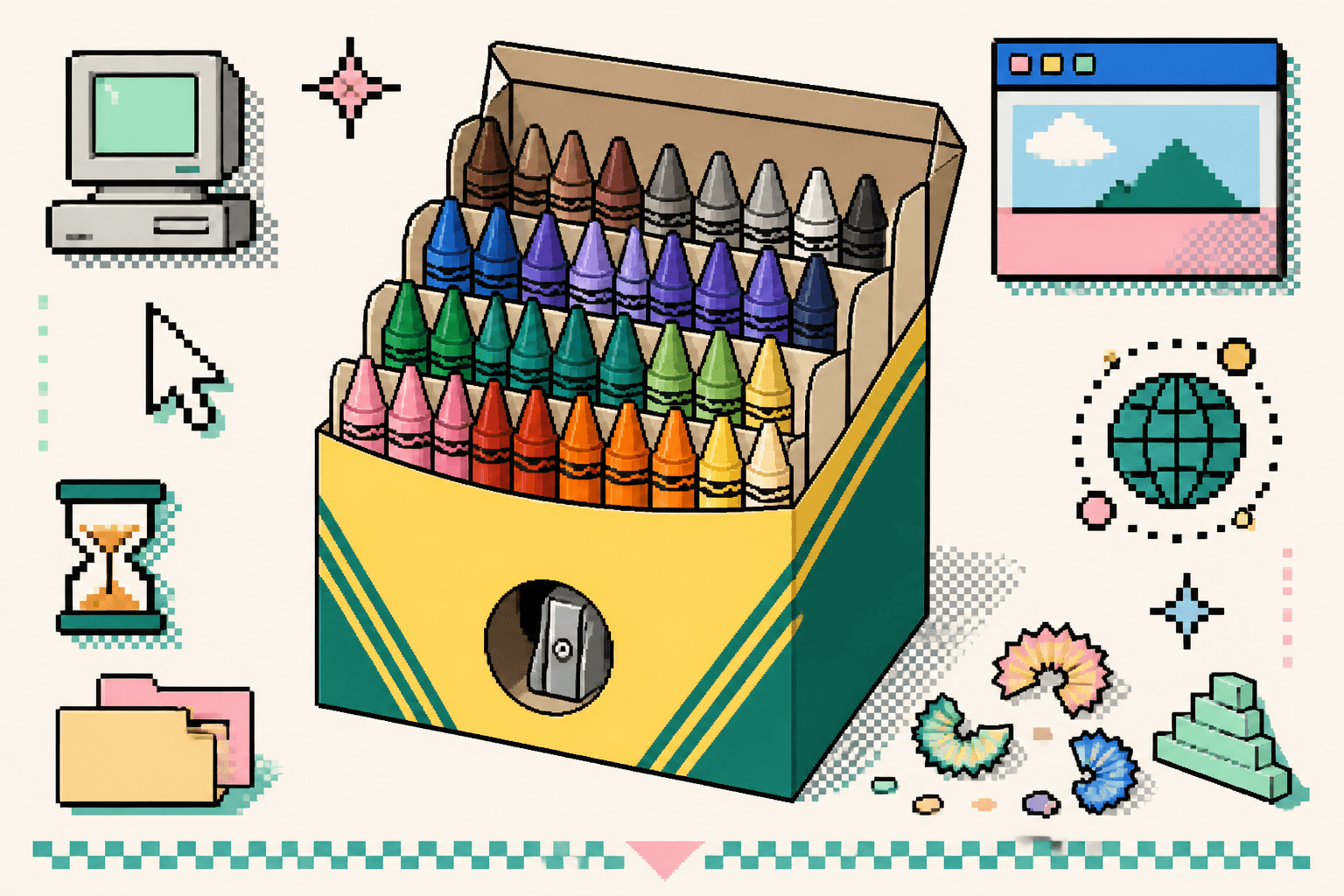
The box was yellow and green. The box was the size of a hardback book turned sideways. On the front there was a cartoon crayon with eyes and a smile, and above the cartoon crayon it said 64 in a font that made 64 feel like a lot, which it was. On the back there was a small round hole, drilled directly into the cardboard, with a sharpener blade visible through it.
You never understood what that hole was for. You understood it in the same way you understood that gum was for chewing. But you had never once put a crayon in it and gotten a crayon back out that was in better shape than when it went in.
The Opening
The 64 pack had a specific opening ritual.
You slid your thumbnail under the little pre-cut flap on the top, which lifted up along a perforated line, and you folded that flap backward and out of the way. Then the crayons were visible. Four tiers, rising toward the back of the box like stadium seating. Sixteen crayons in each tier. The front row was the shortest, the back row the tallest, and together they formed a sloped amphitheater of waxy color, each one standing up in its own little paper sleeve, each one pointed, each one perfect.
The first time you opened a new 64 pack was the only time any of them were pointed. From that moment forward it was all entropy.
The first time you opened a new 64 pack was the only time any of them were pointed. From that moment forward it was all entropy.
The smell came out of the box in one wave. Cedar and paraffin and the specific grainy sweetness of pigment. You put your face directly into the box to smell it, because that was the correct response. Everyone did this. If someone handed you a new 64 pack and you did not immediately smell it, there was something wrong with you, in a way that was not quite diagnosable but was definitely true.
The Names
The colors had names.
Not all of them had sensible names. Red was called Red. Blue was Blue. Yellow was Yellow. Those were the ones you'd use for sixty percent of everything. But further back in the box, deeper into the tiers, there were colors with names that read like someone had been paid by the syllable. Burnt Sienna. Raw Umber. Macaroni and Cheese. Atomic Tangerine. Razzmatazz. Purple Mountains' Majesty. Thistle. Wisteria.
You did not know what a Sienna was, or how one got burnt, or what it had to do with the specific muddy orange-brown of crayon number forty-two. You did not know what Umber meant in either its cooked or raw state. You absolutely did not know what Macaroni and Cheese looked like as a color versus as a food, and the first time you compared the two you were briefly confused by the fact that the crayon was slightly orange-er.
But you learned the names. You memorized them without trying. Thirty years later you can still look at a specific shade of grayish-purple and say that's Thistle with complete confidence, even though you have never once in adult life needed to identify Thistle, and even though if you were asked to describe Thistle without the crayon in front of you, you could not.
The Hierarchy
Within the box there was a hierarchy.
The crayons in the front row got used immediately. Red, Blue, Yellow, Green. These were the workhorse crayons. The ones you'd open the box for. The front row would get stubby and chipped and blunt within a week. The paper sleeves would start to crack. The tips would develop that flat facet that said this crayon has been pressed too hard against newsprint. You could identify a front-row crayon by touch, in the dark, by the fact that it was now barely two inches long and had a wrapper that was starting to tear.
The second row got used sometimes. The third row got used rarely. The fourth row - the back row, the tallest crayons, the ones with the fanciest names - got used almost never. The back row was where Silver and Gold lived, and nobody put Silver and Gold on anything, because Silver did not actually look silver and Gold did not actually look gold. They looked like a gray crayon and a brown crayon with a tiny bit of sparkle, and the sparkle was invisible on construction paper, which was what you were coloring on, because that was the only paper that existed at your house.
The back row also contained the embarrassments. Flesh. (Later renamed Peach, correctly.) Indian Red. (Later renamed Chestnut, correctly.) These sat in the back untouched, in part because they were ugly colors and in part because, even as a child, you had the sense that these names were going to turn out to be a problem for somebody.
- Front row (used weekly): Red, Blue, Yellow, Green, Black, Orange
- Middle rows (used occasionally): Brown, Purple, Pink, Light Blue, Gray
- Back row (used once, maybe): Silver, Gold, Copper, Thistle, Raw Umber, Wisteria, Timberwolf, Beaver
- Never used, ever, in the entire history of the box: White. White was for coloring on black paper, which you did not have.
The white crayon was its own problem. It was in there, always, taking up space, and nobody could figure out what it was for. You'd try it on white paper and it would do nothing. You'd try it on colored paper and it would show up as a kind of waxy ghost, and that was fine, but you did not need a waxy ghost. You needed Red. Red was in the front and getting shorter. Red was being asked to color a fire truck for the ninth time that month.
The white crayon lived its entire life pointed. You could pick it up on your fiftieth birthday and the tip would still be perfect. White is immortal. Nobody has ever used a white crayon.
The Sharpener
Now. The sharpener.
On the back of the box, drilled directly into the cardboard, there was a hole. About the size of a dime. Behind the hole, visible if you tilted the box up to the light, there was a single metal blade mounted at an angle. The blade was dull. The blade had been dull in the factory. The blade was going to remain dull throughout the life of the box, and the box was going to be destroyed before the blade ever became a problem, so Crayola had not seen fit to invest in a sharper blade.
The theory was that you could stick a dull crayon into the hole, give it a twist, and emerge with a freshly pointed crayon. You never emerged with a freshly pointed crayon. You emerged with:
- A crayon that had been snapped off at the tip
- A crayon with a bent, mashed point that was somehow worse than the point you had going in
- A crayon stuck in the hole, which you could not remove, and which you now had to pry out with a pencil while the paper sleeve slowly disintegrated
- A crayon that was now sticky with the melted residue of previous crayons, because the sharpener had a small cone of compacted colored wax inside it that had been accumulating since the box was manufactured
The worst thing about the built-in sharpener was that the shavings had nowhere to go.
Crayola had designed a sharpener and then designed no mechanism to collect what the sharpener produced. The shavings fell into the box. Which is to say: onto the crayons. Which is to say: into your art.
In a pencil sharpener the shavings fall into a drawer. Everyone understood this. Pencil sharpeners had been shipping with shavings drawers for a hundred years. But the Crayola box had no drawer. The crayon shavings fell into the box. They fell onto the other crayons. They coated the back row in a fine dust of colored wax that was impossible to remove, and they turned the inside bottom of the box into a kind of greasy terrarium, and they got on your fingers, and your fingers then got on your drawing, which now had a smear of mystery wax across the sky.
You stopped using the sharpener. Everyone stopped using the sharpener. By age eight you had learned that the sharpener was decorative, like the pretend wood paneling on the station wagon, like the thermometer on the clock in your kitchen that said 68° no matter what.
The Breakage
The crayons broke.
Not immediately. The first week they were pristine, standing up straight in their tiered rows like a choir. But crayons break under pressure, and children apply pressure, because the whole point of a crayon is that you are not yet strong enough to apply the pressure needed to make the color really dark, so you keep applying more. By week three the front row had two or three casualties - a Red snapped in half, a Blue with its tip gone, a Black that had been pressed so hard against a dinosaur outline that it had bent and finally cracked.
You put the broken pieces back in the box. Both halves. You lined them up in the slot where the whole crayon used to live. You convinced yourself that this was fine. That you could still use them. That a broken crayon is just two shorter crayons, which is technically more crayons.
It was never fine. The broken halves rolled around in the box. The paper sleeves separated. The shorter pieces got lost at the bottom. By the end of the school year the box had thirty whole crayons, twelve broken halves, four unidentifiable stubs with no wrapper, and a thin layer of wax dust across the bottom. The lid no longer closed properly. The sharpener hole was clogged. The whole system had degraded, as all systems do, into a kind of beautiful disorder.
The Argument
I'm not going to argue that the 64 pack was secretly good design. The sharpener was a lie. The box fell apart. The names were pretentious. Half the colors were never used. Flesh was called Flesh for too long. The crayons broke. The shavings got everywhere. The white crayon was useless. By any reasonable metric, the 64 pack was a mediocre product with excellent packaging.
But it was the first time most of us owned a thing with sixty-four distinct options. Sixty-four. More options than you'd had in your entire previous life combined. You had owned, before this: eight crayons. Then sixteen. Then twenty-four. And now, suddenly, sixty-four, arranged in slopes, with a hole in the back that promised more.
The jump from twenty-four to sixty-four was not quantitative. It was qualitative. It was the first time it occurred to you that colors existed on a continuum, that there was not just orange but seven different oranges, that the color between red and orange had its own name, that between blue and green there lived Turquoise and Teal and Cerulean, each one slightly different, each one Crayola's considered opinion about what to call a specific wavelength. You had been given, essentially, your first taxonomy. You had been shown that the world was more finely divided than you'd suspected.
My mother still has one. The 64 pack. Not from my childhood - from my sister's, I think, which means it's from 1997, which means it's older than most of the people who make the internet now. It lives in a kitchen drawer that also contains birthday candles, a half-used book of stamps, and a receipt from a hardware store that closed in 2004.
I pulled it out last Thanksgiving. The lid was warped. The sharpener hole was packed solid with gray wax. Half the crayons were broken, half the wrappers were cracked, and the back row - Silver, Gold, Copper, Thistle, Timberwolf, Wisteria - was almost perfectly pristine. Untouched. The silver crayon still had a point.
I pressed the point against the back of an envelope. It still worked. The color came out exactly how it always had: not really silver, more of a soft gray with a hint of shine, almost nothing on paper, exactly the color I remembered. I wrote the word silver on the envelope and nobody could read it. You had to tilt the envelope to the light to see what was there.
I put the box back in the drawer. I did not try the sharpener. I knew what the sharpener would do. The sharpener had made its position clear in 1992 and I was not going to give it a second chance.