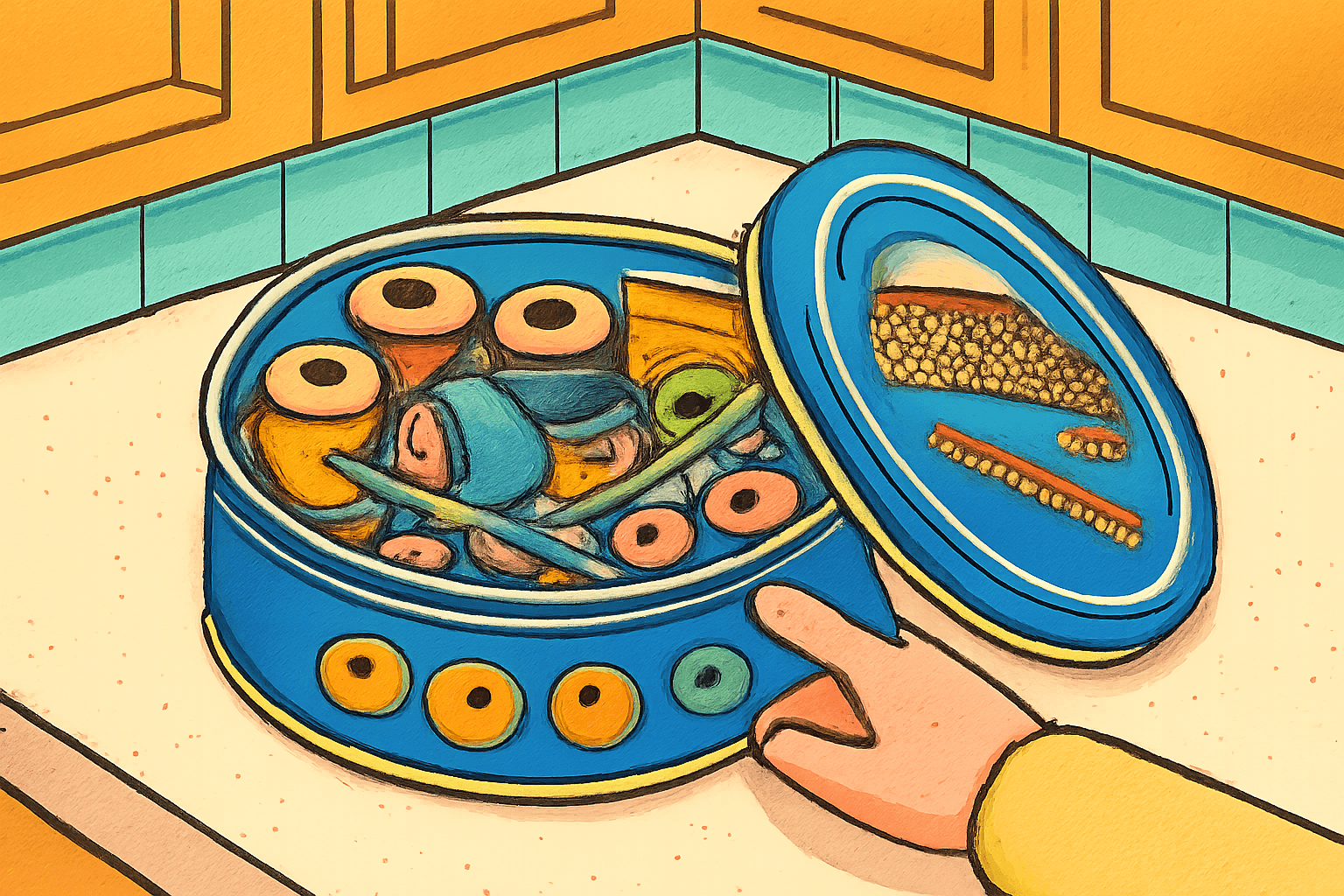
You knew the tin. You know the tin. Round, blue, maybe twelve inches across, with a painting of a Danish countryside on the lid - or was it a coat of arms? Some kind of old-world insignia that suggested royalty, heritage, a baker in Copenhagen who had perfected something. The words DANISH BUTTER COOKIES in gold lettering, arcing across the top like a promise made directly to you, a child, standing in your grandmother's kitchen on a Saturday afternoon with nothing to do and everything to hope for.
You reached for it. You always reached for it. Some part of your brain - the part that had not yet been broken by experience - still believed that this time, this time, the tin would contain what the tin said it contained.
It did not.
The Royal Dansk cookie tin was a sewing kit. It was always a sewing kit. It had been a sewing kit since before you were born, and it would be a sewing kit when you were dead, and no amount of hoping would change the fundamental nature of that tin.
The Lift
There was a specific physical sensation. A weight check. You'd pick up the tin and some part of your hindbrain would assess: too light for cookies, too heavy for empty. Cookies have a specific heft - the distributed weight of dozens of small butter-dense objects shifting gently against each other. What was in this tin didn't shift. It clattered. A muffled, metallic rattle that said needles and buttons and spools, not shortbread and sugar rings.
But you opened it anyway. You always opened it anyway.
The lid came off with that particular tin-on-tin scraping sound - not a pop, not a click, just the slow grind of pressed steel against pressed steel, the sound of a container that had been opened and closed ten thousand times and still fit, still worked, still held its seal with the quiet competence of mid-century Danish manufacturing.
And inside: chaos. Beautiful, devastating chaos.
The Inventory
Every cookie tin sewing kit contained the same things. Not similar things. The same things. As if there were a federal regulation, a hidden statute requiring that the contents of repurposed butter cookie tins conform to a universal standard.
- Thread spools in colors nobody wore (burnt orange, olive green, that specific mauve)
- Loose buttons in every size, belonging to no known garment
- At least two needles stuck into a small square of fabric
- One pair of tiny scissors that barely worked
- A soft measuring tape, coiled like a sleeping snake
- Safety pins in three sizes
- A single thimble, always silver, worn smooth
- Several buttons still attached to their original cardboard backing from the store
- A zipper that was never installed in anything
The buttons. We need to talk about the buttons. There were always buttons. Dozens of them, in every color and size, rattling around the bottom of the tin like loose change. Some were clearly from specific garments - you could see a thread still looped through the holes, a small square of fabric still attached, torn from a shirt that no longer existed. Others had no origin. No history. They were just buttons, untethered from context, waiting for a purpose that would never come.
Your grandmother could identify every single one. "That's from your grandfather's blue cardigan. That one came off a coat I gave to Goodwill in 1983. Those two are from a dress I made for your mother when she was four." The buttons were a genealogy. A family tree made of plastic and thread.
The Betrayal Cycle
Here is the thing about the cookie tin. You never learned. Not really. You would see it on the counter, or the shelf above the stove, or the top of the refrigerator, and some deep, unkillable part of you would think: what if this time. What if someone actually bought cookies and put them in there. What if the sewing supplies had been relocated. What if this particular tin, in this particular kitchen, on this particular afternoon, contained what it was supposed to contain.
You knew it wouldn't. You opened it anyway. Every single time.
The Danish cookie tin didn't teach you about sewing. It taught you about hope - specifically, that hope is a renewable resource that ignores all available evidence.
And every time, for the first half-second after the lid came off, you'd look down at the tangle of thread and buttons and feel it again. The drop. The tiny, familiar collapse of expectation. Not sadness, exactly. More like recognition. Oh, right. Of course. This is what this is. This is what this has always been.
Then you'd put the lid back on, and the tin would go back on the shelf, and you'd go find a sleeve of Chips Ahoy in the pantry like a normal person.
Why the Cookie Tin?
This is the part that interests me now, as an adult. Why that specific tin? Your grandmother had other containers. She had Tupperware. She had drawers. She had an actual sewing basket - the wicker kind with the pincushion lid that you could buy at any craft store. And yet the sewing supplies lived in the cookie tin. Always in the cookie tin.
I think it's because the tin was perfect. Not aesthetically - though the blue was nice, and the gold lettering gave it a certain dignity. But functionally. It was the exact right size. It was sturdy. The lid fit snugly and kept everything contained. It was round, which meant the thread spools sat nicely and the measuring tape could coil naturally along the curve. It was shallow enough that you could see everything at a glance without digging. And it was metal, which meant it lasted. It didn't crack. It didn't stain. It didn't warp.
The Royal Dansk company designed the perfect cookie tin, and in doing so, accidentally designed the perfect sewing kit container. Their product endured not because of the cookies - which were fine, dry, a little bland, the kind of thing you ate six of without enjoyment and then stopped - but because the packaging was so good that it outlived its original purpose by decades.
The Generational Transmission
Here is what nobody talks about. The cookie tin sewing kit was inherited. Not formally, not in a will, not with any ceremony. But when your grandmother died, or downsized, or moved to a smaller place, someone - your mother, your aunt, the responsible daughter - took the tin. And that tin went to their kitchen. And it sat on their counter. And the same buttons and the same olive-green thread and the same dull scissors continued their existence in a new zip code, serving a new family, disappointing a new generation of children who just wanted a cookie.
My mother has the tin now. I have been opening it since 1991. The same tin. The same lid-scraping sound. The same burnt orange thread that has never been used for anything. There are buttons in there from shirts my grandfather wore before I was born. There's a thimble that was old when my grandmother was young. The tin is an heirloom that nobody chose, an artifact that persists not because anyone values it but because nobody can figure out what else to put the sewing stuff in.
Nobody bought a cookie tin to be a sewing kit. Nobody chose this. It just happened, in every household, simultaneously, as if by agreement. The most universal repurposing decision in domestic history, and not one person can explain why.
The Cookies Themselves
I should say something about the actual cookies, the ones that were in the tin for the brief, shining moment before it became a sewing kit. Because someone, at some point, did buy those cookies. Someone brought them home, probably as a holiday gift or a hostess offering, and the family ate them. And they were - let's be honest - fine. Just fine.
There were the round ones with the sugar crystals on top. The pretzel-shaped ones that were slightly darker. The ones with a swirl piped on that looked like little nests. And the ring-shaped ones, which were the best, and which were always gone first, and which there were never enough of.
You ate them one afternoon, probably around Christmas, probably while watching something on television, and then they were gone and the tin was empty and your grandmother looked at it and thought: that's a good tin. And she was right. It was a good tin. It is a good tin. It has been a good tin for thirty years, holding needles and buttons and the quiet domestic faith that someday someone in this house will lose a button and she'll be ready.
The Real Betrayal
The real betrayal isn't that the tin doesn't have cookies. The real betrayal is that you can buy your own Royal Dansk cookies now. You're an adult. You can go to any grocery store, any Target, any random gas station that carries an oddly complete selection of imported biscuits, and buy yourself a fresh blue tin of Danish butter cookies. You can eat the pretzel ones and the ring ones and even the sugar-crystal ones and nobody can stop you.
And when you're done - when the cookies are gone and the wax paper dividers are crumpled in the trash and nothing remains but the empty tin and a few crumbs - you will look at it and think: that's a good tin. And you will put your sewing supplies in it. And you will put it on a shelf. And your children will open it expecting cookies. And the cycle will continue because the cycle has always continued, because the cookie tin was never really about the cookies. It was about the fact that some containers are so good at being containers that they transcend their original purpose and become something permanent, something inherited, something that sits on a shelf in every kitchen in the country holding buttons from shirts that no longer exist and thread in colors that no one will ever wear.
I bought a tin last Christmas. The cookies were fine. The tin is in my kitchen now, on the shelf above the stove. Inside: three spools of thread, a packet of needles, a measuring tape, and a small collection of buttons I've been saving from shirts that have worn out. I didn't decide to do this. I just opened the empty tin one day and thought - that's a good tin. And now it's a sewing kit, because it was always going to be a sewing kit, because that is what those tins are for, no matter what the lid says.