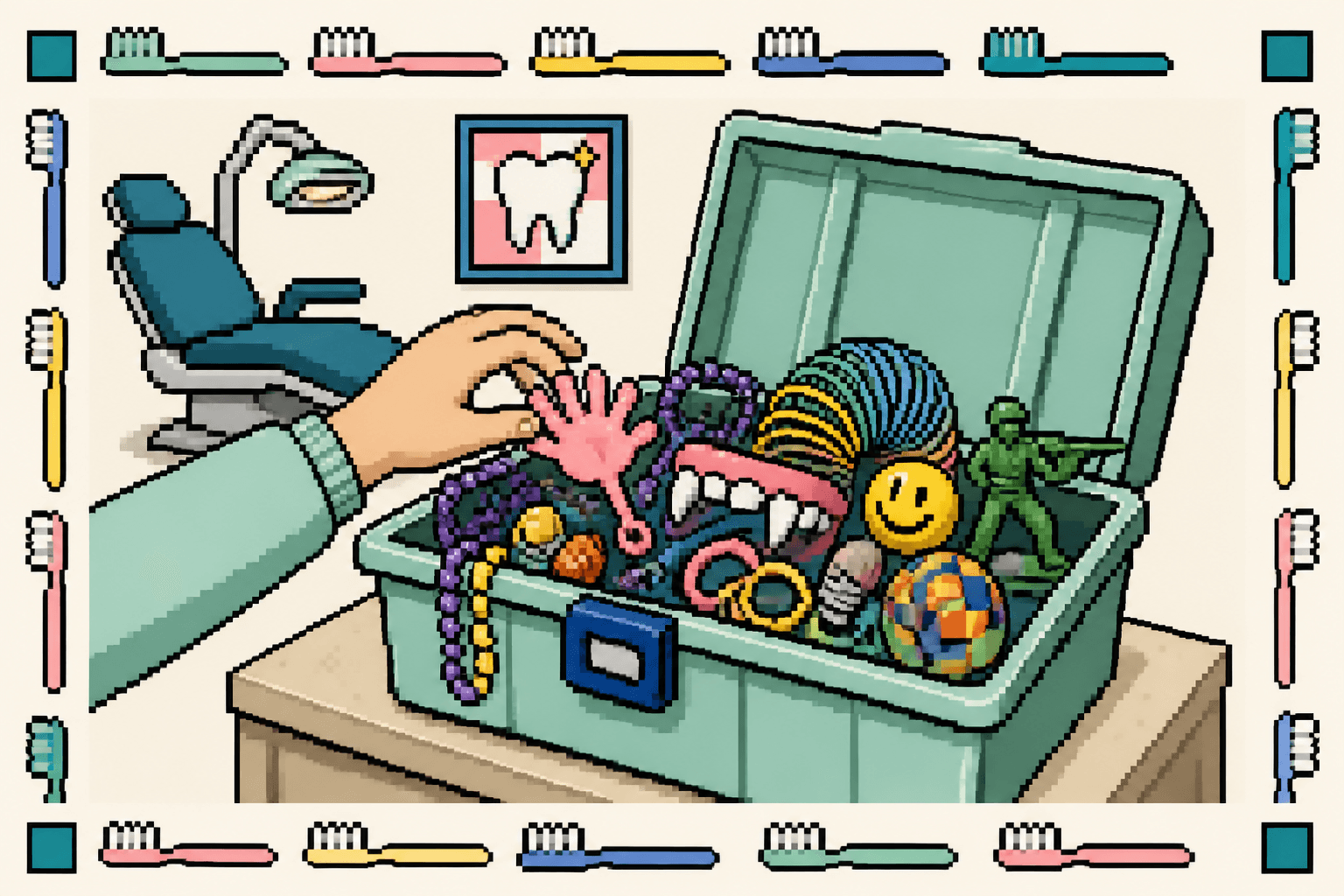
The chest was never actually a chest. It was a plastic bin from an office supply store, or a cardboard treasure-chest-shaped box with a cutout handle, or in the fancier offices, an actual wooden thing with a brass clasp that nobody ever closed. The lid, if there was a lid, was always open. The contents were always visible. The point was not the discovery. The point was the picking.
You had just lain in a chair for forty minutes. Fluoride was still on your teeth. There was a thin paper bib dangling from a plastic chain around your neck, which the hygienist unclipped and dropped in the trash before escorting you to the front. On the way, she stopped. She bent down slightly. She said the sentence.
"You can pick one thing."
The Rules Were Never Written Down
The rules had been established before you were born. Nobody in that office had ever been handed a laminated card listing them. The rules were:
- One prize. Not two. The hygienist is watching.
- No digging to the bottom to look for the good one. You stir, you commit.
- The toothbrush in the bin is, technically, a prize. Avoid.
- If you ask what any item is, that is a tell. Nothing in the bin is good enough to warrant asking.
- Thirty seconds. Your mom is already at the counter writing a check for the co-pay.
Everybody knew the rules. The six-year-olds knew them. The twelve-year-olds knew them. The three-year-old whose brother was also at this appointment knew them. The rules were ambient, the way the rules of a schoolyard are ambient. Nobody taught you. You just started picking the day you learned to walk, and you kept picking, every six months, until the day somebody said you're a little old for this and you stopped.
Nobody told you the rules. You walked in at age three and already knew that you got one, that you couldn't trade, and that the toothbrush in the bin was a trap. The ritual pre-existed you. You were just the next kid in the chair.
The Taxonomy
The bin had, roughly, four tiers.
The jackpot tier was two items, maybe three. A sticky hand. A mini slinky. On a very good day, a parachute army guy, which was really just three prizes bundled together - the guy, the parachute, and the string that connected them, which you would untie and lose by Tuesday. These items were in the bin at the start of the week and gone by the end. If your appointment was Thursday afternoon, you were not seeing a sticky hand. The six-year-old who had the eight a.m. slot on Monday had seen the sticky hand. He had it in his pocket right now at school. He had already thrown it at the ceiling of the cafeteria. It was stuck up there, slowly releasing bits of carpet lint, where it would remain until the janitor noticed in April.
The respectable tier was things that resembled real toys. Plastic vampire fangs that fit badly over your real teeth. A rubber finger puppet of some ambiguous creature. A spider ring left over from last Halloween. A pencil-top eraser shaped like a shark, which you knew would not actually erase, but which was shaped like a shark and that was something.
The filler tier was things that were technically objects. A dum-dum sucker, even though the hygienist had already given you one. A single Mardi Gras bead necklace that had been there since 1996 and was clearly meant for a parade. A bouncy ball the size of a corn kernel. A tiny notebook with four pages. These were not prizes. They were ballast. They existed to make the bin look full.
The garbage tier was items that had been placed in the bin by someone with an active sense of humor. A fake paper mustache. A plastic whistle. A glow stick bracelet that had expired in 2001 and would never glow again, which you would discover in your bedroom at two a.m. by bending it in the dark and feeling nothing. A single pog, not a slammer, just a pog, with a cartoon sun on it, from a game nobody at this dentist's office played.
- Jackpot: sticky hand, mini slinky, parachute army guy
- Respectable: vampire fangs, spider ring, finger puppet, shark eraser
- Filler: bonus Dum-Dum, lone Mardi Gras beads, bouncy ball, tiny notebook
- Garbage: fake mustache, plastic whistle, dead glow bracelet, lone pog, and - inexplicably, right there in the bin - a toothbrush
And then: the toothbrush. There was always a toothbrush. Sometimes two. It was a Reach, or an Oral-B child's model with a cartoon dinosaur on the handle, and it was in the prize bin, next to the parachute guy, as if the two things were equivalent. The adults who assembled the bin had included a toothbrush. They had looked at the sticky hands and the Mardi Gras beads and said: and this. A toothbrush. Among the prizes.
It was not a mistake. It was a message. The message was everything in this bin is a toothbrush, actually. The parachute guy is a toothbrush. The vampire fangs are a toothbrush. We are all working for the same company here, and the company sells dentistry.
You were six. You did not get the message. You just knew to not pick the toothbrush.
The Decision
Here is what nobody tells you about picking.
The bin was large. The jackpot items were on top at eight a.m. and under three layers of filler by three p.m. The hygienist, who had seen a thousand kids pick a thousand prizes, could have handed you the sticky hand. She knew where it was. She was standing right there. But handing was not the ritual. The ritual required you to reach. Your small arm went into the bin. Your hand pushed aside the fake mustache, the bouncy ball, the lone pog. You could feel the sticky hand in there, somewhere, in the way an archaeologist feels a femur before they see it.
If you were lucky, you got the sticky hand on the first try. If you were a scientist, you stirred methodically from one side to the other, cataloguing the inventory and then selecting. If you were a six-year-old boy, you grabbed the first thing that looked plastic and shaped like a weapon, which was often the pencil-top eraser shaped like a shark. If you were a seven-year-old girl at the appointment with your little brother, you took the Mardi Gras beads because they were jewelry, and then you were sad about it for an hour.
The decision was yours. You could not undo it. You could not swap. The hygienist's hand hovered near your mom's wrist, waiting to shake, and the prize went in your pocket, and the appointment was over, and the ritual was complete.
The treasure chest was the first consumer experience that taught you the central lesson of most consumer experiences, which is: the thing on the box is not the thing in the box, and the person at the counter is already waiting on the next customer.
The Car
The sticky hand lasted the car ride. If you were careful, it lasted into the house. If you were less careful, it lasted thirty seconds longer than that, because the moment you got home you threw it at the ceiling of your bedroom and it came back down covered in a thin layer of ceiling popcorn, which fused permanently to the sticky part, and the sticky hand was done. The gel part would still be gel. The hand part would still be hand. But the stickiness, which was the whole point, was now a crust of white ceiling flakes, and no amount of rinsing was going to fix it.
The mini slinky, if you got one, lasted longer. It walked down two stairs before someone pulled on one end and it was now a wire sculpture of regret. The parachute army guy was functional for an afternoon. The vampire fangs were lost by Monday. The finger puppet became a pencil eraser for the three weeks it took to roll under your dresser and vanish for seven years.
By your next appointment - six months later - every prize from the last appointment was gone. All of them. You could not find a single one. They had been consumed by the house. The house, in a quiet 90s way, was eating all the small plastic objects it was fed, and nobody was tracking the balance sheet.
The Argument, Briefly
The whole bin was engineering. I want to be honest about this.
The prizes cost the dentist's office roughly fourteen cents apiece in bulk from a catalogue called something like Oriental Trading Company or Smilemakers.com or Fun Express, where you could buy 144 sticky hands for twelve dollars. The bin was budget line item somewhere between "paper cups" and "latex gloves." The entire economy of the pediatric prize chest - every bouncy ball, every fake mustache, every parachute guy - was a volume discount applied to a developmental psychology principle, which is that children associate pain with the thing immediately before the pain, and reward with the thing immediately after.
The dentist was buying your return. She was buying your parents' return. She was buying the right to say, when you cried in the chair at age five, just one more minute and then you can pick a prize, which worked, because it did work, because you stopped crying, and ten minutes later you were in the parking lot with a plastic finger puppet, and that was the deal.
The Other Side
But.
I keep thinking about the picking. Not the prize. The picking.
The dentist's office was one of the few places in your childhood where an adult, a stranger, a professional, bent down to your eye level and said you decide. The decision was tiny. The outcomes were all bad. The sticky hand was going to the ceiling and the vampire fangs did not fit. The whole bin was, by any adult standard, trash.
But the picking was yours. The hygienist did not pre-select for you. Your mom did not pre-select for you - she was writing a check, she was not in the picking business. The decision was made by a six-year-old, in a room full of adults, after forty minutes of being told to open wider. The person doing the deciding was you.
That is a small amount of agency, delivered reliably every six months, from age four to age ten, in a context where you had been given almost none for the previous forty minutes. It was engagement design. It was psychology. It was also, for the kid, picking a thing.
I remember what I picked. I remember I picked the parachute guy over the sticky hand once, because it was my first time seeing a parachute guy, and I was scientifically curious about whether the parachute would actually work. (It did, briefly. It worked once. The parachute came off the second time, and the guy fell straight down into my sister's hair, and that was the whole arc of the parachute guy's professional life.) I remember I picked the fangs because a kid at school had them and I wanted to see what the fuss was. (Not much.) I remember I picked a bouncy ball exactly once, because I was impatient and running out of time, and I lost it under the fridge within an hour.
What I don't remember is picking a toothbrush. I don't think anyone ever did. The toothbrush was always in the bin. The toothbrush was always in the bin at my next appointment too. It may have been the same toothbrush.
The Chest Is Still There
Pediatric dentists still have treasure chests. The chests are now, often, actual chests, because the branding got better. The prizes are now sometimes temporary tattoos, which did not exist in the bin of 1994. The fake paper mustaches are gone, which is a loss. The sticky hands are still there, I checked. The dum-dums are still there. The toothbrush is still, inexplicably, in the bin, which means that at some point this century, a dental hygienist in training, told to prep the prize chest, has chosen to include a toothbrush. Decade after decade. The ritual, unchanged. The toothbrush, among the prizes.
My nephew is six. He goes to a pediatric dentist in a strip mall off a highway in Virginia. The last time I was in town, I took him. I sat in the waiting room while they cleaned his teeth. When he came out, the hygienist had him pick a prize, and he reached into the bin and did the exact thing I had done thirty years ago, which is to say he grabbed the first plastic object that looked like a weapon, which turned out to be a plastic shark pencil-top eraser.
In the car, he examined it. He held it up to the light. He pressed the eraser part to the back of his hand to see if it left a smudge. (It did. He checked.) He put it in his pocket.
"How was it," I said.
"It doesn't erase," he said.
"No."
He nodded. He looked out the window. He did not seem surprised. He did not seem disappointed. He had made a decision, and the decision had turned out the way most decisions turn out, which is: approximately. The shark eraser did not erase. The sticky hand ate ceiling popcorn. The parachute guy fell on your sister. The bin was mostly a toothbrush.
But you had picked. For a minute, in a strip mall off a highway, you had picked.
That was the whole thing.