Mrs. Dietrich had a rubber stamp that she pressed into an ink pad exactly once per book, with the kind of deliberate force usually reserved for notarizing legal documents. She'd open the back cover, pull out the little manila card, line up the stamp with the next empty row, and press. The date appeared in purple ink - slightly crooked, always slightly crooked - and just like that, the book was yours. For two weeks. Not thirteen days. Not fifteen. Two weeks, and Mrs. Dietrich would find you if you forgot.
That stamp was a contract. And the card was a history. You could flip through the dates and see who'd had the book before you, how many times it had been checked out, whether it was popular or forgotten. Some cards were full - both columns, front and back. Some had three stamps on them total, and you felt like you were discovering something nobody else had bothered to find.
The Card Catalogue
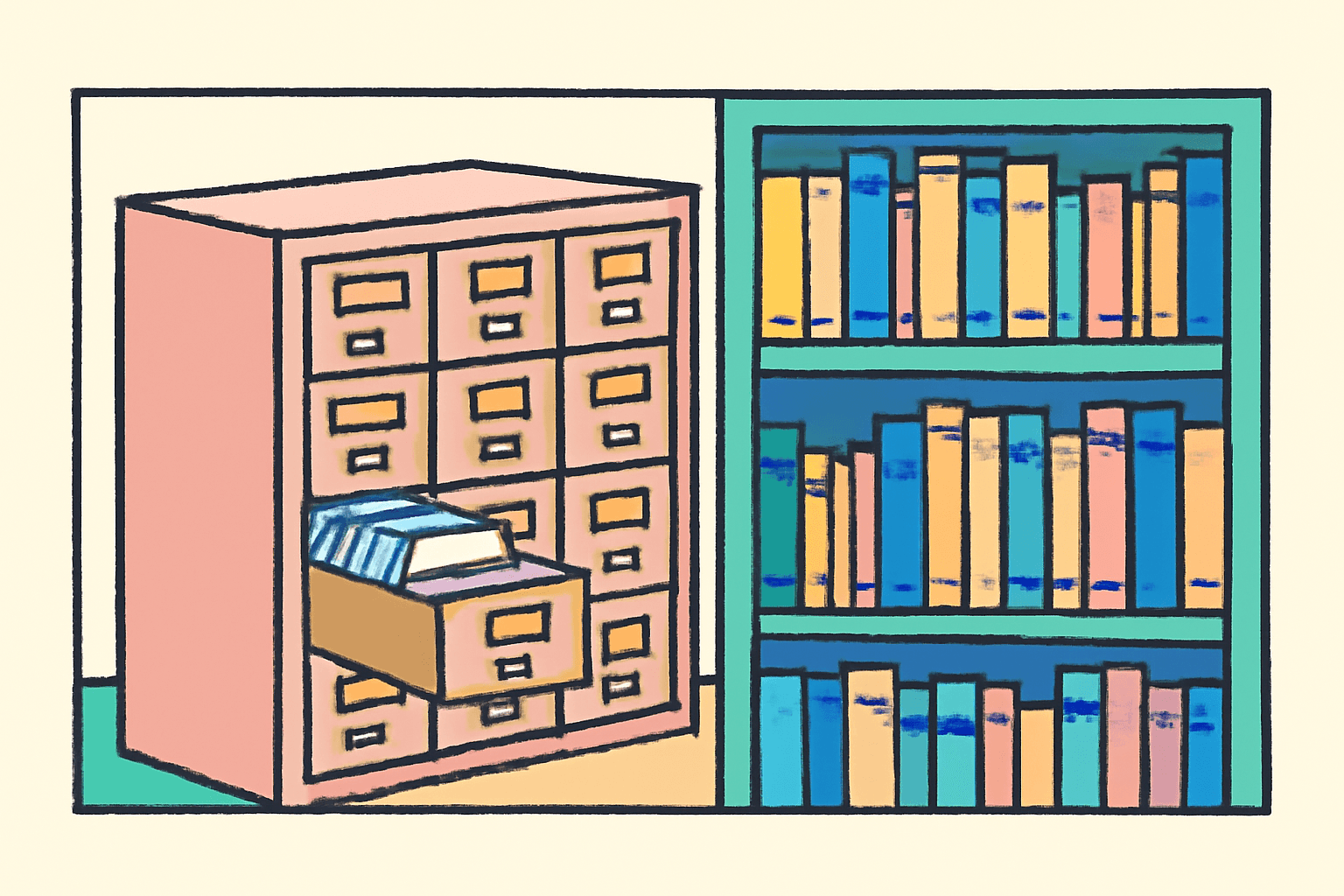
Before you got to the stamp, though, you had to find the book. And finding the book meant the card catalogue, which was a piece of furniture that looked like it belonged in a law office - a wooden cabinet with dozens of tiny drawers, each one labeled with a range of letters in that old-fashioned brass frame. You pulled a drawer out and it was packed tight with index cards, each one typed on an actual typewriter, each one containing a title, an author, a subject heading, and a call number that looked like a math problem.
The Dewey Decimal System. 500s for science. 700s for arts. 800s for literature. 900s for history. The numbers were supposed to make everything logical and findable, like a map of all human knowledge organized into tidy neighborhoods. In theory, if you understood Dewey, you could find anything.
There were kids who understood Dewey and kids who wandered. The wanderers found better books.
In practice, there were two kinds of kids. There were the kids who actually used the card catalogue - who looked up their subject, wrote the call number on a scrap of paper with one of those tiny golf pencils the library kept in a cup by the door, and walked directly to the right shelf. These kids turned in their assignments early. These kids had neat handwriting. These kids grew up to have functioning filing systems in their homes and I both admire and do not understand them.
Then there were the rest of us. The wanderers. We'd head in the general direction of the right section and then just... browse. Pull something off the shelf because the spine looked interesting. Open a book about volcanoes when we were supposed to be researching the Constitutional Convention. End up in the 600s reading about how bridges are built when our report was on Abraham Lincoln. The wanderers didn't use Dewey. Dewey was a suggestion.
The Sections
Every kid had a section. You might not have known the number, but you knew the shelf. You knew exactly where to go when the teacher said "free reading time" and you had twenty minutes to grab something.
- 398.2 - Fairy tales and folklore (the myths and legends shelf was always picked over)
- 500s - Animals, animals, animals. Especially sharks, wolves, and any book with a snake on the cover.
- 567.9 - Dinosaurs. Its own gravity well.
- 629.1 - Airplanes and space stuff. The boys who read these became either pilots or IT guys.
- 741.5 - Where the comic strip and cartooning books lived. A sacred corner.
- 790s - Sports. Always a line. Always someone hogging the basketball book.
- 031 - The Guinness Book of World Records. Technically reference, practically unobtainable.
The 500s were the great equalizer. Everyone spent time in the 500s at some point because the 500s had animals, and animals were the universal elementary school currency. You could get the quietest kid in class to light up by handing them a book about sharks. The DK Eyewitness books lived here - those oversized hardcovers with the white covers and the single photograph on front - and they were pristine works of art. A cross-section of a beehive. A close-up of a tarantula's face. Pages so glossy they reflected the fluorescent lights.
The 790s were a warzone. The sports books were always checked out, fought over, hoarded. There were maybe four books about basketball in the entire library, and twenty kids who wanted them at any given time. You'd check the shelf on library day like you were checking lottery numbers, already knowing they wouldn't be there but hoping anyway.
And the Guinness Book of World Records. That book was a phantom. Everyone wanted it. Nobody ever had it when you looked. It lived in a state of perpetual checkout, passed from kid to kid through some underground economy that operated outside the normal library system. If you actually got your hands on it, you didn't read it so much as hold court with it - other kids gathering around your desk at silent reading time to look at the guy with the longest fingernails or the woman with the most tattoos.
Library Day
Library day was every Wednesday, and it was the best day of the week. Better than Friday, because Friday you just went home. Wednesday you went to the library.
You lined up single file in the hallway. You walked quietly, or at least quieter than usual, because the library had rules and the rules started before you got through the door. The hallway leading to the library always smelled different from the rest of the school - less like floor wax and more like old paper and that specific binding glue that I've never smelled anywhere else in my adult life. Library paste. Not quite vanilla, not quite chemical. Something in between that my brain still files under safe.
The library was the one room in school where you got to choose. Not your desk, not your partner, not your assignment. You chose the book. That was everything.
Mrs. Dietrich - or whoever your Mrs. Dietrich was, because every school had one - stood at the front and gave the same speech every week. Return your books to the cart. Browse quietly. You may check out two books. Two. Not three. Tyler, that means you. She knew every kid by name and she knew what every kid was reading, and if you brought back a book she thought was too easy for you she'd say so. Not mean. Just honest. "You can do better than that," she'd say, and steer you toward something with more pages and fewer pictures, and you'd resist until you didn't.
The librarian was a gatekeeper in the truest sense. She decided what was on the shelves. She decided what got displayed face-out on the rotating rack by the door - the prime real estate, the books that caught your eye before you even started browsing. She ran the book fair. She controlled the AV cart. She knew things about every subject because people had been asking her questions for thirty years and she'd looked up every single answer.
The Stamp
There's something I keep thinking about with those due date cards. Every stamp was a record of someone else's curiosity. You'd open the back of a book and see twelve dates spanning three years, and each one represented a kid who wanted to know the same thing you wanted to know. A book about space with a full card meant dozens of kids had looked up at the sky and thought I need to know more about that. A book with two stamps meant you'd found something almost no one else had found, and that felt like its own kind of treasure.
The card catalogues are gone now, mostly. Replaced by computer terminals and then by the internet and then by the vague sense that you can just Google anything so why would you need a building full of books. The due date cards are gone too - replaced by barcode scanners that beep instead of stamp. Faster. Cleaner. No crooked purple ink.
My daughter's school has a library. She goes every week, which I'm glad about. They scan the books with a little gun and the return date prints on a receipt like she's buying groceries. She doesn't know what a card catalogue is. She's never written a call number on a scrap of paper or wandered the stacks hoping to stumble on something good.
I don't tell her she's missing anything. Maybe she's not. She can find any fact in three seconds on a screen, which is a kind of magic Mrs. Dietrich would have respected.
But she'll never open the back of a book and see all those dates. All those kids, all those years, all reaching for the same thing on the same shelf. She'll never know she wasn't the first one to wonder, and she'll never get to feel how good that was - knowing someone had been there before you, and left the book behind for you to find.