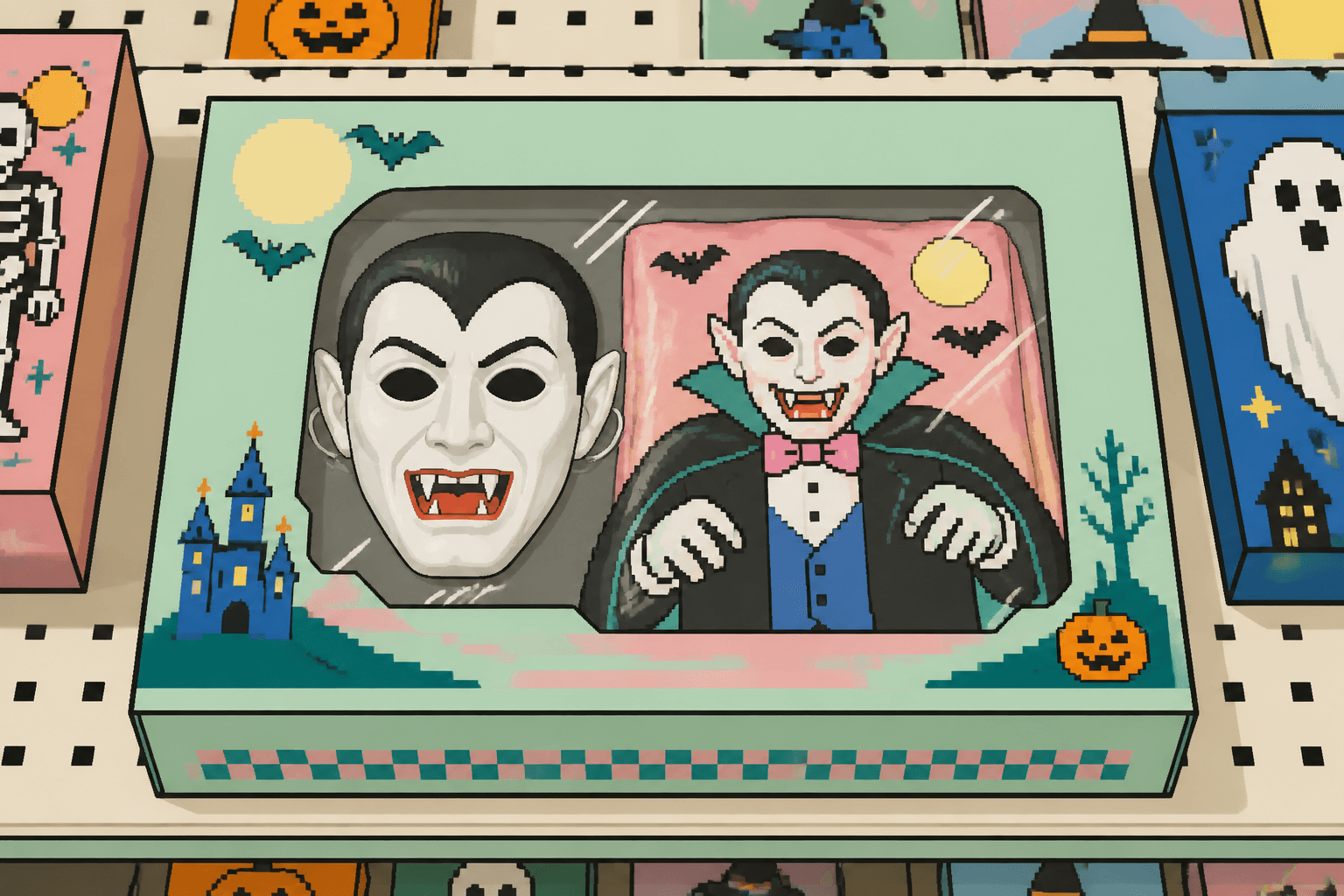
The box was on an endcap at the CVS, or the Caldor, or the Kmart, or wherever your mom was willing to drive on a Tuesday after dinner in the second week of October. It was a flat rectangle of brown cardboard, about the size of a piece of notebook paper, with a clear plastic window across the front. Through the window you could see the mask. The mask was face-down, pressed against the cellophane, looking at you with its tiny slit eyes already closed.
Below the mask, folded once, was the smock. The smock had the character's face printed on the chest. And below the face, in case there was any confusion, the character's name. In a font.
You were going to be a vampire because the box said VAMPIRE.
The Box
You need to understand the box. The box was the entire pitch. The box did all the marketing the toy company was going to do that year. There was no commercial. There was no jingle. There was just a stack of these things on a metal peg-and-shelf display unit, four costumes wide, eight high, all shrink-wrapped and slightly askew because kids had been touching them since September.
You went up to the display and you looked at the choices. The choices were not great. There was the vampire. There was the witch. There was the ghost, which was somehow the worst one because they couldn't print a face on the ghost, so the mask was just a white oval with two black holes and a frown. There was the current cartoon turtle in a green domino mask which was almost certainly not licensed, judging by the slightly wrong shade of green. There was the masked hero with the chest emblem that was sort of a spider but also sort of not.
The choices were not great. There was the vampire. There was the witch. There was the ghost, which was somehow the worst one because they couldn't print a face on the ghost.
The box was the decision tree. You took one off the peg, you turned it over to look at the back - the back had nothing on it, just a black-and-white photo of a different kid in the same costume making finger-guns at the camera - and you handed it to your mom. She read the price sticker. She put it in the cart. The negotiation took six seconds.
The Aisle
This is, more or less, where you were. Five boxes in a row, none of them quite the character you wanted, all of them about to be your face for an entire evening.
Pick one. Put it on. Look out through the slits.
The Mask
The mask was a piece of injection-molded plastic about a millimeter thick. It was flat. It was not shaped like a face. It was shaped like a picture of a face, in the way a stop sign is shaped like a picture of a sign. The features were painted on with two or three colors of cheap acrylic that would chip off if you rubbed them with your thumb, which you would do, before you'd even left the driveway.
The eye holes were not eye holes. They were slits. Two horizontal slots, each about the width of a piece of dry spaghetti, located approximately where the mask's painted eyes were, which was approximately, but not precisely, where your eyes were. The slits were not large enough to see out of. You looked through them at a world that had been cropped to a letterbox aspect ratio with a peripheral vision of zero.
The nose hole was a hole. Singular. One nostril, on a face that had two painted nostrils. The mouth was a slit too, although on some masks there was a row of tiny pinholes instead, because someone at the factory had thought about ventilation for a moment and then moved on.
The eye holes were not eye holes. They were slits. Two horizontal slots, each about the width of a piece of dry spaghetti.
The whole thing was held to your head by a thin elastic band stapled to either side of the mask. One staple per side. Sometimes two if the factory was feeling generous. The staple went through the elastic, through the plastic, and bent over on the inside. The metal end of the staple pressed into your temple. By the third house you had a faint matching pair of indentations on either side of your skull.
The Smock
The smock was, technically, the costume. The mask was the lead, but the smock was the body of the thing. It was a sheet of vinyl - thin enough to be transparent in places - cut roughly in the shape of a tunic. It went over your head and tied at the neck with a piece of fishing line.
On the front of the smock was a picture of the character. Not an abstract representation. Not a costume element. A literal printed picture of the character's face. So you, the kid, were wearing a hard plastic mask of Dracula, and beneath the mask, on your chest, also Dracula, in case anyone got confused about which one of you was the costume.
Below the picture, the name. VAMPIRE. Or WITCH. Or, in the case of the suspiciously-not-quite-Spider-Man costume, MASKED HERO, in a typeface that nobody had cleared.
- Crinkling. Constantly. Every step you took produced a sound like someone gently squeezing a Capri Sun pouch.
- Riding up. The fishing-line neck closure had no opinion about the rest of the garment, and the smock would slowly creep north over the course of the night.
- Tearing. The vinyl was about the structural integrity of a sandwich bag. The tear usually started under one armpit.
- Not keeping you warm. It was October. You were wearing what amounted to a printed plastic poncho over a long-sleeve t-shirt. Your mom made you wear a coat. The coat covered the picture. The picture was the whole costume.
The coat over the smock was the part nobody planned for. You'd see kids in winter coats with one corner of a printed vinyl tunic peeking out from the bottom hem and a hard plastic Dracula face on top, and you would know. You would say oh, Dracula. The system, somehow, worked.
The Smell
I have to talk about the smell. The smell was a molecule. You opened the box on October 1st and the molecule was waiting for you. It was the smell of new vinyl plus printed acrylic plus the off-gassing of a substance that had been sealed in cellophane in a warehouse in Guangzhou and shipped via container vessel to a distribution center in New Jersey and then to your local pharmacy, where it had been on the shelf next to a display of room deodorizers for three weeks.
It was sweet. It was chemical. It was vaguely, distantly, the smell of a new car, if the new car had been built entirely out of shower curtains. It got into the plastic in a way that suggested it would still be there in forty years, and forty years later, when you found the mask in a box in your parents' attic, you would smell it and you would be eight again, briefly, before the headache started.
The Inside of the Mask
By the second block, the inside of the mask was wet.
This was unavoidable. You were breathing. Your breath was warm and contained water vapor. The water vapor was hitting the cold plastic on the inside of the mask and condensing. There was no airflow. There was no vent. There was a single nostril hole and a row of pinholes at the mouth that did approximately nothing.
The condensation pooled in two places. It pooled at the bottom of the mask, where it formed a tiny puddle along the lower lip. And it pooled across the inside of the eye slits, where it slowly, definitively, fogged out your vision.
You could see your front yard when you started. By the time you got to the corner, you could see a blur. By the time you got to the first house, you could only see the porch light, and then only as a glow, and then only when you tilted your head up at the right angle.
So you peeked. You lifted the bottom of the mask and let cold air in. The condensation cleared. You could see again. And then within forty seconds it was back, and you were peeking again, and after a while you just walked the rest of the way to the door with the mask balanced on top of your head like a hat, because the staple was about to give up on the elastic anyway, and the smock was the part that said who you were.
You walked the rest of the way to the door with the mask balanced on top of your head like a hat, because the staple was about to give up on the elastic anyway, and the smock was the part that said who you were.
The Hand Wave
Here is something I have not heard anyone else say. The drugstore costume was, in its way, honest about what a costume is.
Most costumes are pretending. They're trying. They want to be the thing. They want the kid to disappear into Batman, and for the costume's job to be the seamless illusion of Batman. The drugstore costume did not do this. The drugstore costume was a plastic mask of Batman, plus a vinyl bib that had a picture of Batman on it, plus the word BATMAN in big letters underneath the picture. There were three separate Batmans on you at once.
It was a costume that pointed at itself. The kid was the kid. The picture was the picture. The label was the label. The costume said here are some signs. Assemble them. Conclude that I am Batman. And you nodded, because you were a kid, and signs were enough.
I think we lost something when we got good at this. When the costumes got latex and the masks got airbrushed and the smocks turned into actual fabric jumpsuits with actual seams, we stopped having to play along. The illusion did the work. The kid was a spectator. With the drugstore costume, the kid was a collaborator. The kid had to look out through the slits and act like Dracula, because the costume couldn't act like Dracula on its own.
The Class Photo
Every elementary school I have ever heard of, in the late 80s and 90s, did the Halloween parade. The kids walked single-file down the hallway to the gym, in costume, while parents stood along the walls taking pictures. Roughly a third of the kids were in drugstore costumes. The rest were in homemade costumes - a bedsheet ghost, a hobo with a bindle, a princess in last year's flower-girl dress. The drugstore kids were recognizable. The smock said who they were. The hard plastic mask reflected the gym lights.
In the class photos, the drugstore kids are the easiest to identify. You can still see, twenty-five years later, exactly who they were trying to be. TURTLE WARRIOR. VAMPIRE. WITCH. The kid in the bedsheet ghost is now a 38-year-old you can't quite place. The kid in the plastic Dracula mask is forever Dracula, in the photo, in your memory, in the box of school papers your mom kept.
What Was in the Pillowcase
You came home with the pillowcase about half-full. The mask was already off, tossed somewhere - in the front seat of the car, or onto the kitchen table, or balanced on the post of the staircase. The smock had a tear in the side and a piece of candy stuck to the inside near the hem. The elastic was off the mask completely; the staple had given up around house seventeen. Your mom said take that off before bed, meaning the smock, and you did, and you left it in a small crinkly pile by the back door.
In the morning the mask had a single eye-slit pointed at the ceiling and the other one looking sideways at the dishwasher. You could see your own breath had left a fine white residue on the inside, like a lake had evaporated. The smock smelled, faintly, of corn syrup and printed vinyl. Your mom would throw it away on November 3rd, after she was sure you didn't want it anymore. You wouldn't want it. You would also, for a long time afterwards, remember exactly what it had said across the chest.
You were the vampire, the box was clear about it, the picture matched, the name was right there. Nobody had any questions.