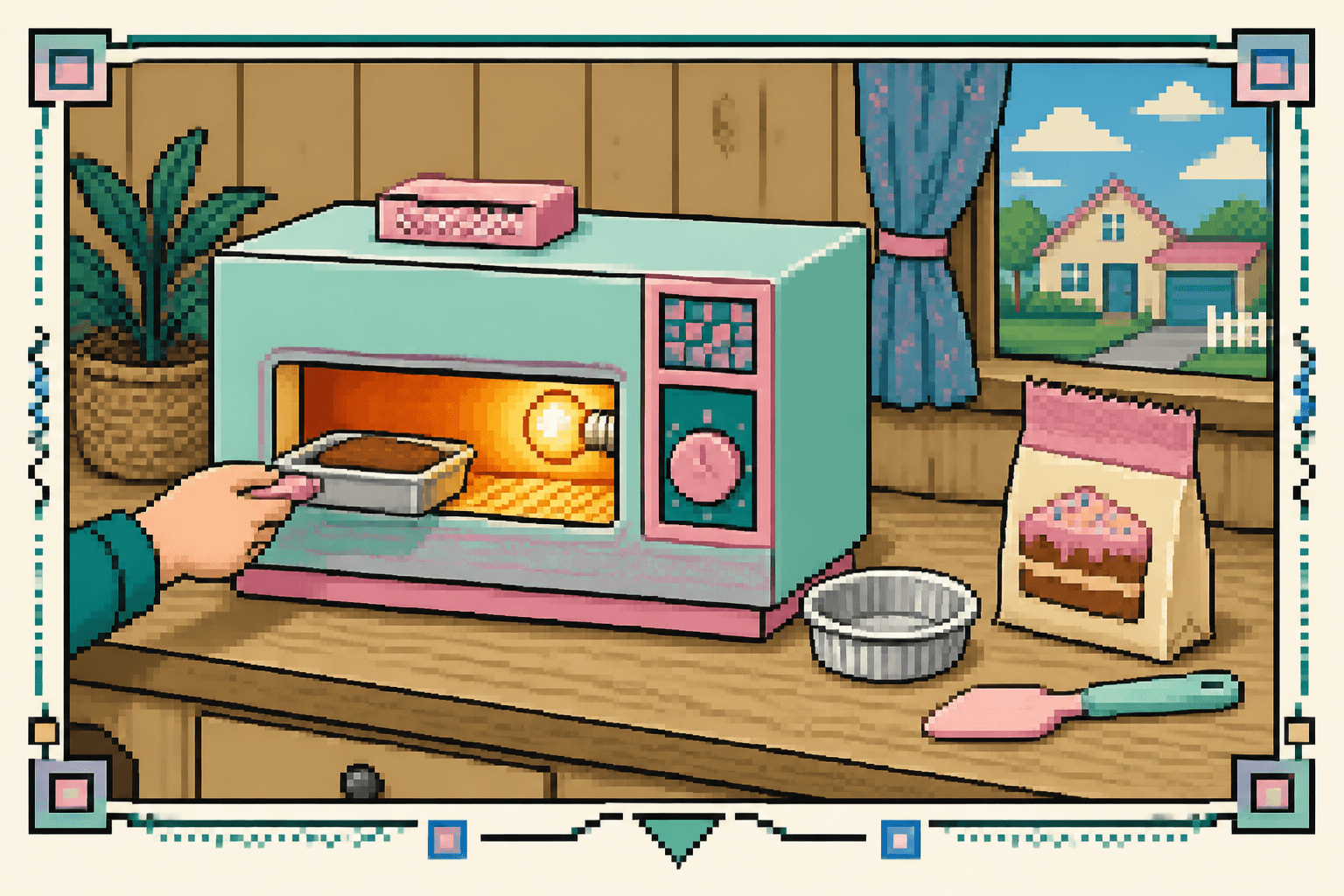
The oven was pink. The oven was pink and turquoise and about the size of a shoe box, and it sat on the kitchen counter the way a kid's foot sat in a grown-up's shoe, which is to say it was there, but nobody was going to pretend it belonged.
There was a slot in the front. There was a dial on top that did not actually do anything, because the oven had one setting, which was on. There was a plastic warming tray on the side that was always slightly warm to the touch and that nobody could explain the purpose of. And there was, behind a thin pink shell of injection-molded ABS plastic, a 100-watt incandescent bulb.
The bulb was the oven.
The Bulb Was the Oven
This is the thing I did not understand until I was thirty.
The Easy-Bake Oven, from 1963 until roughly 2011, did not contain a heating element. It did not contain a coil. It did not contain an induction plate, a convection fan, a thermostat, or a timer. It contained a lightbulb. A regular incandescent lightbulb. The kind that screwed into a lamp in the living room. The kind that got hot enough, incidentally, to bake a cake, if the cake was tiny and the bake chamber was small and the kid was patient.
This was legal, and this was marketed, and this was sold to children, because of a happy fact about the physics of a tungsten filament: a 100-watt incandescent bulb runs at a surface temperature of about 500 degrees Fahrenheit, and the air immediately around it, in a small enclosed cavity, settles at around 350. 350 is cake temperature. The bulb was, through no plan of its own, a baking appliance.
Kenner, which made the Easy-Bake, figured this out. They built the plastic shell around it. They put a slot in the front for the pan. They put a dial on top that was decorative. They printed a diagram on the box of a smiling girl in a 60s dress holding a tray of cupcakes. They did not, until much later, put a safety sticker on the back that said contains a lightbulb. They did not need to. The lightbulb was the entire oven.
Kenner realized that a lightbulb, in a small enclosed cavity, is a 350-degree oven. The rest of the Easy-Bake was packaging around a fact of physics.
The Mix
The mix came in a tiny pouch.
The pouch was foil on the inside and paper on the outside, and the paper had a cartoon drawing of a cake on it, and the pouch contained about three tablespoons of a powder that was mostly cake mix and partly a mystery. The mix was sold by Kenner, in a box, in the toy aisle, next to the oven itself. One box had six pouches. Six cakes. One pouch per cake. The pouches cost roughly a dollar each in 1994 money, which is to say the ongoing cost of operating an Easy-Bake Oven was higher, per calorie, than almost any food item in the pantry, and it was understood that this was not food. It was the idea of food, delivered in a pouch, aimed at a child.
The pouch said: add 2 teaspoons of water. Stir until smooth. Pour into pan.
The pan was a tiny rectangle of silver foil the size of a credit card, slightly deeper, with sides you could bend by looking at them wrong. You poured the pouch into a plastic mixing cup. You added two teaspoons of water, which the pouch had thought carefully about and which the box lid had printed a measurement line for in case you did not have a measuring spoon that small. You stirred with a tiny plastic spatula that came in the box and that always looked slightly dirty even when it was clean, because it was pink, and pink plastic always looks slightly dirty.
The batter was, by weight, about seventy percent sugar.
- Yellow Cake Mix. The default. Pale, slightly chemical, never set in the middle.
- Chocolate Cake Mix. Hid structural flaws the way a dark shirt hides stains.
- Strawberry Cake Mix. Pink. Tasted like a Pop-Tart.
- Vanilla Frosting Mix. A separate pouch. White powder. Add water. Smear.
- Chocolate Chip Cookie Mix. Came out hard regardless of time. Beloved anyway.
- Pizza Mix. Yes, there was a pizza mix. No, I don't want to talk about it.
- The cup. Scratched. Pink. Lived in the oven's accessory drawer forever.
- The spatula. Pink. Always looked slightly dirty. See above.
The Push
You pushed the pan into the slot with the push rod.
The push rod was a plastic stick with a cup at one end that fit the pan. You placed the pan on the push rod. You slid the push rod into the slot on the front of the oven. The pan traveled through a short tunnel in the back of the plastic shell and emerged in the baking chamber, where it sat on a thin metal rail two inches below the bulb, which was glowing orange, because the oven had been on for the three minutes the box recommended as a preheat.
You could not see the pan.
This was the entire mystery of the Easy-Bake. There was no window. The baking chamber was dark except for the warm orange glow of the bulb. You pushed the pan in. You pulled the rod out. The pan was now somewhere in there, under a lightbulb, becoming a cake. You could not watch it rise. You could not see it brown. You could not confirm, with your eyes, that anything was happening. You had to trust that the box had told you the truth, which was that twelve minutes was enough.
The clock on the microwave said 3:17. You added twelve minutes. You watched Full House. You did not actually watch Full House. You watched the microwave clock. You watched the pink oven, which did not have a window.
At 3:29 you pushed the push rod into the back slot of the oven. The pan came out the front. You pulled it out onto the counter. You touched the pan with your finger. The pan was hot. The pan was extremely hot, actually, because an aluminum foil rectangle that has been under a 100-watt bulb for twelve minutes is 350 degrees Fahrenheit regardless of what toy aisle it came from. Your finger learned this. Your finger remembered this for about six seconds. Then your finger did it again anyway.
There was no window. You could not watch the cake. The entire experience was: push a pan into a dark hole, wait, trust, pull.
Try It
Push the pan in. Wait, or don't. The bulb will do what it does. The cake will be what the clock makes it.
The Cake
The cake came out of the pan in a specific way.
The top was set. The top had a slight dome and a small crack that showed, in cross-section, that there had been some rising, and the rising had split the top the way the top of a pound cake splits in a real oven. The sides were brown, the real brown of a thing that has been genuinely baked, which was the surprise, because you had not fully believed, going in, that a lightbulb was going to make a brown edge on anything.
The middle was batter.
Not every time. Sometimes it was a cake. Sometimes it was a cake with a small raw spot in the exact geometric center, which was the farthest point from any wall of the pan and therefore the hardest to cook. Sometimes it was mostly batter with a crust on top, which was what happened when you pulled it at eight minutes instead of twelve. Sometimes it was a hockey puck, which was what happened when you forgot about it during Full House and remembered during Family Matters. The oven did not warn you. The oven had no timer. The oven had a bulb and the bulb did not know what time it was.
You ate it anyway. You ate the top of it, and the sides of it, and sometimes the middle if the middle had turned into something, and you ate it with a plastic fork, and it was warm, and it was something you had made, and it was approximately a cake. You smeared vanilla frosting on it. The frosting was reconstituted powder and water and it tasted like the memory of frosting. You ate that too.
- Raw middle. You pulled it at eight minutes because you were impatient. The outside was done. The inside was goo. You ate the outside and left the goo.
- Hockey puck. You forgot it was in there. Twenty-five minutes later it came out as a dense brown disc. The frosting slid off.
- Burnt finger. The pan was hot, every time, and you touched it, every time, and you were surprised, every time.
- Spilled batter. You poured the mix wrong and some of it went on the rail inside the oven, where it would stay, carbonizing, for the next six years.
- Pan jam. The pan did not come out when pushed. You panicked. Your mom came in with a chopstick.
- The oven just not turning on. The bulb had burned out. Your parents did not have a spare 100-watt. The Easy-Bake was off the air for a week.
The Argument
The Easy-Bake Oven was, by any serious measure, a stupid toy.
The oven did not teach you to bake. The thing a real oven does, which is to produce a predictable temperature across a defined volume for a knowable amount of time with feedback mechanisms you can observe, was precisely the thing the Easy-Bake did not do. The Easy-Bake produced an approximately 350-degree volume in an invisible chamber for a vague amount of time with no feedback mechanism at all. The cake was done when the box said it should be done, and the box was often wrong, and you learned nothing about the chemistry of batter, the role of leavening, the Maillard reaction, the behavior of starch under heat, or anything else a real baker learns. You learned that a bulb got hot, and that cake was good, and that your finger was dumb.
And yet.
The Easy-Bake Oven did teach you one real thing, which was that an input produced an output, and the output was something you could eat. You added mix. You added water. You stirred. You put the thing in the box. You waited. You pulled it out. The thing you ate at the end was a direct consequence of the thing you had done at the beginning, in a way almost nothing else in a child's life was. You could not make a sandwich without help. You could not use the stove. You could not use the microwave for anything more involved than reheating pizza. The Easy-Bake was the first thing in the kitchen that was fully yours, from the pouch to the pan to the plate.
The lightbulb was a cheat. The lightbulb was Kenner finding a way to put a baking appliance in a child's bedroom under the toy aisle budget, which was about $25, which did not pay for an actual heating element. The lightbulb was a loophole, and the loophole was that a 100-watt bulb in a small cavity was already, by physics, an oven, and you did not have to engineer anything to make it work. You just had to put a slot in the front and some pink around the sides.
I think about this, actually, more than I think about the cake.
The Easy-Bake was the first thing in the kitchen that was fully yours, from the pouch to the pan to the plate. The lightbulb was a cheat. The cheat worked.
The End
The LED happened in 2007.
Not to the Easy-Bake, exactly, but to the lightbulb. The Energy Independence and Security Act of 2007 began a phase-out of the standard 100-watt incandescent bulb, which was inefficient, which converted about ninety percent of its electrical input into heat and only about ten percent into light. For a reading lamp, this was a problem. For an Easy-Bake Oven, this was the entire point. The ninety percent of waste heat was the oven.
Hasbro, which had bought Kenner, saw this coming. In 2006 they released the Easy-Bake Ultimate Oven, which used an actual heating element, like a real oven, in a plastic shell. It was purple. It was still a toy. The pan still went in through a slot. The cake still took twelve minutes. But the bulb was gone. The physics was intentional now, instead of a happy accident. The oven was a small oven instead of a light fixture pretending to be an oven.
The new one is a better product. The new one is also, somehow, less interesting. The cheat is gone. The thing that made the Easy-Bake a joke, which was that it was running on a lightbulb, was also the thing that made the Easy-Bake a marvel, which was that it was running on a lightbulb. The appliance in your bedroom was, structurally, a lamp. The cake you ate was, in some real sense, light. 100 watts of light had been pointed at a tablespoon of yellow powder for twelve minutes and had become a cake, and you had eaten it, and the frosting had been powder too.
I don't miss the raw middle. I don't miss the burnt finger. But I think, sometimes, about the fact that the thing I was proudest of making in 1996 was a 350-degree pile of sugar baked by a sixty-cent lamp, in a slot I could not see into, in a pink plastic shell that cost twenty-five dollars, and that this was, in some way, the entire idea of being a kid: a cheat you did not understand producing a thing you were proud of, delivered through a slot you could not see through, on a timer you did not trust.
The 100-watt bulb was banned, in general use, by the EU in 2009 and in the US in 2014. Hasbro, which owns Kenner, which bought the original design from a man named Ronald Howes in 1963, still sells the Easy-Bake Ultimate Oven, which still bakes a cake, which still comes out of a slot, which still has a middle that is sometimes raw. The old pink oven is in a thrift store in Phoenix, and the pouch of yellow mix in the drawer below it is almost certainly still shelf-stable, because sugar is forever, and the pouch is foil on the inside, and nothing in that pouch ever intended to spoil. The lightbulb is gone from the oven. The lightbulb is on, somewhere, in a lamp in a living room, pointed at a book. The cake is in a landfill. The pan, folded four times, is in the landfill next to it. The middle of the cake, which was never fully baked, is still, technically, batter.