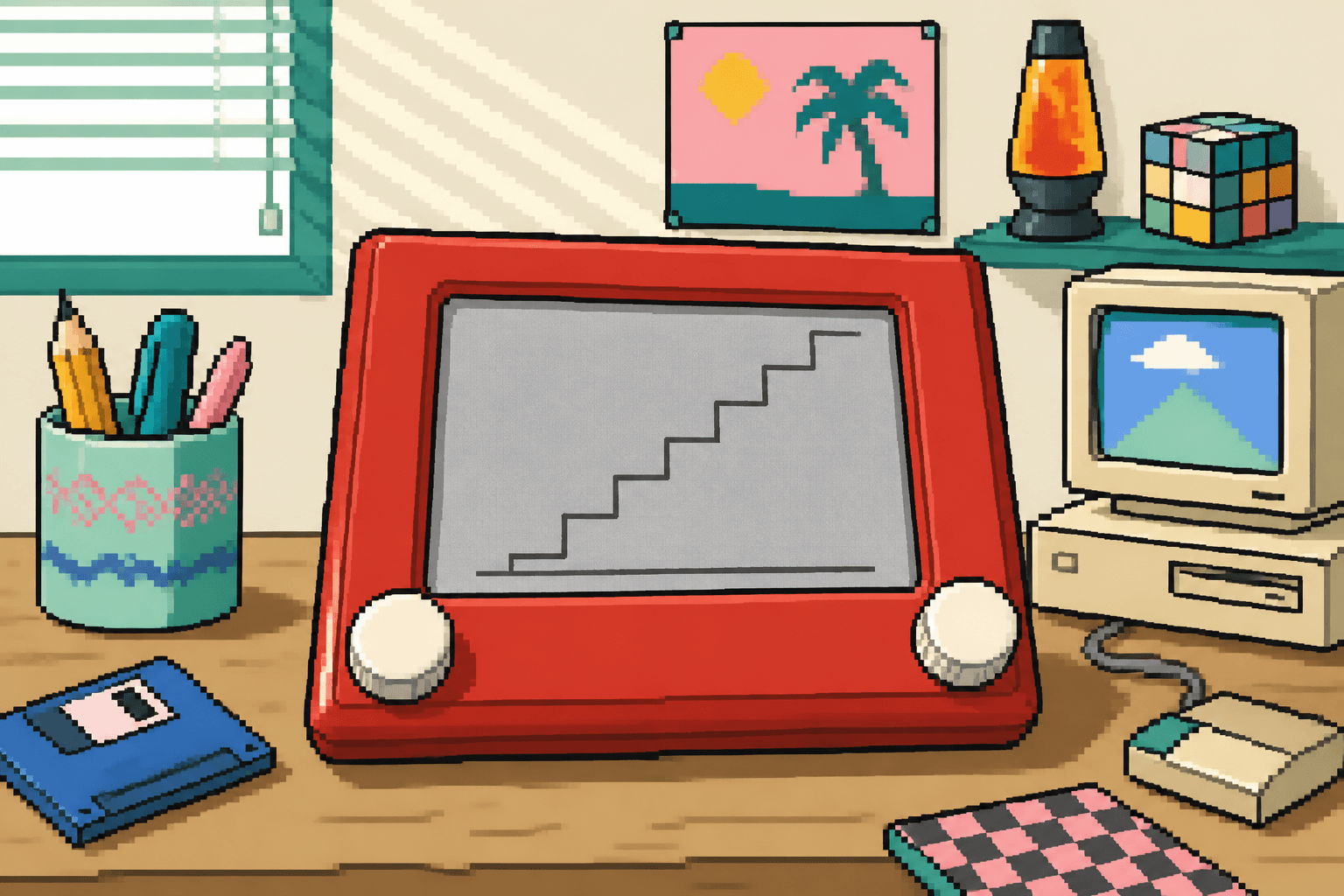
It was red. It was heavy in a way a toy had no business being heavy. The screen was gray and the knobs were white and the whole thing was the exact size of a paperback book that had eaten a second, thicker paperback book.
You picked it up. You turned the left knob. A line appeared on the screen, going left, or going right, and you couldn't remember which knob did which. You turned the other knob. The line jumped ninety degrees. You had drawn an L. You would eventually draw a staircase. Everyone drew a staircase.
The Knobs
There were two knobs and only two knobs and this was the entire problem.
The left knob moved the pen horizontally. The right knob moved the pen vertically. If you turned only the left knob, you got a horizontal line. If you turned only the right knob, you got a vertical line. If you were an adult, or a genius child, or someone whose hands could rub-your-belly-and-pat-your-head at a professional level, you could turn both knobs at the same time and produce a diagonal. You could not draw a curve. You could produce something curve-shaped by turning both knobs at slightly different rates and gradually accelerating one while decelerating the other, and if you managed this for four full seconds without one of your hands cramping up, you got a little arc, and you were, briefly, a god.
Then your thumb slipped on one knob and the line jerked and now the arc had a small vertical spike in it and you were, once again, a child.
You could not draw a curve. You could produce something curve-shaped by turning both knobs at slightly different rates. If you managed this for four full seconds you got a little arc, and you were, briefly, a god.
The Line
Here is the thing about the Etch-a-Sketch that nobody wrote on the box, because it was the whole product and they assumed you knew.
You could not lift the pen.
There was no lift-the-pen mechanism. There was no stop drawing here, resume drawing there. The pen was inside the case, held between two crossed rails, and it scraped a line across the back of the screen from wherever it currently was to wherever you drove it next, and it kept scraping, and it never stopped scraping. Every drawing you made was, by physics, one continuous line from the moment you started to the moment you shook the screen back to gray.
You could not draw two eyes. You could draw one eye, and then draw a very careful line from that eye to where the second eye would be, and then draw the second eye, and then leave the line in between there forever, because you couldn't erase just the line without erasing everything.
You could not draw a face. You could draw a suggestion of a face, or you could draw a face that included, as a permanent architectural feature, a straight thin line running from the top of the head down to the chin and then across to the bottom of the mouth and up to one of the eyes, because that was the path you had taken.
or use ← → ↑ ↓
Most kids never really internalized this. Most kids drew until they hit a wall, then shook it, then started over. The kids who did internalize it - the ones who sat down and thought about the drawing before they started, who planned the route, who did whole rooftops and houses and cursive signatures in one uninterrupted motion - were terrifying, and are now, statistically, either surgeons or the kind of adult who does a marathon they didn't tell anyone about.
The Screen
The screen was silver-gray with a slight warmth to it, and you were told, if you asked, that it was aluminum powder.
This was technically true and pleasantly weird. Behind the plastic window there was a thin fluffy layer of aluminum powder mixed with tiny plastic beads, dusted evenly across the inside of the glass. The pen inside the case wasn't a pen. It was a small stylus with a hard point that scraped a clean line through the powder, exposing the dark backing of the screen underneath. That dark backing was what you saw as your line. You were not drawing. You were removing dust in a very specific pattern.
The two knobs turned two threaded rods. The rods dragged the stylus. Horizontal rod, vertical rod, one stylus, one dark trail through the dust behind a plastic window. That was it. That was the entire mechanism. There were no electronics. There were no batteries. There was nothing to break except the plastic case itself, which, in fairness, my cousin managed to break the corner off of by throwing it at his sister in 1997, but that is not the toy's fault.
When you shook the Etch-a-Sketch - and you had to actually shake it, not just wave it around, you had to hold it face-down and jostle it so the aluminum powder would resettle - the dust redistributed itself across the inside of the screen, filling in the trail behind the stylus, and the drawing disappeared. Not gradually. Not with a satisfying fade. It just went. One minute your staircase existed. The next minute the screen was a flat silver-gray again and your staircase was inside the case, mixed with all the other staircases you had ever drawn, forever.
- Anything rectangular. Rectangles were the freebie. Left, down, right, up. Dads always drew rectangles.
- A staircase. The Etch-a-Sketch's spirit animal. Both knobs, alternating quarter-turns.
- Cursive. If you could actually do cursive, which most of us couldn't.
- A house from a single side. With the roof line built in. Never with two windows.
- Your name. In block letters. Once. With a connective slash between letters that you had to just accept.
- A city skyline. Rectangles all the way across. This was the flex.
The Shake
Every kid handled the shake differently, and it told you something about them.
There was the kid who shook it too enthusiastically, in one big motion, and half the drawing stayed on the screen because the powder had migrated but not settled, and now they had a ghostly, hollowed-out version of their drawing with a small drift of aluminum in the corner. There was the kid who shook it too gently, and the drawing wouldn't go, and they'd shake it again, and again, and then just start drawing over the old drawing, so now there was a house superimposed on the previous house, and the house was haunted. There was the kid who shook it sideways, which did nothing at all, because the powder needed gravity to work, and this was a small physics lesson delivered by a red plastic toy.
And there was the kid who lined it up perfectly, face down, three sharp deliberate shakes, and every time, the screen came up completely blank and perfectly gray, and they'd flip it back over and start again immediately. That kid grew up to run marathons.
Every drawing you made was, by physics, one continuous line from the moment you started to the moment you shook the screen back to gray.
The Dad Rectangle
Every dad drew the same thing.
You would hand the Etch-a-Sketch to your dad and say draw something, and he would take it, and he would turn the left knob, and a horizontal line would appear across the top of the screen. He would turn the right knob, and a vertical line would appear coming down. He would turn the left knob back. He would turn the right knob back. He would hand you a perfect rectangle.
You would look at the rectangle. He would look at you. He would say something like there you go or hard to draw much else on this and hand it back to you and go read the paper. That was the entire interaction. The dad rectangle was the universal male response to being handed an Etch-a-Sketch by his own child in the years 1988 through 2001, and I have interviewed no one about this and I don't need to, because I have seen it happen in three separate houses.
The dad rectangle was not a failure of imagination. The dad rectangle was a proof of concept. It was: I acknowledge this toy. I have engaged with it in good faith. I have produced the maximum output the toy is honestly capable of producing without a fifteen-minute time investment I do not have. Here is your rectangle. Please shake it.
The Argument
Every article about the Etch-a-Sketch, eventually, wants to make it be about constraints. About how the two-knob interface forced creativity, about how kids raised on Etch-a-Sketches were somehow more imaginative because they had to work within the grid, about how the modern iPad drawing app with its unlimited layers and undo history has somehow ruined something.
I want to make that argument. I sort of believe it. I'm not going to make it, because it would be dishonest, because the truth is nobody drew anything good on an Etch-a-Sketch. Nobody. Not you. Not me. Not the kid at your school who was allegedly really good at it. The people who drew good things on an Etch-a-Sketch were adults, at art shows, with hundreds of hours of practice and a specific working technique that involved turning the whole toy upside down between line segments to fake a pen lift. Those people were not kids. Those were craftsmen. What kids did on an Etch-a-Sketch was the staircase.
But something happened during the staircase.
You learned that a horizontal line was one motion and a vertical line was a different motion. You learned that if you wanted to go from one place to another on a grid, you had to plan the route. You learned that some marks were permanent - that once you had drawn a line from point A to point B, that line existed on your screen until you gave up on the whole picture, and that this was a feature, not a bug, because it meant you had to commit. You learned to look at a blank gray field and see, in advance, the path your line would need to take. You learned this at six.
I don't know if you use this skill now. But you have it. You held it for the first time in front of a red plastic toy on a beige carpet on a Saturday morning, and you couldn't lift the pen, and you couldn't undo, and you finished your staircase, and you shook the screen, and it went away.
My son is five. He has a drawing app on my old iPhone. He can undo. He can change the color of a line after he's drawn it. He can zoom in and add a detail he forgot. He can pick a pen thickness. He can pick a pen. He can pick, from a menu of six options, which of six kinds of shading he wants the shadow of his dinosaur to be.
He is having, I think, a great time. His drawings are better than mine were at five, technically. They have color. They have layers. They have small dogs standing in front of larger dogs.
I bought an Etch-a-Sketch off eBay last year. The screen was scratched and one of the knobs was a little loose and it made a faint gritty sound when you turned it, because the aluminum powder inside was thirty years old and had probably clumped in places it shouldn't. I gave it to my son. I said draw something. I did not tell him about the rules.
He turned the left knob. A line appeared. He turned it more. The line got longer. He tried to turn it back, expecting the line to disappear, the way undo worked on the app, and it did not disappear. He turned the right knob. The line jumped ninety degrees. He looked at me.
How do I fix it, he said.
I said, you don't. You just keep going.
He kept going. He drew a very long, very confused shape that was mostly right angles and one accidental diagonal where his hands did something interesting. It looked like the outline of a city, or a keyboard, or possibly a very stressed dog. He wanted to erase the accidental diagonal. He couldn't. He looked at it for a long time, and then he decided the diagonal was a hill, and he drew a sun over the hill, and the sun was a square because a square was the only sun the Etch-a-Sketch would let him have.
He held it up. He said I drew this.
I said, yeah, you did.
Then I showed him how to shake it, and the picture went away, and he did not cry, which surprised me. He said again and started over. He drew a rectangle. Then he drew a rectangle inside the rectangle. Then he drew a staircase inside the second rectangle. Then he tried to draw a curve, and it did not work, and he stopped trying, and he drew another staircase.
I don't know what he learned. I don't know if there was a lesson. I don't know if he'll remember any of it, or if the Etch-a-Sketch will end up in a closet the way mine did, forgotten between a Battleship game and a broken flashlight, until somebody moves.
But he shook it clean and started again, without complaining, three separate times in one afternoon.
That was more than I expected.