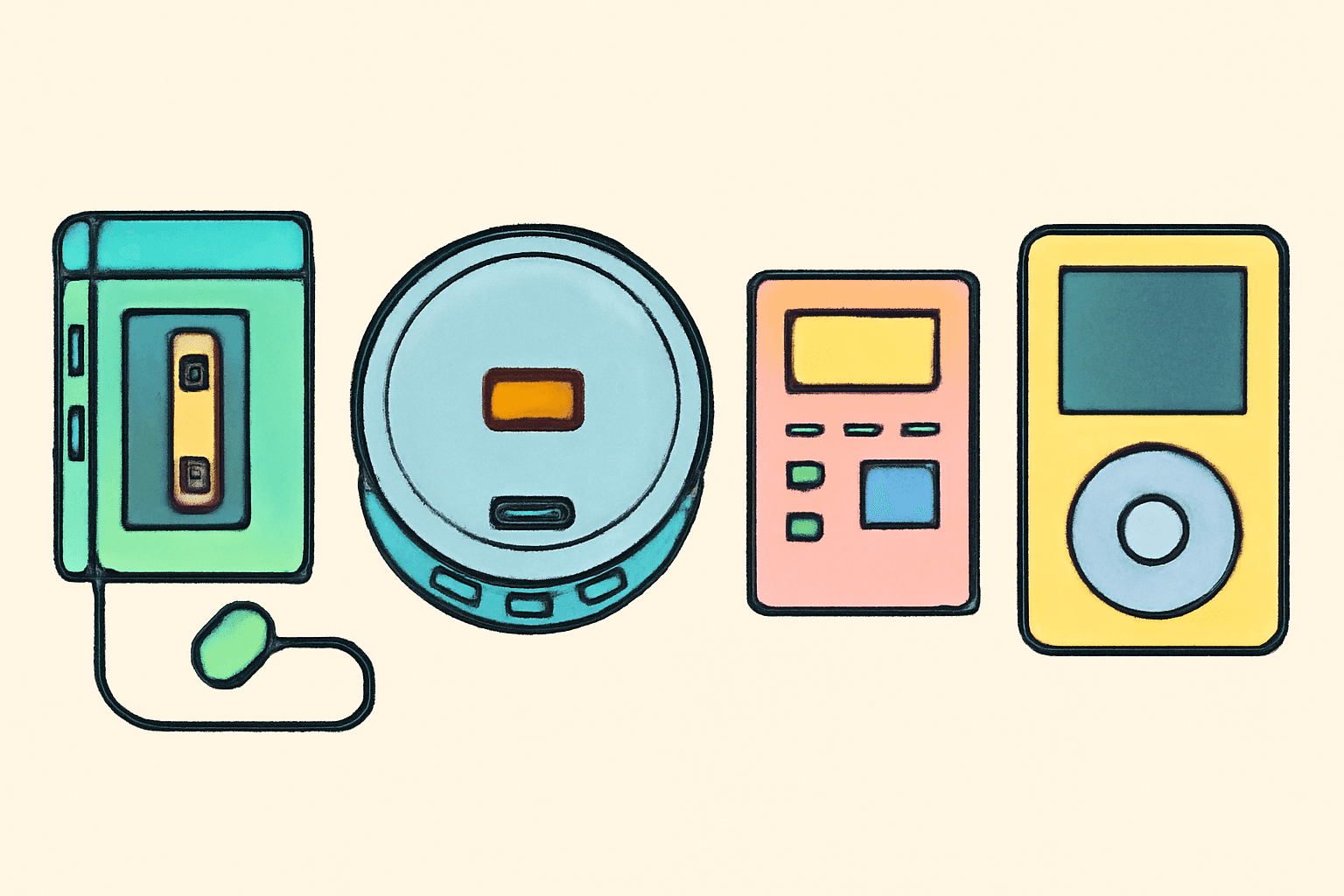
The foam was disintegrating.
You could see it happening in real time - little orange-brown flakes crumbling off the headphone pads every time you put them on, sticking to your ears, getting in your hair, leaving a fine dust on whatever surface you set them down on. The headphones came with your Sony Walkman and they were falling apart after six months of daily use, and you didn't care. You wore them anyway. You wore them on the bus. You wore them walking to your friend's house. You wore them mowing the lawn, the foam slowly composting against the sides of your head, because the alternative was silence, and silence was unacceptable.
This is the story of how we carried music. All the ways we tried. The ones that worked, the ones that didn't, and the ones that were so deeply weird that you forgot they existed until just now.
The Walkman Era
The Sony Walkman was perfect. I need to say that up front. It was the size of a cassette tape plus a little bit extra, it ran on one AA battery, and it clipped to your belt with a confidence that said I am a person who goes places and brings music with me. The belt clip was load-bearing fashion. It meant something.
You pressed play and the little window showed the tape reels spinning and there was something hypnotic about that. Mechanical. Real. You could see the music happening. And the sound was warm and slightly hissy and the bass was never quite right, but it didn't matter because you were walking down the street with your own personal soundtrack and that was a kind of magic that's hard to explain to someone who's had Spotify since they were nine.
The belt clip was load-bearing fashion. It meant something.
The only problem was the tape itself. Tapes wore out. They got eaten by the mechanism - that sickening moment when you'd press play and hear a grinding crunch and pull the tape out to find six inches of brown ribbon bunched up and wrinkled like an accordion. You'd stick a pencil in the reel and carefully wind it back, holding your breath, trying not to crease it further. Sometimes you saved the tape. Sometimes you didn't. Either way, "In Utero" never sounded the same after the surgery.
The Discman and the Skip Problem
Then came the Discman, and with it, the greatest lie the consumer electronics industry ever told: that you could listen to CDs while moving.
You could not.
You could listen to CDs while sitting perfectly still on a couch. You could listen to CDs while lying in bed with the player balanced on your chest like a small glass of water you were trying not to spill. But walking? Forget it. Every third step sent the laser bouncing and the music would stutter and skip and you'd sound like a broken DJ at a middle school dance. The Discman turned every sidewalk into an obstacle course. You'd walk with this careful, gliding shuffle, like you were trying not to wake a sleeping baby, and it would still skip.
- Walking at a normal pace
- Walking at a slow pace
- Being in a car that went over a bump
- Being in a car that turned
- Breathing too aggressively
- Someone closing a door in the same room
- Existing
Then Sony introduced "anti-skip protection" and everyone at Circuit City lost their minds. The technology read ahead and stored a few seconds of audio in a buffer, so when the laser got jostled, it could keep playing from memory. The little "ESP" logo on the front of the player meant Electronic Shock Protection, which sounded like something from a sci-fi movie. It helped. A little. You could now walk at a very slow pace and only get skips every thirty seconds instead of every five. Revolutionary.
The thing nobody admitted was that anti-skip never fully worked. Not really. It was better, sure. But "better" and "good" are not the same word. You'd still be on the bus, Discman balanced on your knees, and the kid behind you would kick your seat and that was it. Three seconds of silence while the buffer caught up and you sat there, frozen, waiting for Smash Mouth to come back.
The MiniDisc: Cool, Doomed, Gone
And then there was MiniDisc. Oh, MiniDisc.
If you had a MiniDisc player, you were either very cool or very confused, and sometimes both. Sony launched it in the early '90s and it was genuinely brilliant - a tiny disc in a protective cartridge, recordable, skip-resistant, with sound quality that was better than cassettes. It was the future. Everyone in Japan had one. The ads were gorgeous.
If you had a MiniDisc player, you were either very cool or very confused, and sometimes both.
The problem was that almost nobody in America had one. The players were expensive. The blank discs were expensive. Your local Sam Goody didn't sell pre-recorded MiniDiscs. You had to record everything yourself from CDs, which took real time and real effort. The MiniDisc was the Betamax of portable music - technically superior, culturally irrelevant. The few kids who had them carried this air of quiet superiority, like they knew something the rest of us didn't. They did. They knew what good portable music sounded like. They just couldn't share it with anyone because nobody else had the format.
The Weird Detours
Here's one nobody talks about: micro cassette recorders. Those little dictation machines your dad used for work, the ones with the tiny tapes the size of a matchbox. Some of us - and I'm not proud of this - tried to use them for music. You'd hold the recorder up to your boombox speaker and press record and capture the worst possible version of a song, complete with room echo and your mom yelling something about dinner from downstairs. The audio quality was unspeakable. We did it anyway because we were desperate and resourceful and didn't have $150 for a MiniDisc player.
Then came the MP3 CD player era, and honestly, this one was pretty great. By 2001 or so, you could burn 200 MP3 files onto a single CD-R and get a player from Best Buy for like forty bucks that would read them. Two hundred songs. On one disc. After years of being limited to 74 minutes on a regular CD, this felt like infinity. You'd burn a disc with your entire music collection on it - every song you'd carefully downloaded over months of dial-up - and carry it around like a treasure.
The interface was terrible, of course. A tiny LCD screen showing filenames that were truncated to about eight characters. You'd be scrolling through tracks labeled "03_TRACK" and "smashm~1" trying to find the one song you actually wanted. No album art. No search. Just a list of garbled filenames and the up/down buttons on the player. But two hundred songs! On one disc! For fifty cents! We were living in the future and the future was confusing but generous.
The Diamond Rio and the Dawn of MP3
The Diamond Rio PMP300 arrived in 1998 and it held 32 megabytes of music. Thirty-two. That was about eight songs. You paid $200 for the privilege of carrying eight songs in a device the size of a deck of cards, and you felt like a time traveler.
- Storage: 32 MB (roughly 8 songs)
- Price: $200
- Cost per song carried: $25
- How it connected to your PC: Parallel port (seriously)
- Transfer speed: Glacial
- Did you feel cool using it: Absolutely
The Rio was important not because it was good - it was barely adequate - but because it proved the concept. No moving parts. No discs. No tapes. Just files on a chip. The music industry sued the company that made it, because of course they did, and they lost, and that legal victory cracked open the door for everything that came after.
Other early MP3 players followed. The Creative Nomad. The Archos Jukebox, which was the size of a small brick and had an actual hard drive inside it that you could hear spinning. These were devices for enthusiasts, for the kind of person who read MP3 player reviews on CNET and had opinions about bitrates. Normal people were still using Discmans. Normal people were fine.
Then the iPod
And then, in October 2001, Steve Jobs stood on a stage and pulled a white rectangle out of his pocket and nothing was ever the same.
The iPod held a thousand songs. A thousand. That scroll wheel. That clean white interface. The way the earbuds were white instead of black, which seems like nothing but was actually everything, because it meant you could see someone wearing them from across the street and you knew. You knew what they had.
The iPod didn't just win the portable music war. It ended it so completely that we forgot there had been a war at all.
It took a year or two to fully take over. The first iPod was Mac-only and expensive, and plenty of people kept rocking their Discmans and MP3 CD players for a while. But by 2003, 2004, the white earbuds were everywhere. On the subway. In the mall. At school. The silhouette ads were on every billboard. And all those other devices - the Walkman, the Discman, the MiniDisc, the Rio, the Nomad - they just quietly disappeared. Not with a bang. Not with a farewell tour. They just stopped being in people's pockets.
Sometimes I think about all those foam headphone pads that crumbled away over the years. All the belt clips that held a Walkman to a pair of jeans. All the MiniDisc players sitting in junk drawers in apartments across America, still technically functional, waiting for someone to remember they exist. Every one of those devices was someone's daily companion. The thing that made the bus ride bearable. The thing that turned a walk into a movie scene.
We tried so many ways to make music move with us. Most of them barely worked. We loved them anyway.