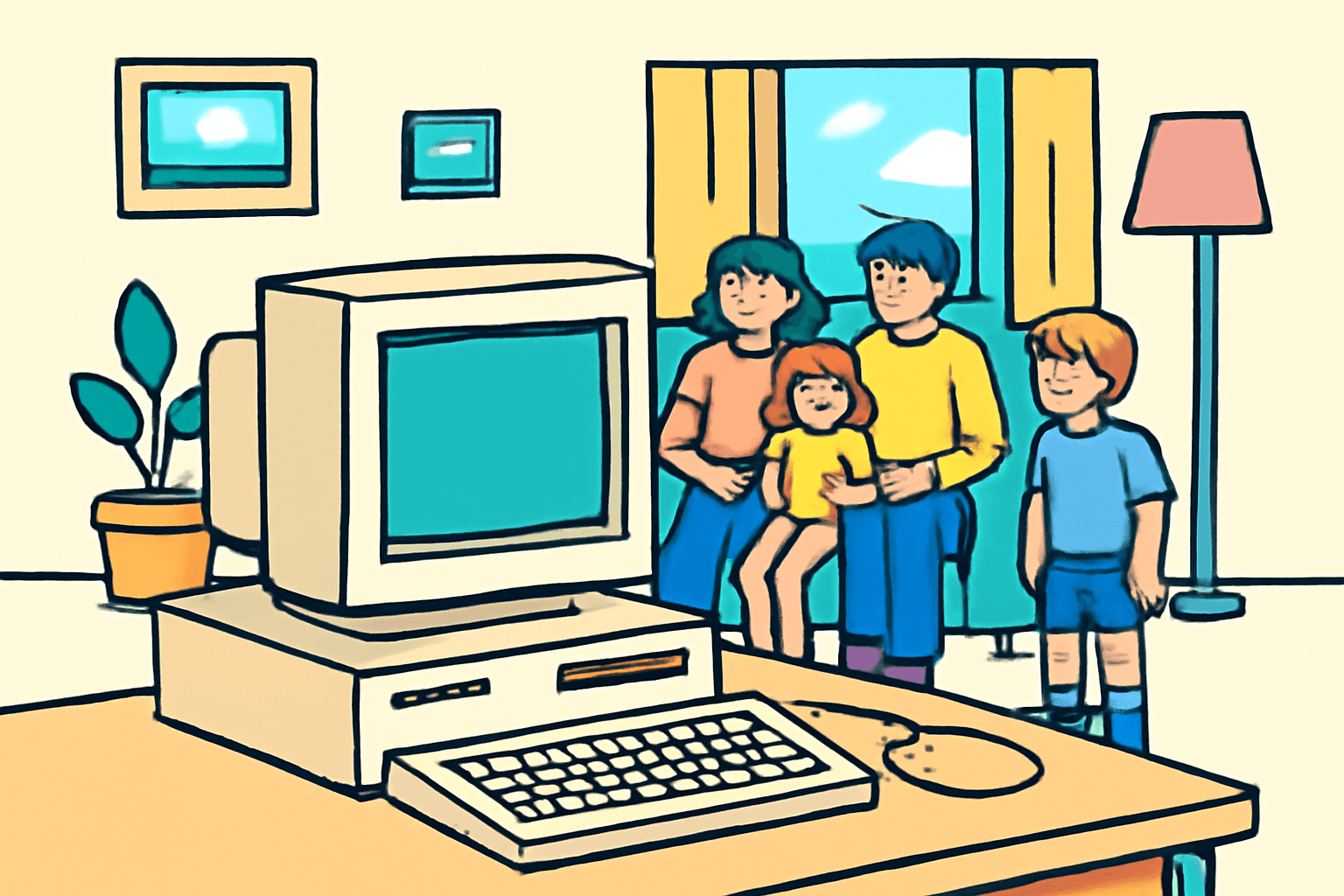
The Gateway 2000 box had cow print on it. I want you to sit with that for a second. Somebody in a boardroom in South Dakota decided that the best way to sell a personal computer was to make the packaging look like a Holstein. And it worked. My dad carried that box into the living room on a Saturday afternoon in 1997, and we gathered around it like it was a new sibling. Better than a new sibling, actually. Nobody had to share a bedroom with it.
It went right next to the TV. Of course it did. Where else would it go? The family computer lived in the family room because it was a family computer, emphasis on the first word. This was not your machine. This was not my machine. This was the machine, and it sat on a $40 computer desk from Office Depot that wobbled every time you moved the mouse.
The Desk That Held Everything
That desk. You remember it. Pressed particleboard with a fake wood grain finish. A pull-out keyboard tray that never quite slid back in all the way. A little shelf for the printer - an Epson that screamed like a fax machine every time it printed a book report. The whole thing was slightly too small for the monitor, which was roughly the size and weight of a cinder block.
And on that desktop - the Windows one, not the physical one - was everything. Dad's Quicken files. Mom's PrintShop greeting cards. Your older brother's Encarta encyclopedia. Your copy of Roller Coaster Tycoon, sitting right next to a folder called "TAXES 1998" and a shortcut to Netscape Navigator that everyone used but nobody could explain.
- At least three slightly different icons for AOL
- A PrintShop shortcut nobody remembered installing
- Encarta '98
- Dad's spreadsheets in a folder called "IMPORTANT DO NOT DELETE"
- SkiFree
- A screensaver of flying toasters
- Roughly 900 files in My Documents with names like "Document1" through "Document47"
There was no such thing as user accounts. Not really. Windows 95 had that login screen, sure, but everyone knew you could just hit Cancel and get right in. Everything was shared. Your bookmarks were next to Dad's bookmarks. Your saved games lived alongside Mom's recipe printouts in a folder structure that made sense to absolutely no one.
The Sound Everyone Heard
You could not sneak onto the internet. This is the thing kids today will never understand. Getting online was a public event.
The modem screamed. There is no other word for it. That dial-up handshake - the beeping, the static, the demonic gargling - announced to every person in the house that someone was about to use the phone line. And once you were on, the phone was dead. Your mom could not call Aunt Linda. Your dad could not check his voicemail. You were, in a very real sense, holding the entire household's telecommunications hostage so you could look at a webpage about Dragonball Z that took four minutes to load.
"Get off the internet, I need to make a call!" was a sentence yelled up stairs and down hallways in every house in America between 1996 and 2002. It was the "close the door, you're letting the heat out" of the digital age.
You could not sneak onto the internet. The modem screamed. Everyone knew.
And if someone picked up the phone while you were connected? That horrible crunch of static, and then silence, and then you were offline. Twenty minutes of waiting for a file to download on Napster - gone. Just gone. Because your sister wanted to call her friend about nothing.
The Fight for Time
Computer time was rationed like wartime butter. There was one machine and four, five, six people who all wanted to use it. You developed a sixth sense for when someone was about to finish. You'd hover in the doorway, pretending to watch TV, glancing over every thirty seconds. "Are you almost done?" became the most loaded question in the English language.
My brother and I had a system. Thirty-minute blocks. A kitchen timer sitting next to the monitor, ticking down. When it rang, you saved your game and you got up. No arguments. Except there were always arguments. "I just started this level." "I'm in the middle of something." "Five more minutes." Five more minutes was the biggest lie of the 1990s.
Siblings were the worst. They hovered. They watched. They narrated what you were doing to no one in particular. "He's just playing Solitaire. He's been playing Solitaire for like twenty minutes." Thanks for the commentary. Very helpful. Please go literally anywhere else.
And the screen was visible to everyone. That was the architectural reality of having the computer in the living room. Mom could see the monitor from the kitchen. Dad could see it from his recliner. There was no privacy. There was no incognito mode. There wasn't even a minimizing reflex yet - that came later, once we all learned the terror of Alt-Tab.
Chat Rooms and Peripheral Vision
The first time I went into an AOL chat room, my mom walked by and asked who I was talking to. I said nobody. She said it didn't look like nobody. She was right. It was xSkatePunk99 from Tucson, and we were having a very important conversation about whether Superman could beat Goku.
Chat rooms in the living room were an exercise in paranoia. You typed with one eye on the screen and one eye on the room. Every footstep behind you was a potential audience. You developed a typing posture - slightly hunched, body angled to block the screen, ready to switch to the Yahooligans homepage at a moment's notice.
- Step 1: Hear footsteps approaching
- Step 2: Casually click to a homework-related tab
- Step 3: Act bored
- Step 4: Wait for parent to leave
- Step 5: Return to chat room
- Step 6: Type "sorry, brb, mom"
Your parents didn't really understand what chat rooms were. They just knew that strangers were in there, and strangers were bad, and you should never give out your real name. Which was solid advice, honestly. The one genuinely good take of the early internet parenting era. We were all "Mike from California" regardless of our actual name or location.
The CompUSA Pilgrimage
When something went wrong with the family computer - and something always went wrong - it meant a trip to CompUSA. Or Circuit City. Or, if you were really unlucky, a call to the Gateway support line where you'd sit on hold for forty-five minutes listening to smooth jazz.
CompUSA was enormous and deeply confusing. Aisles of software in boxes the size of textbooks. Walls of cables that all looked the same but apparently were not. A teenager in a polo shirt who knew less than your dad but spoke with the authority of someone who knew more. You'd leave with a $30 piece of hardware, a vague sense that you'd been upsold, and the computer would remain broken for another two weeks until your neighbor Greg came over and fixed it for free.
The family computer was, in hindsight, a strange and beautiful experiment. One machine for everyone. No personalization. No privacy. No algorithm feeding you content based on your individual preferences. Just a beige box in the living room where your homework and your dad's fantasy football league and your mom's email to Grandma all lived side by side in the same 4 gigabytes of hard drive space.
We didn't know we were sharing something that would soon become the most personal, most private, most individually tailored object in human history. The computer was going to leave the living room. It was going to shrink, first to a laptop, then to a phone, then to something you never put down. It was going to become yours in a way that the Gateway in the living room never was.
But I think something was lost in that transition. Something about the publicness of it. The negotiation. The shared custody of a single machine that forced you to take turns, to compromise, to exist in the same room as your family while you used it. The family computer made the internet a group activity whether you wanted it to be or not.
Now everyone's online, all the time, in every room, alone. And nobody has to hear you type.