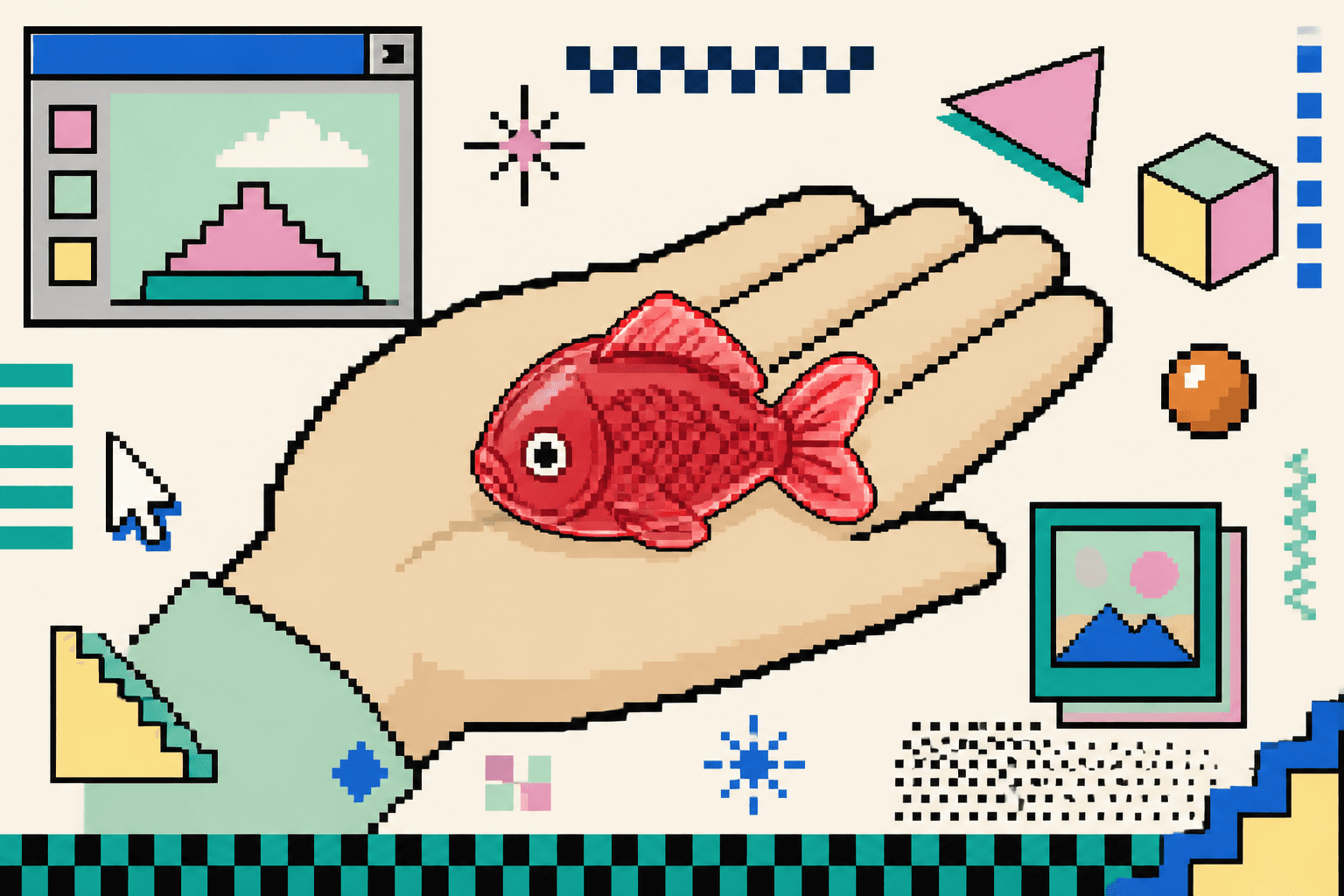
It came in a paper packet the size of a sugar packet. Red and yellow, with a little cartoon fish on the front and a chart on the back printed in type so small that nobody, not even adults, ever read it carefully. Inside, folded between two squares of waxy paper, was a piece of red cellophane shaped like a fish. About an inch long. Thinner than a sandwich bag.
You did not request this packet. You did not buy it. The packet found you - at the bottom of a goody bag, in the prize chest at the dentist, beside the mints at the Chinese restaurant - and you tore it open, because you needed answers.
The Fish
Take the fish out of the packet. Lay it flat on your open palm. Do not breathe on it directly. Do not move your hand. Watch.
After about three seconds, the fish would begin to do something. The head would curl up, or the tail would, or both, or the whole thing would roll over and lie there like it had given up entirely. Different motions meant different things. The chart on the back of the packet told you which was which.
The chart was the entire point of the fish.
The Chart
There were eight readings. They were printed in the typeface of a fortune cookie's ghost.
Moving Head: Jealousy. Moving Tail: Independent. Moving Head and Tail: In Love. Curling Sides: Fickle. Curling: Passionate. Turns Over: False. Motionless: Dead One. Fully Curls: Passionate.
Most of these described a person, not an event. The fortune teller fish was not predicting whether you'd win the spelling bee. It was telling you who you were. You'd put the fish on your palm at recess, four of your friends crowded around, and the fish would tell you - based on the fact that your palms had started sweating because you were nervous about the fish - that you were Fickle. You were Fickle now. The fish had said it.
You'd hand the packet to the next kid. Their fish would lie there motionless. Dead One. Everyone at the picnic table would gasp.
Nobody knew what Dead One meant. It sounded extremely bad.
The Science
The fish was made of a hygroscopic cellophane. It absorbed moisture. When you placed it on the warm, damp skin of your palm, the side touching your skin absorbed water, expanded, and the dry side stayed put. The mismatch curled the cellophane. Different amounts of sweat in different parts of your hand made the fish curl in different shapes.
The fish was, in literal scientific terms, a polygraph. It was reading your palm sweat. The more nervous you were about whatever question you'd silently asked it, the more your palms sweated, the more dramatically it curled. The kid with the calmest hands always got Dead One. The kid with the clammiest hands always got Passionate. We sorted ourselves by autonomic nervous system response and called it personality testing.
The fish was a polygraph the size of a goldfish cracker. It read your palm sweat and called it your character.
If you were dehydrated, the fish would not move. You were Dead One. Your friends would back away from you slowly.
The Use
The thing about the fortune teller fish is that nobody trusted it. Everyone trusted it. Both.
You knew it was just cellophane. You'd read the chart and noticed that two different fortunes both said Passionate, which seemed like a problem. You knew the same fish placed on the same palm twice could produce two different answers. You knew, at some level, that the fish was not a fish.
But you also held your breath while it curled. And you accepted the verdict. And if it said In Love you got embarrassed and threw the fish across the table and the next kid picked it up and put it on their palm and said with who.
This is the thing about being nine. You can hold two contradictory beliefs in your hands at the same time, one in each, and it doesn't bother you. The fish is fake. The fish is real. The fish is a piece of cellophane the size of a guitar pick. The fish is reading your soul. None of these things have to be reconciled. You are just trying to find out if Mike likes you back, and the fish is the only tool you have.
The Distribution
You did not buy the fish. You found it.
- The bottom of a goody bag from a seventh birthday, along with a plastic spider ring and a single Smartie
- The prize chest at the dentist's office, under the stickers
- The little dish by the cash register at the Chinese restaurant your family went to on Fridays
- A piñata, somehow undamaged
- A stocking
- The same kitchen drawer that contained a single chopstick, three rubber bands, and a Phillips screwdriver
- A grandparent's pocket, produced unprompted, on the drive home
Where they came from was a mystery. Where they went was always the same place: lost. They were too small to keep. They stuck to a piece of gum and got thrown out, or your mom found one in the dryer and pulled it off your shirt without recognizing what it was. You never deliberately disposed of one. You simply, eventually, did not have any.
The Argument
I want to say something serious about the fish, but I'm not sure I can.
The fish was a piece of factory-stamped cellophane that exploited the fact that human palms sweat. It was sold in bulk for fractions of a cent. It used the language of fortune-telling - Passionate, Fickle, In Love - because those words were free and emotionally activating. It was, structurally, a piece of trash designed to make a small child have a small feeling.
But it worked.
The fish gave us a tool. The tool was the chart. The chart was a vocabulary - eight feelings, eight types of person, eight ways of being - that we did not otherwise have. We were nine. We did not have the word fickle until the fish said it. We did not have passionate either, or not in a way we could use. We did not have jealousy as a thing you were, rather than a thing you felt. The fish gave us nouns for what was happening in our bodies before we knew it was happening.
The fish told us that the answer to Mike or Brad was Fickle. We did not yet know we were Fickle. The fish saw it first, by reading our sweat.
The fish gave us nouns for what was happening in our bodies before we knew it was happening.
The End of the Fish
I found one last month. Not on purpose - I was looking through a kitchen drawer at my parents' house for batteries. There it was, between a manual for a coffee maker my mom got rid of in 2012 and a fortune from a fortune cookie that said You will travel to a faraway land, which my mom had saved because she'd actually gone to Italy six months later.
The packet was sealed. The illustration was still red. I held it in my hand for a minute. I thought about opening it.
I did not open it. The fish would have curled. The fish would have told me something specific about who I was right then, in my parents' kitchen, in my forties, looking for batteries. I was not ready for that information.
I put the packet back in the drawer. Closed the drawer. Found the batteries in the garage.
The fortune teller fish was a piece of red cellophane that reacted to palm sweat. It cost less than a cent to make. It told you things about yourself that, statistically, would have been true regardless. It survived in goody bags and dental prize chests because it required no batteries and never expired and never lost its hair, and a small child opening a small packet with a small fish inside it would always, for one moment, hold her breath and wait to see what kind of person she was today.
That moment - the wait, the breath, the will-it-curl - was the whole product. The fish was the device that produced it.
The fish was Passionate. The fish was Fickle. The fish was, sometimes, Dead One. The fish was, mostly, doing its job.