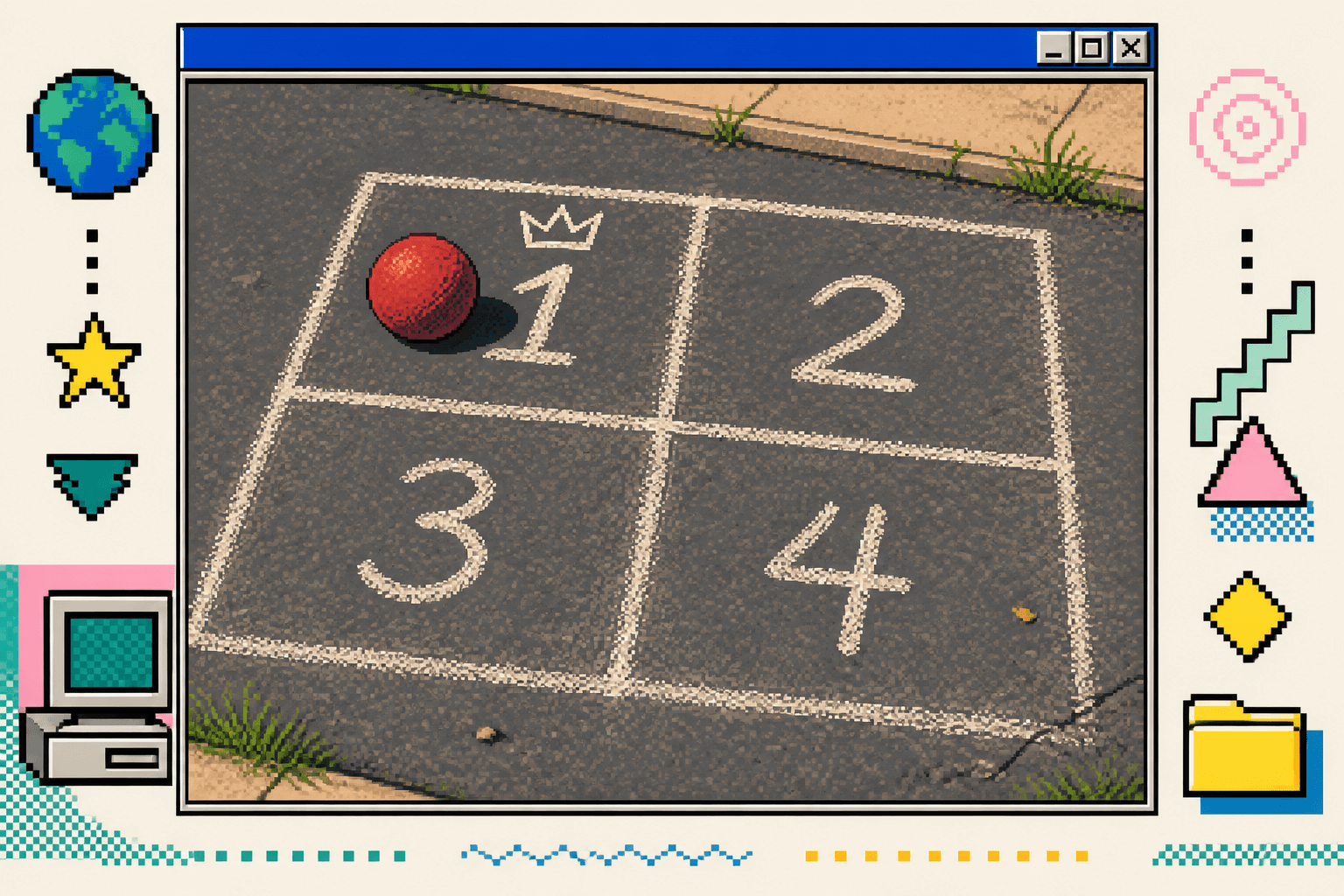
The court was already there when you got outside. Somebody had chalked it in the morning, before the bell, and the chalk was already half-worn-off by the time your class got the back blacktop. You could still see the lines. Four squares, labeled 1, 2, 3, 4, with the 1 up in the far corner and a sort of lopsided crown drawn above it in a child's hand. The 4 was in the near corner closest to the line, where you were going to be standing for a while.
You lined up behind seven other kids. The ball was already in the air.
The Court
The court was a cross. A big chalk square the size of a parking space, bisected both ways, like somebody had drawn a plus sign inside a bigger plus sign. Four squares, each one roughly the width of a kid with their arms out. Numbers in each square. Sometimes letters instead of numbers - A, B, C, D - but it was almost always numbers.
The 1 was the King. The 2 was the Queen. The 3 was the Jack. The 4 was the Dunce, or the Peasant, or Baby Bear, or Garbage, depending on your school and your grade and the mood of the kid in square 1. The hierarchy was total. If you were in 4, you were waiting to leave. If you were in 1, you were in charge of everything, including the rules.
Especially the rules.
The Ball
The ball was always a red rubber playground ball. Slightly deflated. The same ball, apparently, for every court in America. It had the texture of a basketball but the weight of an underfilled balloon, and it made a hollow pock sound when it hit the asphalt, and a wetter thwap sound when it hit your palm.
It smelled like a swimming pool and a tire warehouse. If you got hit with it in the face, which happened, the ball left a pink circle on your cheek that stayed for about an hour.
The Rules
Here is where it gets weird.
There were, nominally, rules to four square. The ball bounced in your square, you hit it with your hands into somebody else's square, it bounced once in their square, they hit it into another square, and so on, until somebody missed or hit a line or caught it or let it bounce twice. Whoever messed up went to the back of the line. Everyone below them moved up a square. The King stayed King until the King missed.
That was the game. In theory.
In practice, before every single round, the King declared the rules. The King said Cherry Bombs, or No Cherry Bombs, or Around the World, or Chicken Feet, or Tea Parties, or Lines Are Out, or Lines Are In, or Babies, or No Babies, or any of about forty other rules that nobody had ever written down anywhere. The King would announce them in a rapid-fire mumble, usually too quietly for the kids in 3 and 4 to hear, and then the King would serve the ball.
If you asked wait, what was that one about chicken feet, the ball was already in your square and you were already out.
Nobody had written the rules down. The rules lived in the voice of the kid in square 1, who was eleven, who had the ball, and who had decided today that lobs were babies and babies were out.
Try It
The rules only matter if the King says they do. Tap one to invoke it. Tap it again when the Queen starts arguing.
Cherry Bombs
I need to explain Cherry Bombs.
A Cherry Bomb was a straight-down slam. You held the ball at shoulder height or above, you let gravity do most of the work, and you drove it into someone else's square so hard that it ricocheted up above the court and came down three feet behind them. It was impossible to return. It was almost impossible to even see coming. It was the single most powerful move in four square, and whether or not it was legal depended entirely on the kid in square 1.
If the King said Cherry Bombs, Cherry Bombs were on. The King would then immediately Cherry Bomb the Queen out of square 2. The Queen would appeal. The Queen would say you can't do that, you can't call the rule and then do the rule, that's not fair. The King would say I called it before I served. The Queen would say I didn't hear you. The King would say not my problem.
The Queen would then walk to the back of the line.
Around the World
Around the World was more elegant and worse.
The rule was that the ball had to travel to each square in order. The King hit it to square 2. The Queen hit it to square 3. The Jack hit it to square 4. The Dunce hit it back to the King. One missed hand-off and someone was out. The person who was out was almost always the Dunce, because by the time the ball got to the Dunce, three kids had been chaining it with increasing speed, and the Dunce was eight years old, and the Dunce had been standing in square 4 for forty seconds without touching the ball, and the Dunce was not ready.
The King loved Around the World. The King also loved just straight-up ignoring Around the World mid-round and hitting the Jack directly, which was not Around the World, and when the Jack missed because the Jack had not been expecting the ball, the King would say you're out, you missed, and the Jack would say you broke the rule, and the King would say I didn't break the rule, you did.
The Jack would walk to the back of the line.
- Chicken Feet - both feet must leave the ground on contact
- No Spinners - the ball cannot rotate when struck
- Diamonds - diagonal hits only, 1→4 and 2→3
- Interference - a kid in line jumps in the way for a laugh, out
- War - all four players hit at once, chaos, the ball ends up on the roof
- Promotion Only - you move up one square per round, no skipping to King
The Line
The line was its own country.
If you were in the line, you were waiting. You might be waiting one round. You might be waiting fourteen rounds. The front of the line watched every serve with the alertness of someone whose life was about to change. The back of the line was eating chips. The middle of the line was negotiating alliances for when they got in. If you had a friend in square 2, you reminded them, from the line, that they owed you from last recess. If you had a rival in square 1, you psyched yourself up for the moment you'd get in and immediately send the ball into their square so hard they'd feel it in their chest.
You never got to send the ball into their square so hard they'd feel it in their chest. You got in, you were in square 4, you got hit with a Cherry Bomb before you could set your feet, and you were back in line. You had a plan but you did not have the Dunce's leverage. The Dunce had no leverage. The Dunce had the ball and nothing else.
The Appeal
There was no appeal.
A thing people got wrong about four square is that they thought it was a game. It wasn't. It was a court. Not a court like a tennis court. A court like a royal court. There was a King, a chain of command, a set of rules, and no one above the King who could overrule the King. If you appealed to a teacher, the teacher said work it out, which meant the King wins. If you appealed to the kid in 2, the kid in 2 was waiting to become King and wasn't going to overrule a precedent they were about to inherit. If you appealed to the kid in 3, the kid in 3 said I don't know, I didn't see, because the kid in 3 was also waiting to become King.
Four square was not a game. It was a court. A royal court, with jurisdiction, precedent, and a succession plan. The teacher was not the Supreme Court. The teacher was the lawn.
The appeal was the back of the line. You went to the back of the line. You rehearsed what you were going to say when you got back in. You never said it. The game had moved on. By the time you got back to square 1, three of the kids who had been in it when the thing happened had graduated to a different grade.
What It Taught Us
I want to be honest about the counter-argument.
The counter-argument is that four square was bad. It was a game whose entire structure rewarded the kid who was already winning. The King made the rules; the King benefited from the rules; the only way to stop benefiting from the rules was to lose the rules; nobody who had the rules ever chose to lose them voluntarily. The Dunce had no path to the King that didn't require the King to miss, and the King wasn't going to miss because the King had declared the rule that governed whether the King missed. It was arbitrary, it was unfair, and the kids on the losing end of it stood in line for an entire recess, in the cold, waiting to touch a ball they weren't going to be allowed to keep.
Nobody wrote this down. We just played.
And this is the part I keep thinking about. We played anyway. We stood in line. We rehearsed our appeals. We lost them. We walked back to the line and we got back in it, because the alternative was to stand against the fence and watch, and nobody wanted that either. The game ran on consent. It ran on the fact that even the Dunce would rather be the Dunce than be nobody. The King got to be King because every one of us agreed, in advance, that having a King was better than not having a game.
The game ran on consent. The Dunce would rather be the Dunce than be nobody. The King was King because everyone agreed, in advance, that having a King was better than having no game.
The Bell
The bell always rang mid-round.
The ball would be in the air. Somebody was mid-swing. The chalk was mid-smudge. And the bell would ring, and everybody would stop, and the kid in square 1 would try to call one more, and the duty teacher would say in, and the ball would roll off into the grass, and we'd all walk back inside and leave the court exactly as it was. Chalk half-faded. Ball in the weeds. The question of who was King when we came back - unsettled, pending, deferred.
Tomorrow somebody would get out to recess first and re-draw the lines. They'd put the 1 in a new corner. They'd skip the crown or draw it fancier. And someone else, probably bigger, probably older, would get there, step into square 1 without being invited, and announce that the rules were different today.
You still remember the exact weight of the ball. You still remember the way your palms felt after a long round, pink and warm and a little sticky from the rubber. You remember standing in line, planning what you were going to call when you got in, and then getting in, and getting out immediately, and standing back in line, planning again. The chalk is gone. The ball is in the weeds. The King graduated. Somebody else is King now and they do not know your name, which is fine, because you do not remember theirs either, only that they stood in square 1 and said something about Cherry Bombs, and you did not hear it, and you were out.