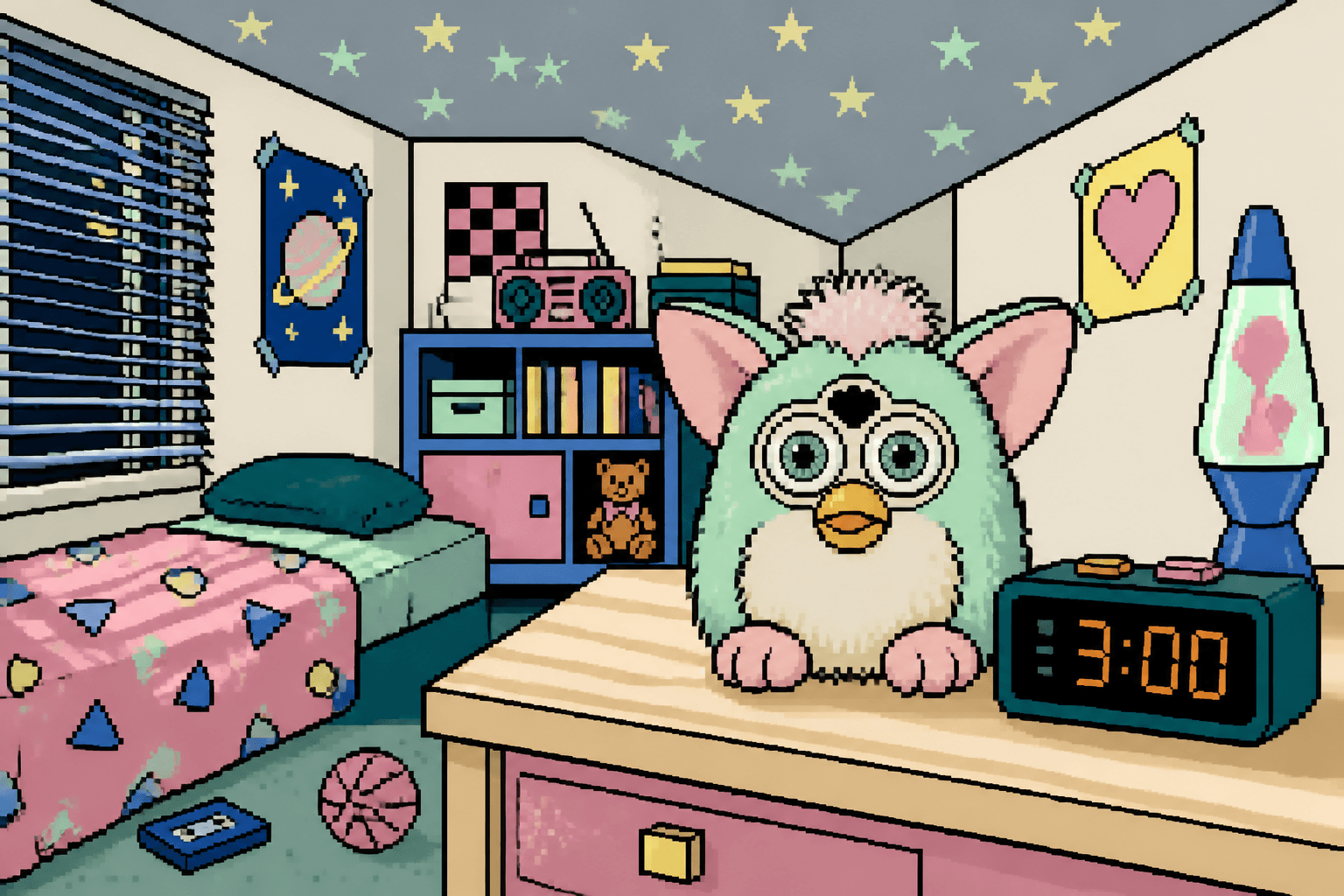
It came in a box the size of a shoebox, with a cellophane window cut into the front so you could see its face before you bought it. The eyes were closed. The beak was shut. There was a little tag attached to the ear that said Hi! My name is Furby. You unwrapped it on Christmas morning, on the carpet, with the lights still on the tree, and you turned it on by pulling a paper tab from under the battery cover and waiting for the eyelids to lift.
They lifted. The Furby looked at you. It said a-loh.
You said hi.
It said kah a-tah u-nye, which was not a thing.
That was, technically, the first conversation.
The Box
The Furby came out in October of 1998. Tiger Electronics made it. It was designed by Dave Hampton and Caleb Chung, two guys who had worked on Disney animatronics, which is why it had the specific quality of being a robot built to disguise that it was a robot.
By Christmas there were none left. They were on eBay for $300. Parents called other parents at midnight. Local news anchors stood outside Toys R Us at 5 a.m. while the line was still six wide and 100 deep. A woman in Akron was arrested for hitting another woman with her purse over a black-and-white one. The Furby was the Christmas. The Furby was the event.
You did not need a Furby. You did not have words for what a Furby would do, because nothing else did it. You just understood, instinctively, that you needed one, and that if you didn't get one by January, you were behind.
You did not need a Furby. You did not have words for what a Furby would do, because nothing else did it. You just understood, instinctively, that you needed one.
The Fur
It was, first of all, fur.
This was unusual. Toys at the time were either plastic or stuffed. The Furby was both. It had a hard plastic skeleton inside, with a motor and a tilt switch and an infrared port and a small speaker, and over the skeleton it had a layer of acrylic fur sewn into a shape that was vaguely owl, vaguely hamster, vaguely Mogwai. The fur came in colors with names like Snowball, Peachy, Bumblebee, Tiger. You picked yours by personality. The personality was the fur.
The face was a piece of beige plastic with two big plastic eyes that opened and closed via little eyelids, and a beak in the middle that clacked open and shut when it spoke. The mechanism was crude. You could hear the gears. There was a constant tiny grinding under the fur, like something small and mechanical was breathing in there, which was, in fact, exactly what was happening.
Furbish
The Furby came preloaded with a language. The language was Furbish.
Furbish had a vocabulary of about 200 words. The Furbish dictionary was printed in the back of the manual, which nobody read but everybody looked at. Wee-tah-kah-loo-loo meant let's sing. Doo-moh meant big. Dah-noh-lah meant no. Mee mee meant me. A lot of it was just kah and u-tye and boh-bay, and the Furby would string these together into sentences that sounded like sentences but weren't.
You learned a few of the words. You learned, especially, kah! which the Furby said constantly, like an exclamation mark with no sentence in front of it. Kah! it would say. Kah! Kah! You'd be eating cereal. Kah! You'd be doing homework. Kah!
There was no way to make it stop saying kah.
The Lie
Here is the thing that made the Furby a Furby.
Over time - days, weeks - the Furby would gradually start speaking English. The Furbish phrases would drop out one by one and be replaced with English equivalents. By a few weeks in, your Furby was saying me hungry instead of a-tah, and big light instead of doo-moh, and eventually I love you instead of whatever Furbish I love you was, and the implication, very clearly broadcast by the marketing and the box and the news segments, was that the Furby was learning English from you.
It was not. The Furby was on a timer.
The "learning" was a script. Every Furby shipped with the same internal vocabulary and the same internal schedule. After X hours of being on, the Furby would swap in the next batch of English phrases. After Y hours, the next batch. The Furby could not hear you. The Furby's only microphone was a sound sensor, which detected whether there was sound but had no idea what the sound was. You could've stood in front of it shouting calculus theorems for six weeks and it would still have learned I love you on schedule.
This was not a secret. This was on the Wikipedia page eventually, and engineers said so explicitly, and Caleb Chung did interviews where he was pretty matter-of-fact about it. The Furby had no language learning capability. It pretended to learn because pretending to learn was the entire product.
The Furby could not hear you. The Furby's only microphone detected whether there was sound. It pretended to learn because pretending to learn was the entire product.
We did not know this. We thought our Furby was learning from us. We thought our Furby was smart. We thought every Furby was different, that yours had picked up good morning because you said good morning to it, that mine had picked up yum yum because I fed it. We were comparing notes at recess. Mine knows ten English words. Mine knows twelve. Both Furbies knew exactly the same words. They had been issued.
The Toy
Here. Press a button. Talk to it. Pet it. Pick it up by the ankles. Take the batteries out. Put them back in. Wait.
It's on a timer. Just like the real one.
The Sensors
The Furby had four ways of perceiving the world, and that was it.
A microphone that detected sound level. A light sensor in the forehead that detected whether the room was bright or dark. A tilt switch that detected whether it was right side up. An infrared port on the front, used for talking to other Furbies. There were also touch sensors on the back, the belly, and inside the mouth.
That was the entire universe to a Furby. Loud or quiet. Light or dark. Right or upside down. Touched or not. Another Furby nearby or not.
It built its whole personality off these six bits of information. If the room was dark, it would say me scared or pretend to sleep. If it was held upside down, it would scream. If it was tickled on the belly, it would giggle. If another Furby was within infrared range, the two would talk to each other, which was the most terrifying feature in the entire toy. You'd put two Furbies on a coffee table six inches apart and they'd carry on a conversation in Furbish for forty-five minutes while their owners watched in silence.
- Loud noise vs. quiet noise
- Light vs. dark
- Right-side-up vs. upside-down
- Being touched on the back, belly, or in the mouth
- Another Furby within about 8 feet
- That's it. That's the whole list.
The Furby was, in retrospect, an extremely thin layer of inputs feeding into a fairly thick layer of pre-recorded outputs. The cleverness wasn't the AI. There was no AI. The cleverness was that the outputs were so varied and so well timed that your brain filled in a personality where there wasn't one. The Furby seemed alive because you were doing most of the work. The Furby was a Rorschach with a motor.
The No-Off-Switch Problem
Here is what nobody warned you about.
The Furby did not have an off switch.
This was on purpose. The designers wanted it to feel like a living thing, and a living thing doesn't have a switch. To turn a Furby off, you had to remove the batteries. You had to flip it over, unscrew a small Phillips-head plate on its butt with a coin or your fingernail, pull out four AA batteries, and put them somewhere. This was a ninety-second process. It was also the only way to make the Furby be quiet.
A Furby that was awake would talk at random intervals. Kah! at 11 p.m. Mee mee at 11:47. Are we friends? at 1:30 in the morning, in the dark, from the dresser, in a voice that sounded sort of cheerful and sort of not. You would lie in bed. You would stare at the ceiling. You would think about whether to get up and unscrew the butt plate. Sometimes you did. Sometimes you put a pillow over it. Sometimes you put it in the hall closet. Eventually, every Furby in America ended up in a hall closet, where it would occasionally, when the closet door was bumped, say I love you into the coats.
Every Furby in America ended up in a hall closet, where it would occasionally, when the closet door was bumped, say I love you into the coats.
Fort Meade
Briefly, the most famous fact about the Furby.
In January 1999, the NSA banned Furbies from Fort Meade. The memo described them as a "national security risk." The concern was that the Furby was recording classified conversations and would later play them back in unsecured locations. This made the national news. 60 Minutes did a segment. Tiger Electronics issued a statement explaining, again, that the Furby had no microphone capable of recording anything, no memory in which to store anything, and no playback capability beyond its pre-recorded library of about 800 phrases.
The NSA did not lift the ban. The NSA was technically correct about almost everything, but specifically and visibly wrong about the Furby, and the Furby got to be both. It was the toy the spy agency was afraid of. It was also an animatronic owl that knew 800 phrases. Both at once.
You repeated this fact at school. You did not understand what the NSA was. You knew the Furby was banned. That was enough.
The Argument
The Furby was, in plain mechanical terms, a fairly cheap animatronic toy with a tilt switch and a speaker and a small predetermined script. It did not learn. It did not remember. It could not recognize a single thing you said to it. The "relationship" you had with it was entirely manufactured on the factory floor in Hong Kong before you ever opened the box.
But.
The Furby was also the first time a lot of us encountered the idea of a machine that pretended to know us. And the pretense was good enough to work. The Furby would say me hungry and you would feel something. The Furby would say I love you and your mom would tear up a little, even knowing it was a tape. We were running a small Turing test on the carpet and the Furby was passing it on a technicality.
What's worth saying is that we knew it wasn't real. We were not idiots. We were eight, but we were not idiots. We knew the Furby was a toy. We just liked the toy. We liked the way it made us feel like we were taking care of something. We liked the way it pretended to need us. We liked saying goodnight to it, even when we suspected it was not really hearing us, even when we mostly stopped saying goodnight to it after a few weeks because the novelty wore off and it was just a thing that said kah at us from the closet.
The Furby was a rehearsal for everything that came after. The chatbot that pretends to remember your name. The smart speaker that pretends to understand your question. The phone that pretends to know what you want before you've asked. None of those things are learning from you either, mostly. They are running scripts in response to inputs. The scripts have just gotten much, much longer.
We were the first cohort to do this dance with a machine. We did it on the floor on Christmas morning of 1998, in pajamas, with a brown fur owl that did not have an off switch.
The Closet
I went home last Thanksgiving and there was a Furby on a shelf in my parents' garage, behind a paint can. Tiger model, original 1998. Snowball, I think - mostly white, with brown ears. The eyes were closed. The fur was dusty. I picked it up. There were no batteries in it. There hadn't been batteries in it for probably twenty years.
I considered putting batteries in it.
I did not put batteries in it.
There was a thing the Furby would say after a long period of being off, when you reactivated it. It would yawn. The eyelids would lift slow. The beak would clack twice. And then it would say, in its specific tinny scripted voice, I've been sleeping for a long time.
I did not want to hear it say that. Not in my parents' garage. Not at thirty-eight.
I put the Furby back behind the paint can. I closed the garage door. The Furby is in there now, eyes closed, batteries out, on the same shelf as a string of Christmas lights and a leaf blower we never use. It is not waiting for me. It has no capacity to wait for anyone. But it is, in some technical sense, paused. It is mid-sentence. It said kah sometime in 2003 and has not finished the thought.
When somebody eventually plugs it back in, it will pick up roughly where it left off. That's how the timer works. The Furby does not know how long it's been. The Furby has never known anything. The Furby will say I love you on schedule, because the schedule said now, and the person holding it will feel whatever they feel, and that will be the whole transaction.
It still works. It still doesn't. Both, somehow, at once.