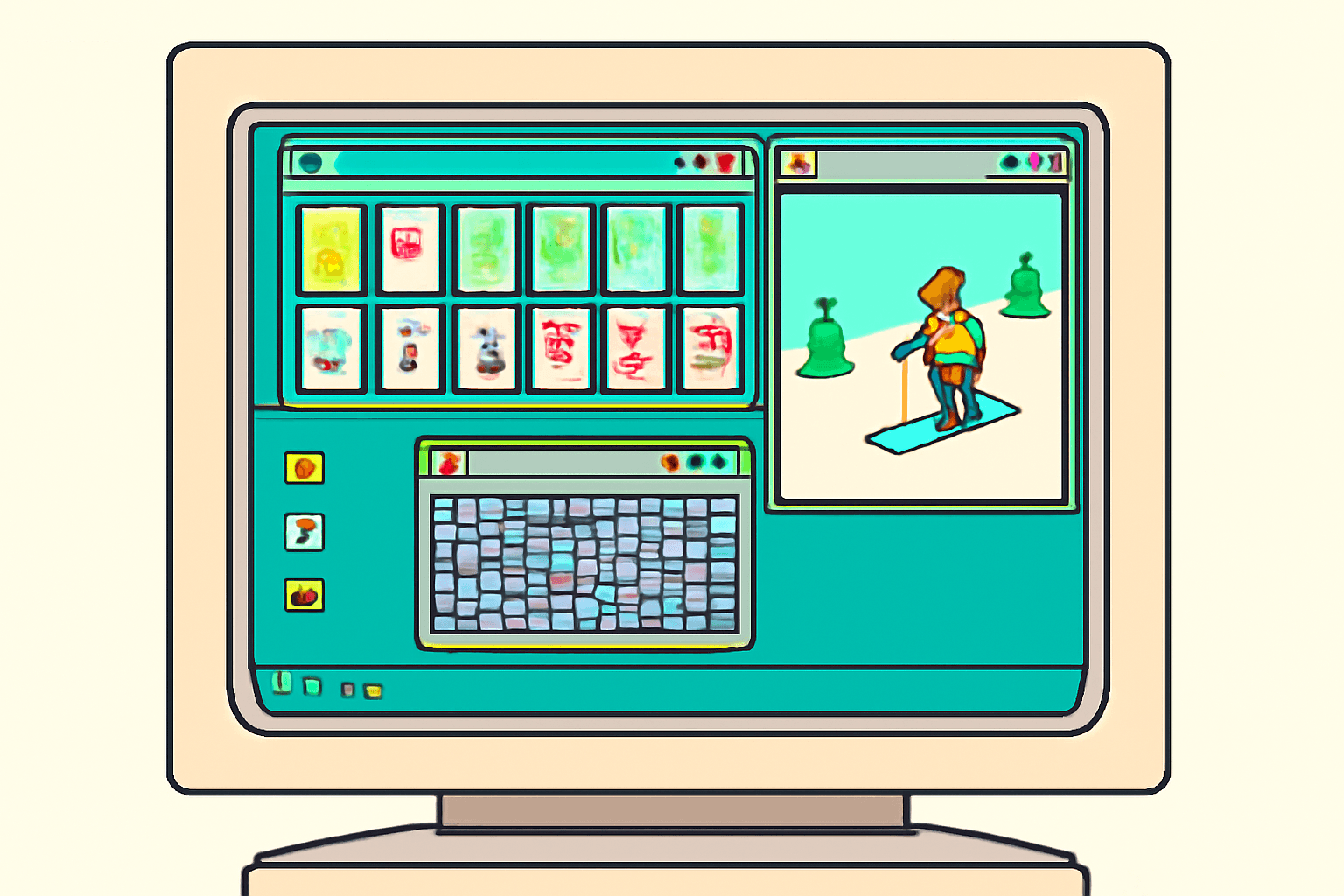
Nobody bought Windows for the games. That's what made them so dangerous. You sat down at the family Compaq to type a book report or print out MapQuest directions, and then you noticed it. A little icon. A green felt table. A deck of cards, already dealt. And just like that, forty-five minutes of your life were gone and you hadn't written a single word.
The games that came with Windows weren't supposed to matter. They were utilities, technically - little training programs Microsoft included to teach people how to use a mouse. But they became something else entirely. They became the background radiation of an entire generation's computer experience. The games you played when you had no games. The games you played when you were supposed to be doing something else.
Solitaire: The Gateway Drug
Klondike Solitaire shipped with Windows 3.0 in 1990, and it was there for a reason. Microsoft had a problem: millions of people were about to use a computer mouse for the first time, and they had no idea how to click, drag, or drop anything. So somebody at Microsoft had the genuinely brilliant idea to bundle a card game that required you to do all three. Click a card. Drag it across the screen. Drop it on a pile. Congratulations, you just learned the fundamental interaction model of modern computing.
Nobody knew this at the time. Nobody sat down at Solitaire and thought, "Ah yes, I'm training my fine motor skills for the graphical user interface." They just thought they were playing cards. Which was the whole point.
Solitaire wasn't just a game. It was a secret mouse tutorial that tricked an entire country into learning how to use a computer.
And then there was the cascade. If you've never won a game of Solitaire on Windows, let me tell you - the win animation was one of the most satisfying things a computer could do in the 1990s. The cards would bounce off the bottom of the screen and cascade down from the top in this beautiful, chaotic waterfall of red and black, leaving colorful trails across that green felt background. It was your reward. Your digital fireworks show. People won games of Solitaire just to see those cards tumble. Some people - and I know this because I was one of them - would sit through an entire game they knew they were going to win just to get to that moment at the end.
Office workers played it between meetings. Your dad played it after dinner. Your mom played it while "waiting for the computer to do something." Solitaire was the great equalizer. It didn't matter if you were eight or fifty-eight. Everybody played.
Minesweeper: The Game Nobody Understood
Let's be honest. You didn't know how to play Minesweeper. I didn't know how to play Minesweeper. Nobody in your family knew how to play Minesweeper. The numbers meant something - they were telling you how many mines were in the adjacent squares - but processing that information in real time felt like doing calculus during an earthquake.
So instead, everybody just clicked randomly. You'd start in the middle, hope for a big opening, and then click squares at the edges until you hit a mine and the whole board exploded. Then you'd start over. This was the game. This was the entire experience for like 90% of Americans who played it.
There was always that one person - a coworker, a cousin, a kid in your class - who actually understood the logic and could clear an expert board in under five minutes. You'd watch them play and it looked like witchcraft. They'd flag mines with right-clicks and chord with both buttons and you'd think, is this the same game I've been randomly clicking on for three years?
The Abominable Snowman Always Wins
SkiFree came on the Microsoft Entertainment Pack, which meant not everybody had it, but enough people did that it became a shared cultural trauma. The premise was simple: you're a skier. You go down a hill. You dodge trees and rocks and other skiers. It's fine. It's pleasant, even. A nice little skiing game.
And then the yeti shows up.
If you skied far enough down the hill, a giant abominable snowman would come sprinting out of nowhere, chase you down, and eat you. Just devour your little pixel skier whole. There was no warning. There was no way to prepare. You just died. Every single time. It was the first jumpscare most of us ever experienced, and it happened on a beige Packard Bell in the living room on a Tuesday afternoon.
SkiFree's abominable snowman was the first jumpscare most of us ever experienced, and it happened on a beige Packard Bell on a Tuesday afternoon.
Years later, people discovered you could actually outrun the yeti by pressing the F key to go faster. Nobody knew this in the 90s. We all just accepted death.
Space Cadet Pinball: The GOAT
If Solitaire was the gateway drug, 3D Pinball for Windows - Space Cadet - was the hard stuff. It shipped with Windows ME, 2000, and XP, which means it was on basically every computer in America between 1999 and 2006. And it was unreasonably good for a free pack-in game.
The sound effects alone. That metallic clang when the ball hit a bumper. The satisfying thwack of the flippers. The way the whole table lit up when you completed a mission. You could hear Space Cadet Pinball from three rooms away, and the sound alone was enough to make you abandon whatever you were doing and go play.
Space Cadet Pinball was the one built-in game that felt like a real game. It had missions. It had a score multiplier. It had that little deployment chute where you pulled back the plunger and launched the ball and if you hit it just right, you could nail the skill shot on the first try. People had high scores they were proud of. People competed with their siblings over Space Cadet Pinball the way other families competed over Monopoly.
It was also, crucially, the game that every kid played when their parents wouldn't buy them real games. If you didn't have a PlayStation and you didn't have a Game Boy and you didn't have anything installed on the family PC except Microsoft Office and Encarta, you had Space Cadet Pinball. And honestly? It was enough. It was more than enough. It was hundreds of hours of entertainment that came free with the operating system.
The Others
There were more, of course. FreeCell, which was Solitaire for people who wanted to feel smarter. Hearts, which required an internet connection in later versions and which taught you that the Queen of Spades was a weapon of mass destruction. Hover!, which shipped on the Windows 95 CD-ROM and was a hovercraft capture-the-flag game that felt like the future in 1995. Chip's Challenge, a puzzle game from the Entertainment Pack that had 131 levels and a plot about a kid trying to impress a girl named Melanie by navigating through increasingly absurd obstacle courses.
Each one of these games was somebody's favorite. Each one ate somebody's afternoon. And none of them cost a dime beyond the price of the operating system your parents already bought because they needed it for TurboTax.
The Real Game Was Killing Time
Here's what I keep coming back to. These games weren't designed to be great. They were designed to fill space, to teach basic computer skills, to give people something to do while they waited for a file to download over a 28.8k modem. They were the digital equivalent of a magazine in a dentist's waiting room.
But they became more than that. They became a shared language. Every American who used a computer in the 90s played these games. Your teacher played Solitaire during lunch. Your boss played Minesweeper during conference calls. Your older sister played Hearts when she was supposed to be writing her college essay. Your little brother played Pinball until the mouse pad wore thin.
Microsoft removed most of them eventually. Windows 8 shipped without Solitaire. They brought it back later, but with ads. Ads in Solitaire. You can pay a subscription to remove them. The free card game that came with your operating system to teach you how to use a mouse now has a premium tier. Something about that feels like the most concise summary of what happened to the internet I've ever heard.
But the originals are still in there, somewhere, in the muscle memory of everyone who grew up with them. You can still feel the drag of a King onto an empty column. You can still hear the thwack of the pinball flipper. You can still see that yeti, sprinting toward you from the edge of the screen, and you still don't press F.
Some lessons you just never learn.