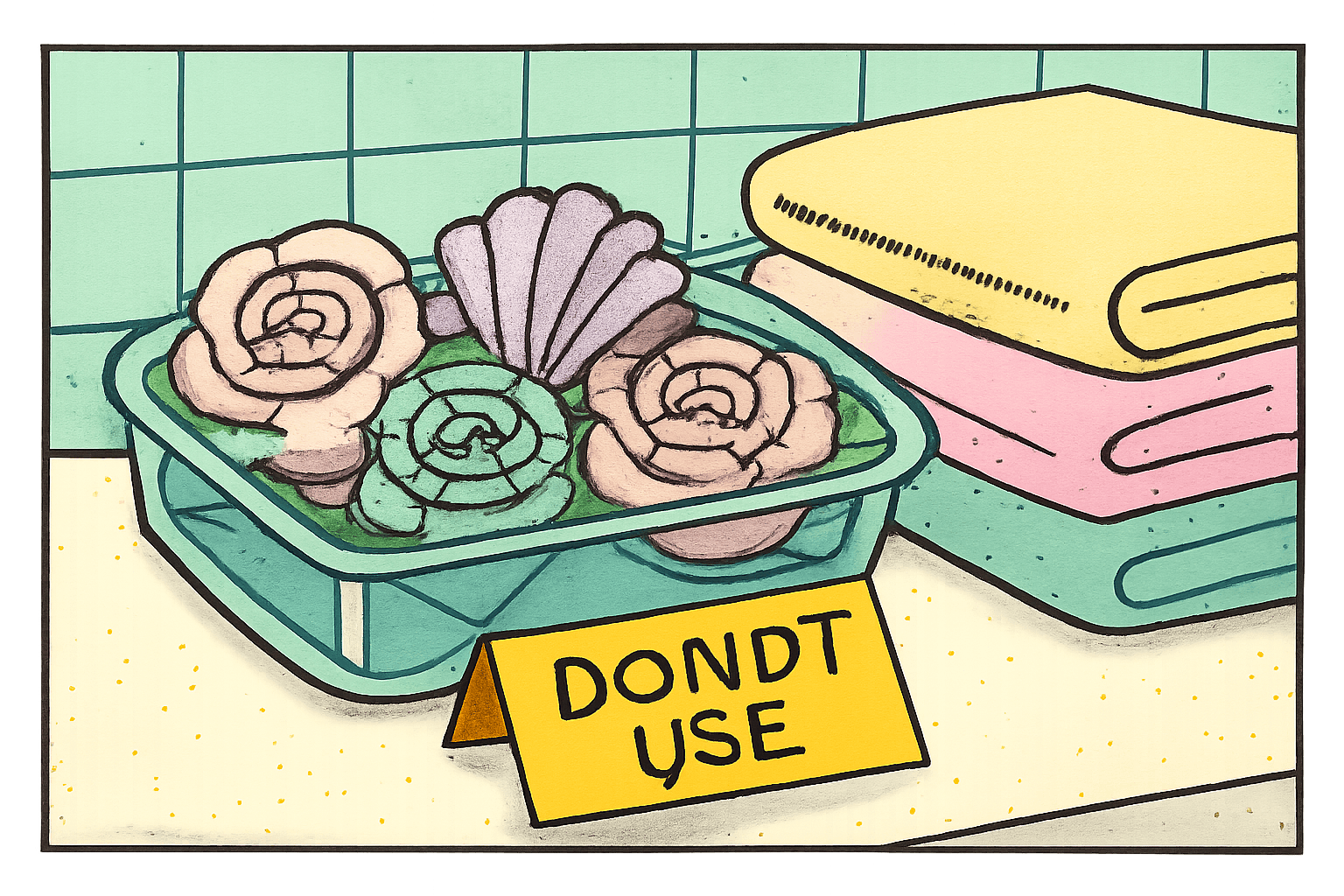
There was a bathroom in your house that wasn't for you. You knew this because the towels were folded into shapes. Because the bathmat was dry. Because on the counter, next to the faucet nobody used, there was a small glass dish holding three or four soaps that had been shaped to look like seashells, and those soaps had been sitting there since before you were born, and you were not - under any circumstances, ever, for any reason - allowed to touch them.
You touched one once. Your mom knew immediately. She could tell. Somehow she could tell.
The Taxonomy of the Untouchable Soap
They came in a few standard forms. There was the seashell, which was the most popular - a ridged, pastel scallop that sat in the dish like a tiny artifact from a bathroom in Atlantis. There was the rose, which was more ambitious - hand-shaped petals in pink or lavender, sometimes with a dusting of glitter that had been slowly shedding onto the dish since 1993. And there was the mysterious third soap, the one shaped like a fruit or a leaf or something that had maybe once been a recognizable object but had been sitting in ambient humidity for so long that it had become a smooth, cracked lump of intent.
They smelled like your grandmother's purse. Not bad. Not good. A smell that existed outside the spectrum of pleasant or unpleasant and occupied its own category: decorative.
The decorative soap was not soap. It was a boundary marker. It said: this room is not for living in. This room is for company.
The Gift Economy
Here's what nobody explains to children. The decorative soaps were gifts. Specifically, they were the kind of gifts that women gave to other women when they didn't know each other well enough to give a real gift but knew each other too well to give nothing. They came in little cellophane-wrapped baskets from stores like Crabtree & Evelyn or Bath & Body Works or that one kiosk at the mall that smelled so aggressive you could locate it from the food court.
Your mom received them at Christmas parties. At work gift exchanges. From the neighbor who brought them over with a card. They arrived in sets of three, nestled in shredded tissue paper, sealed in plastic, and they were beautiful in the way that things you'll never use are always beautiful.
Nobody threw them away. That would be rude. Nobody used them. That would be wasteful. So they went to the guest bathroom, which was really just a museum of gifts your mother felt obligated to display, and they sat in their little dish, and they stayed.
The Rules Nobody Wrote Down
The guest bathroom operated on an unspoken constitution. You could use it in emergencies - if the main bathroom was occupied, if there were actual guests over, if you were directed there explicitly by a parent. But even then, you used the regular soap. The regular soap lived under the sink, or sometimes on a small shelf behind the toilet, hidden like a utility. It was a Dial bar. It was a pump of Softsoap. It was there for function. The decorative soaps were there for meaning.
What meaning? Nobody could tell you. Not even your mom. If you asked her why the soaps were there she would look at you like you'd asked why the walls were there. They were there. They had always been there. They were part of the room the way the towels were part of the room and the little basket of dried flowers was part of the room and the framed cross-stitch thing that said "Bless This Mess" was part of the room. Questioning it was like questioning gravity.
You could use the guest bathroom. You could not inhabit it. It was a stage set. You were not in the cast.
The Slow Death of a Decorative Soap
Here is something true: decorative soaps age. They don't age like regular soaps, which get used and shrink and go soft and eventually dissolve into nothing in the shower dish. Decorative soaps age like artifacts. They crack. They lose their color from the outside in, fading to a pale ghost of their original pastel. The surface develops a fine network of lines, like a Renaissance painting, like something that belongs behind velvet rope at a museum.
The scent changes too. In year one, a decorative soap smells like roses or lavender or "ocean breeze" or whatever optimistic fiction was printed on the cellophane. By year three, it smells like wax. By year five, it smells like nothing. By year eight, it smells like the bathroom itself - like tile grout and hand lotion and the specific staleness of a room where air circulates but nothing happens.
And still nobody threw them away.
Sometimes a soap would crack in half. Your mom would arrange the halves to hide the break. Sometimes a soap would develop a dark spot - some chemical process nobody understood - and she'd flip it over. The dish was curated with the intensity of a gallery installation. Rotate, rearrange, maintain the illusion. These soaps were fine. These soaps were still nice.
Everyone's Bathroom Had the Same One
The thing about the decorative soap phenomenon is that it was completely universal and nobody organized it. There was no meeting. No cultural memo. But you could walk into any house in any suburb in America in 1996 and find the same glass dish, the same shell-shaped soap, the same folded towels that nobody had ever unfolded. It was as if every mother in the country had received the same invisible instruction manual for how to furnish a room that existed solely to prove you were the kind of household that had a room to spare.
The guest bathroom was a performance. It performed readiness. It said: we are prepared for guests at all times. We have matching towels. We have a soap dish. We are not animals. And the decorative soaps were the centerpiece of that performance - proof that someone in this house cared enough to put out something nice, and everyone in this house respected it enough to never, ever use it.
What Happened to Them
I don't know when the soaps disappeared from my mother's guest bathroom. I didn't notice them leave. One visit they were there - the same dish, the same three shell-shaped relics, faded now to near-white - and some visit after that, they weren't. Replaced, maybe, by a pump of something from Target. Or maybe just gone. The dish put away. The counter cleared. A room that had spent two decades performing readiness finally allowed to just be a bathroom.
I have a guest bathroom now. It has a regular soap in it. A nice one, from a brand I looked up online, in a ceramic dish I bought on purpose. Guests actually use it. The towels come off the rack. The room functions. It's better this way. Obviously it's better this way.
But sometimes I think about those seashell soaps. The way they just sat there, year after year, doing nothing, being nothing, serving no purpose except to mark a boundary between the life we lived and the life we presented. How my mom would glance at them when she walked past and feel, I think, a small, private satisfaction that they were still there. Still nice. Still untouched.
There was something to that. Having a thing you kept just to keep it. A room you maintained for no one. A soap you never used, in a dish you never moved, in a bathroom that proved - to nobody who was checking - that you had your life together.