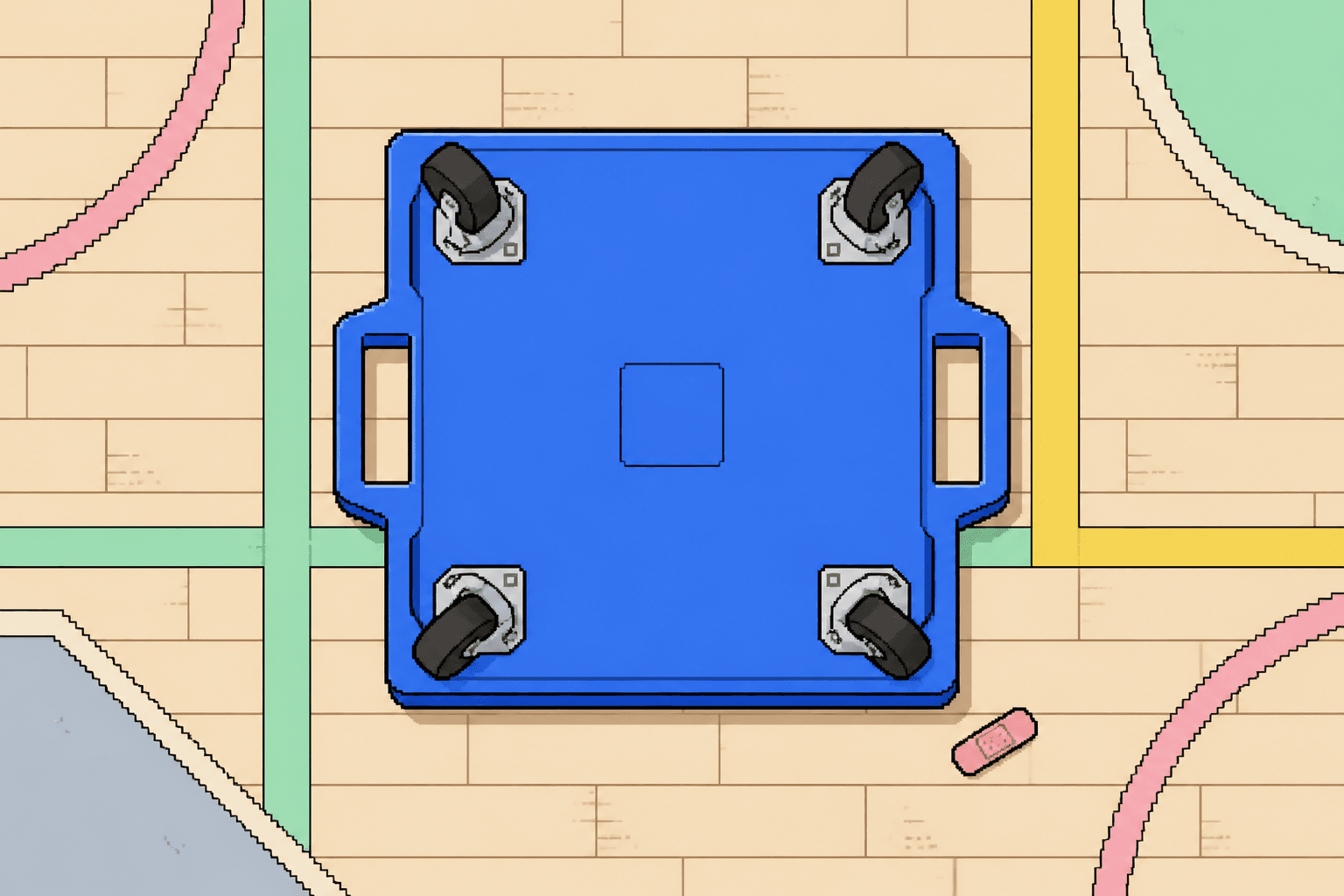
They lived in a stack in the gym closet, six high, with the bottom one slightly caved in from the weight. Blue plastic squares, each the size of a dinner plate and about an inch thick. Four little casters screwed to the underside, each one spinning independently in whatever direction physics suggested. There was no handle. There was no front. There was not, in any real sense, a right side up.
Mr. Hernandez - or whoever your gym teacher was, they were all basically the same person - would pull one off the top and drop it on the hardwood with a thunk that reverberated through the sternum of every kid in a thirty-foot radius.
Then another. Another. Until there were thirty of them scattered across the court and he would blow his whistle and say the only line of parachute-day magic he ever delivered:
Scooters today.
The Design
The gym scooter had been designed, I am sure, in approximately 1964, by one adult, over a weekend, with the goal of being cheap and indestructible. They were. They are. The same blue plastic squares are still sold today, by companies with names like Champion Sports and CASL Industries, and if you went into the closet of your old elementary school right now, I would bet you a dollar the same scooters are still in there, in the same stack, with slightly more Sharpie writing on the undersides.
The design brief was: a plastic square. Four casters. That was the whole thing.
There was no padding. There was no grip. There was no little lip on the edge to stop your fingers from sliding off. It was a board on wheels. It was what a child draws when you say draw me a vehicle.
There was no padding. There was no grip. There was no lip. It was a board on wheels. It was what a child draws when you say draw me a vehicle.
The plastic was a specific blue - a bright, cheap, slightly-waxy blue that does not exist in nature and does not exist in adult life. You have not seen this blue since you left elementary school. It was the blue of plastic that had been formulated to survive being dropped two hundred thousand times on a hardwood floor by a small human who had been promised ten more minutes until the bell. It was a blue with a job.
The Pinch
Here is how the pinch happened. Every time.
You sat on the scooter - or lay on your stomach on the scooter, or knelt on the scooter - and you put your hands flat on the gym floor beside it, and you pushed. The scooter rolled. Your hands came off the floor. You coasted. Then you put your hands down again and pushed again.
And the scooter, carrying you forward at the speed of a person walking briskly, rolled over the hand you had just put down.
Your fingers - which had been right there, next to the caster, where you had deliberately placed them - got caught under a wheel. The wheel stopped. Your body kept going. The scooter stopped with you still on it. For a half-second you did not understand what had happened. Then you did.
The wheel of the scooter rolled over the hand of the kid pushing the scooter. This was a one-way causal chain. It happened to everybody. It never stopped happening.
The bruise would come up an hour later, flat and purple, across the pad of your index and middle fingers, and it would be there, slightly yellower, for a week. You would show it to people. It was a credential.
The nurse did not give you ice for a scooter pinch. The nurse gave you ice if you were bleeding, or crying hard enough to be sent, or had done something theatrical in front of a teacher. A scooter pinch was beneath ice. A scooter pinch was the base rate.
The Games
The games were:
Scooter races. Two teams, a relay. You scooted to the far wall, tagged a cone, scooted back, tagged the next kid. The kid pushing the hardest was the kid most likely to get a wheel over a knuckle, which meant the kid pushing the hardest was also the kid most likely to come up short, which meant the race was not actually won by speed. It was won by not flinching.
Scooter dodgeball. Prohibited in about half the districts in America by 2001, but if your gym teacher was from the old school, you got it. You sat on a scooter and tried not to get hit. If you got hit, you rolled yours to the sideline and sat on it like a vehicle you had been pulled over on. Nobody has ever again owned a car they loved as much as they loved the scooter they were eliminated on.
Scooter chariots. Two kids. One sat on the scooter. The other pulled them around by a rope, or a jump rope, or a hula hoop. This was the most dangerous thing we did in a school building that was not a chemistry lab. The puller would get yanked backwards, the rider would spin, and the rider's fingers - dangling off the edge of the scooter because there was nowhere else to put them - were a running insurance claim.
Freeze tag on scooters. Just normal freeze tag. On wheels. Nobody can tell you why this was fun. It was.
- Lying on your stomach. Superman pose. Fastest. Most fingers at risk.
- Sitting cross-legged. The default. Hands push behind you. The classic pinch position.
- Kneeling. For the kid who had been pinched twice already and was no longer taking chances.
- Standing on it. Banned the first time anyone tried it. Became the Everest.
- Two scooters, one under each foot. Instant split. Instant fall. Instant ice pack.
- Nobody on it, just pushed across the floor. A bowling ball. Hit a kid. Got taken away.
Try It
Push off with the button or the spacebar. Every push rolls you a little. Sometimes the wheel catches a finger. The wheel is not malicious. The wheel is doing its job. Your fingers are in the way.
The Closet
The scooters lived in a closet.
The gym closet - every gym closet, in every school - was a room that smelled like rubber. Not the rubber of a new pencil eraser. The rubber of ten thousand bouncing balls slowly off-gassing into stagnant air over twenty years. Inside: the parachute, bagged, in its canvas sack. The dodgeballs in a mesh bag. The hula hoops on a peg. A dozen orange cones nested into one tall orange cone. A broken beanbag. And the stack of scooters, a blue plastic tower about four feet high, leaning slightly to the left because the bottom one was warped.
You were not supposed to go into the gym closet. The gym closet was Mr. Hernandez's, and the door had a key, and the key hung on a lanyard around his neck. If he sent you in to get something, you were briefly famous. The kid who got sent for the scooters was, for that one afternoon, the king. You walked out carrying two of them stacked, one in each hand, with your fingers hooked through the caster holes, and the whole class watched you cross the court like you were carrying the crown jewels.
The crown jewels pinched your fingers on the way out.
The Argument With Itself
I want to be fair about this.
Nobody lost a finger. I am sure of this. In fifty years of American physical education with hundreds of millions of scooter-reps logged, there is no record - that I can find - of an actual digit coming off. The bruises were real. The pinches were real. The occasional busted lip, when the chariot puller let go of the rope at full tilt, was real. But nobody got maimed. The scooters are, by any measure that matters, safe.
I agree with that.
I would also note, out loud, that we spent an hour a week, from roughly age six to age eleven, voluntarily putting the same part of our body into the same hazard, over and over, in exchange for the right to spin in a small circle on a plastic board. That was the deal. That was the deal we took. And the fact that we took it enthusiastically - that we fought to be first in line, that we petitioned for scooter day the way other kids petitioned for recess - says something about what counts as fun at nine.
What it says, I think, is: anything with wheels that moves by your own effort, in a gym where you are otherwise required to stand in a line, is worth a little pinch.
That is not a complicated trade. That is pretty good math.
Anything with wheels that moves by your own effort, in a gym where you are otherwise required to stand in a line, is worth a little pinch. That is pretty good math.
The Other Argument
I also want to be honest about the other side of this.
The scooter was, in a sense I can see now and could not see then, the first vehicle any of us had. The bike came later and came with training wheels and a parent's hand on the back of the seat. The skateboard came later still and came with an older cousin's worried face. The car came much, much later, after a test and a permit and a photograph you hated. But the scooter came at seven, and nobody tested you, and nobody came with you, and the brief was: there is the far wall; here is the floor; good luck.
You pushed. You went. You stopped when you wanted to, or when you hit a cone, or when a wheel rolled over your hand. The whole system of steering was lean the way you want to go, and that was the entire driver's ed. You figured it out in about four seconds. By the fifth second you were going faster than you thought you could and spinning in a direction you had not chosen, and that was fine, because the floor was smooth and the gym teacher had not stopped the drill.
That is a thing I did not get to do again until much later, and only in a car, and with much higher stakes.
The End
The last time I sat on a gym scooter I was ten. I did not know it was the last time.
I had my hands flat on the gym floor. I pushed off. I rolled maybe fifteen feet with my legs tucked under me, and the whistle blew, and we put the scooters back in the stack. Mr. Hernandez rolled the tower back into the closet. I got in line for water.
Later that year we moved up to the big gym in the middle school, where there were no scooters, because scooters were for the little kids. In middle school we ran laps. In middle school we did the Presidential Fitness Test. In middle school nobody handed you a plastic square and said: here. Figure out what this does.
The scooter was a blunt object and a complete object. You got on. You pushed. You went. You bruised a knuckle. You got back on.
If somebody asked me what we did in the nineties, I might say we paid for things in small, unimportant pieces of ourselves. A quarter at the counter. A tooth from a Warhead. A knuckle from a scooter wheel. Not much. Just a little. A small ongoing tax on being a kid.
The receipt was: for one hour on a Wednesday, we got to move.