A cousin at a family cookout told you about it. Or a kid in computer lab. Or an older sister who had just gotten her own email address and was using it with the energy of a person who had been handed a megaphone.
The pitch was always the same. You have to see this website. It's just hamsters.
You wrote the URL down on the inside cover of a notebook. You typed it into the family computer three days later, after dinner, when the phone line was free and your mom said five minutes. You hit enter. The modem did its handshake. The page loaded one row at a time, each row a little stripe of animated hamsters appearing a beat after the one above it, the way GIFs loaded when the pipe was a straw.
Then the music started. And you sat there for forty minutes.
The Page
The page was called hampsterdance.com. The misspelling was on purpose or it wasn't. Nobody knew. Nobody cared. You could not get to it any other way.
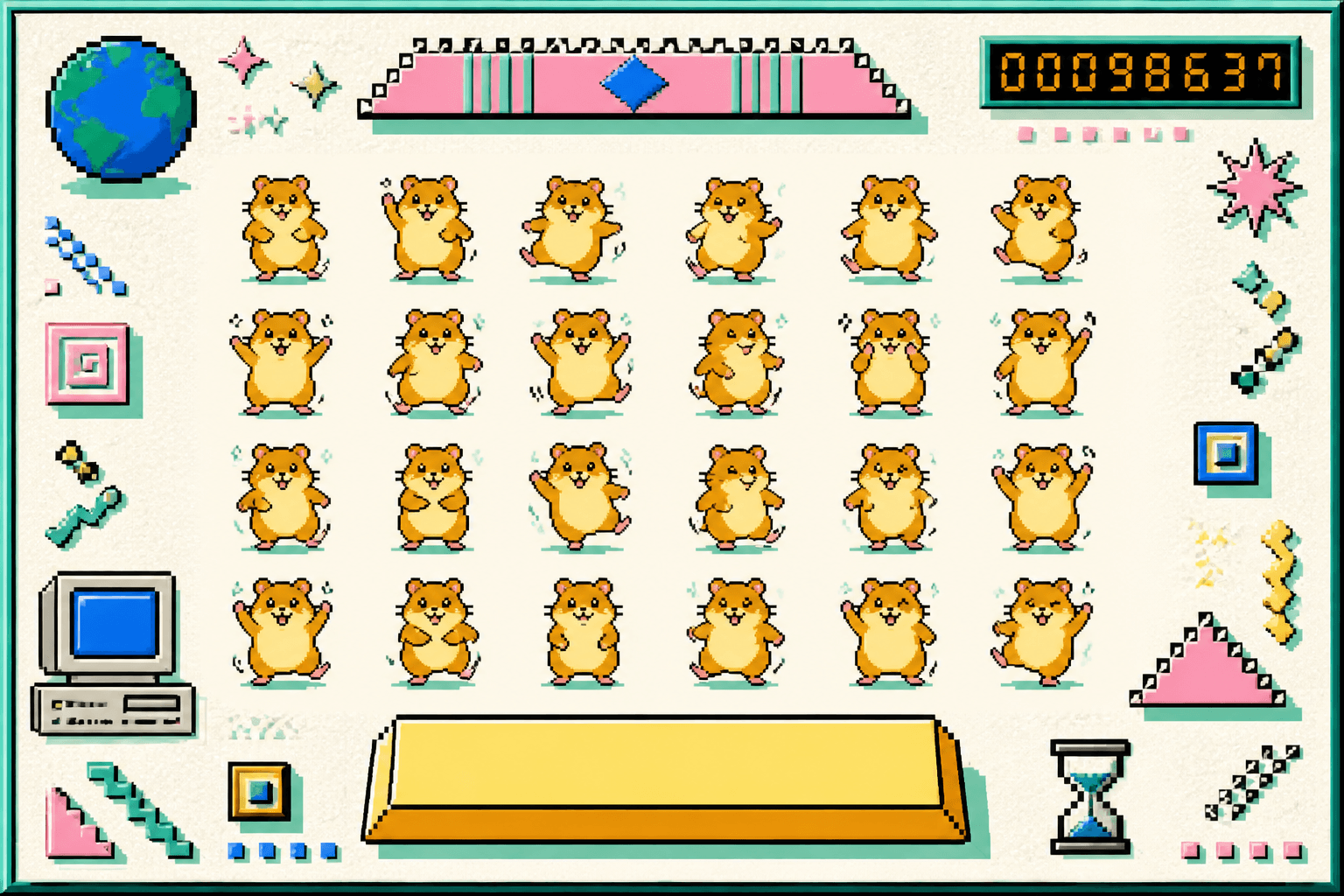
On the page: four rows of animated hamsters. Each row was a different hamster doing a different thing. One row shuffled side to side. One row bobbed. One row jumped. One row did a little twist that was either a dance move or a seizure depending on your frame rate. Each hamster was about the size of a quarter on your monitor. There were maybe twenty of them.
Underneath: a MIDI file of the "Whistle Stop" song from Disney's Robin Hood, sped up by a factor of two, looped on a nine-second track that restarted the moment it ended with a little tape-splice click.
That was the website.
That was the whole thing.
Four rows of hamsters. A sped-up MIDI on a nine-second loop. There was no About page. There was no Next button. It was a destination with no exit sign.
There was no About page. There was no Next button. There was no store. There was no newsletter signup. There was a hit counter in the corner that rolled over about once a minute. That was your only hint that other people were also there, doing this, at the same time, from their own family computers in their own kitchens. The hit counter said four million and change. By the end of 1999 it would say seventeen million. The hit counter was the only context.
Try It
Hit the button. The hamsters move. The music starts. There is nothing to click. There is nothing to win. There is a timer that tells you how long you have been watching, in case you lose track, which you will.
What We Did On The Page
What we did on the page was: nothing.
There was nothing to do. That was the structure. That was the design. You could not interact with the hamsters. You could not change the music. You could not leave a comment, because leaving a comment on a website was not a thing most of us had ever done. The web, in 1998, was still mostly a one-way broadcast. Somebody made a page. You looked at it. You left.
Except here you did not leave. You sat on the carpet in front of the family computer, in the room where the family computer lived - the dining room, the den, the corner of your parents' bedroom - and you watched the hamsters shuffle. You tapped your foot. After about a minute you stopped noticing you were listening to the same nine seconds. After five minutes you had made the music part of your brain. After ten minutes you were not watching anymore so much as being watched by.
Then your mom would come in and say get off the computer. You would say just one more minute. She would say I need the phone. You would hit the back button, the modem would chirp its disconnect, the house would go quiet, and the hamsters, unobserved, would keep dancing on the server for anybody else who typed in the URL.
The Forward
Here is what was new. Here is what we did not know we were doing.
You went to school the next day. You told three kids about the website. You typed the URL on a corner of their binder. By Friday, the hamster dance was on every computer in the lab at lunch. By the following Tuesday the librarian had figured out how to block it, because the music coming out of six computers at once in a quiet library with no headphone jacks is a thing that will make a librarian start pulling the plug by the plug and not by the application.
This was the forward. This was how it moved.
We did not have retweets. We did not have shares. We did not have algorithms that would notice a page catching heat and shove it into the feed of every other person on earth. We had: a URL, a napkin, a mouth. We had: you have to see this website. The entire distribution engine of the hampster dance, from a programmer named Deidre LaCarte in Toronto in 1998 to seventeen million unique visitors by the end of 1999, was a kid telling another kid.
The entire distribution engine was a kid telling another kid. There was no algorithm. The algorithm was you, and a napkin, and the words you have to see this website.
That is, when I say it out loud, not a small thing.
The Other Hamster Sites
Because here is the other part.
The hampster dance was not the hampster dance for very long. Within a year there were copies. There were tribute pages. There was a "Hampster Dance 2" with, if you can believe it, more hamsters. There were anti-hampster pages, where somebody had put a red circle-with-a-slash over a hamster. There were ring pages, where the hampster dance was one of eight hamster-themed sites linked in a little ring at the bottom and you could click NEXT and NEXT and watch different arrangements of the same animated GIFs for the better part of an afternoon.
There was a knock-off hampster dance with the same music but the hamsters were cats. Nobody was mad. Everybody understood. It was the same game.
There was also - and this is the part I think about most - a song. A novelty record label signed the thing, got clearance on the loop, added lyrics that were basically just the word "hamster" repeated at various pitches, and released a full "Hampsterdance Song" single that hit the UK top twenty in 2000. A website with four GIFs on it became a charting pop song. In two years. With no precedent. With no business model. With no marketing plan other than the napkin.
- the original. four rows, one song, one hit counter.
- hampster dance 2. more hamsters. same song. more loop. no improvement.
- the kitten dance. cats this time. exact same song. unauthorized but fine.
- the song. boyd & the boyz, 2000, number four UK. somebody got paid.
- the lawsuit. some noise about MIDI ownership. everybody shrugged.
- the webring. eight themed hamster pages, linked in a circle. you could go for hours.
- the beanie. they made a beanie. nobody remembers who bought it.
The Internet Before It Was A Thing
Here is what I keep coming back to.
The hampster dance was not funny. It is not a joke. There is no punchline. There is nothing about it. Twenty animated hamsters on a tiled background, doing four different animations, over a sped-up MIDI of a whistling song from a 1973 Disney movie. If you describe it to a person who was not there, they will nod politely and change the subject. They are being generous. The description is accurate. The thing described is not interesting.
And yet.
And yet seventeen million people in 1999 typed in the URL. By hand. On a computer that was sitting in the dining room. Over a dial-up connection they had to negotiate with their mother to use. To look at some hamsters.
The hampster dance is interesting because the hampster dance is the shape of the thing that came after the hampster dance. The shape was: you make a thing with nearly no inputs and no cost and no reason. You put it somewhere other people can reach it. If it hits something small and specific in a person - a rhythm, a loop, a surprise, a shape - they will tell five other people. Those five will tell twenty. Twenty will tell a thousand. No gatekeeper. No cover charge. No approval. Just: you have to see this.
That is every piece of internet culture for the last twenty-five years. That is Keyboard Cat. That is Nyan Cat. That is the dress. That is every TikTok that ever came through your phone from a cousin who insisted you watch it right now, in the kitchen, with the sound on. The hampster dance was the first time that machine ran, cleanly, at scale, with no commercial engine behind it. Just a page, and a song, and a napkin.
The Argument With Itself
I want to be fair about this.
It was a good website. It was a kind website. It did not sell you anything, it did not log your IP for later, it did not come with a pop-up ad for X10 spy cameras. The music was free. The hamsters were free. The hit counter was a little lie about how popular you were for being there. The whole page was, in retrospect, one of the purest things the web has ever produced - a thing that existed because one person in Toronto thought it would be nice if there were hamsters on the internet, and then there were, and then everybody looked at them.
I agree with that. I love that about it.
I would also note, out loud, that we spent hours staring at it. That we did not know we were doing anything in particular. That the muscle we were building - the muscle for consuming a short, looping, hypnotic, context-free piece of visual-plus-audio content, delivered through a browser, recommended by a friend, with no way to leave but the back button - is the muscle that now controls most of our evenings and some of our afternoons.
The hampster dance was not training us for anything. The hampster dance did not have a plan. But it was, as it happened, teaching our brains how to receive the next twenty-five years. The nine-second loop. The random stream of a thing at a thing at a thing. The sensation of being inside a small, animated room from which there was no exit and in which you also did not want one.
The hampster dance did not have a plan. But it was, as it happened, teaching our brains how to receive the next twenty-five years.
I am not saying the hampster dance made us the way we are. I am saying the hampster dance was the first thing a lot of us encountered on a screen that did what later screens would do without asking: get in, loop, hold us there, release us only when a parent told us to log off so the phone could ring.
That is a weird thing to notice about a page full of hamsters.
The Nine Seconds
The song was nine seconds long.
The song was, specifically, a little passage from Roger Miller's Whistle Stop, sped up to about one and a half times its original speed, which made Roger Miller sound like a chipmunk, which is probably not what Roger Miller had in mind in 1973 when he was writing the soundtrack for an animated fox version of Robin Hood for Disney. Roger Miller was dead by the time the hampster dance started looping him. His estate, I assume, got nothing. Nobody got much of anything. The whole economy of it was: a woman in Toronto, some free hosting, a GIF animator, and the goodwill of a MIDI file.
Nine seconds, looped forever. You can still hear it, right now, if you grew up with it. The whistle. The little dum-de-dum. The drop. The restart. The restart. The restart.
The restart was the whole product. The restart was the thing that made you not leave. The song did not resolve. The song never got anywhere. The song could not end, because the song was designed - if designed is the word - to loop without seam, and so you sat there, the hamsters moving in their rows, the music refusing to go anywhere else, and you waited, without knowing you were waiting, for the thing that was never going to happen next.
The End
I typed the URL once, maybe three years ago, out of curiosity. The site was still there. The hamsters were still dancing. The hit counter had stopped at some round number many years ago because nobody was updating the server, but the GIFs were still looping, and the MIDI was still playing, and the whole thing was still a page that did nothing, the same nothing, at the same tempo, that it had been doing when I first saw it on a beige computer in my parents' dining room in 1998.
I watched it for a minute.
I was going to say I watched it for a minute and then I closed the tab. That would be the clean ending. That would be where the essay stops.
I watched it for about eleven minutes.
I did not do anything else during the eleven minutes. I did not scroll. I did not take notes. I did not open another tab. I sat in a chair at thirty-something years old and watched twenty animated hamsters do four different dances on a tiled background, and I listened to a chipmunked loop of a seventy-year-old whistling song, and I had, somewhere around minute six, a specific and completely useless memory of sitting on the carpet in a room that no longer exists in a house my parents sold years ago, watching the same hamsters do the same four dances while my mom said five more minutes from the other room.
The hampster dance is still working.
That might be the problem. That might be the point.
The nine seconds still loops. The hit counter still lies a little. Somewhere, a kid I will never meet is typing the URL into a browser because somebody wrote it on a napkin. There is nothing there. There is everything there. There are just hamsters.
I was a visitor. I am a visitor. You are a visitor. The hampster dance is not asking you to do anything. The hampster dance is not asking you to stay.
You will stay anyway. It will not notice. It does not care.
That is, I think, the only thing we really learned on the internet.