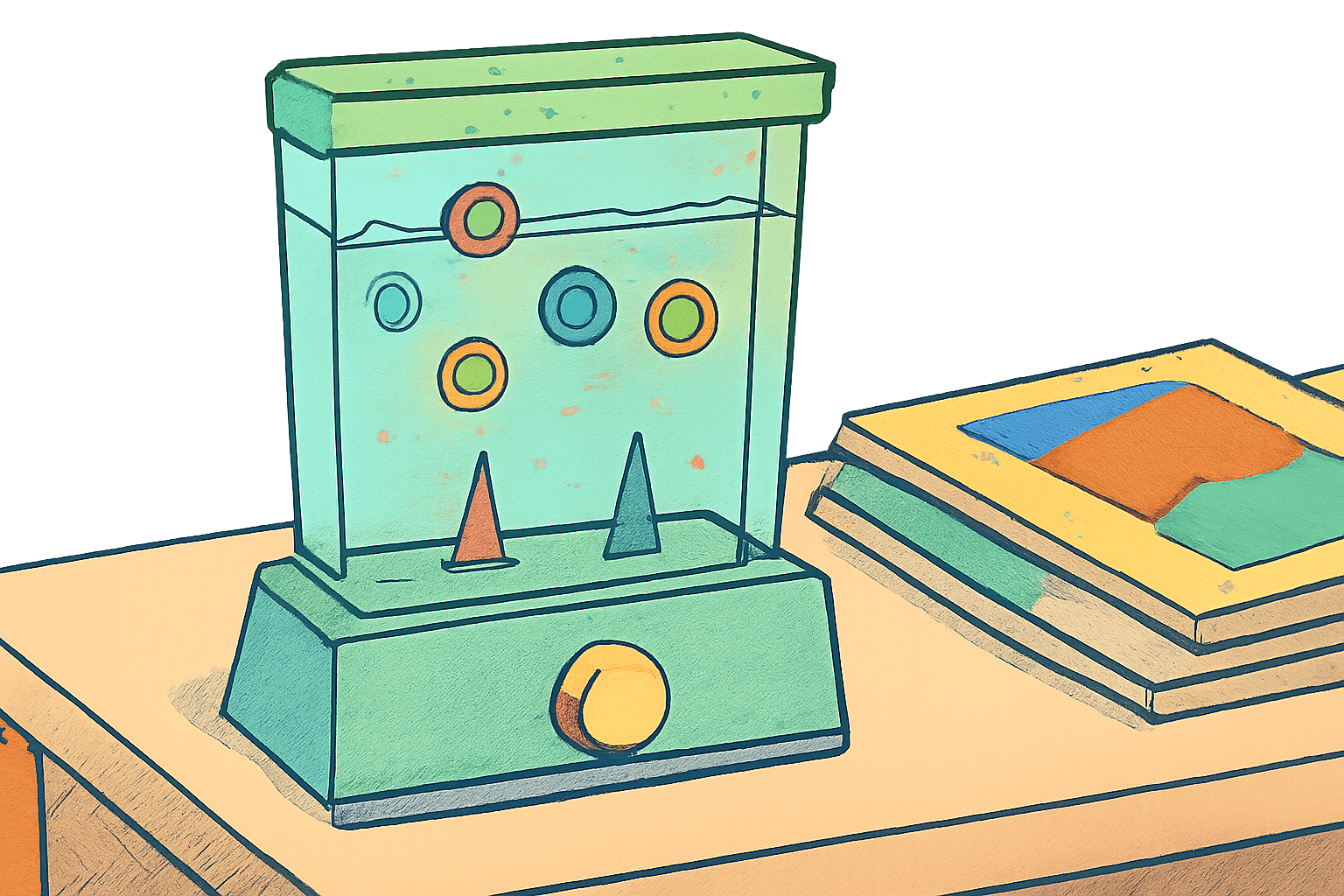
It was sitting on the end table next to a Reader's Digest from 1994 and a bowl of those strawberry candies that nobody ever purchased but every grandmother possessed. The handheld water ring toss game. You know the one. Clear plastic, shaped like a little rectangle or sometimes a little phone, filled with water and a few colored rings floating around inside. Two little posts sticking up from the bottom. A single white button on the front that, when pressed, shot a tiny jet of air bubbles into the water, sending the rings tumbling upward in slow motion.
You picked it up because there was nothing else to do. You were seven, maybe eight, and you were in a place where time didn't work - the podiatrist's waiting room, your great aunt's living room, the back of a laundromat, the lobby of the H&R Block where your mom was getting her taxes done. Places that smelled like carpet cleaner and old coffee. Places where the magazines were for adults and the chairs were for adults and everything about the environment communicated, clearly and without apology, you are not the priority here.
But the water ring toss game was there. It was always there.
The Physics of Almost
You pressed the button. A little puff of bubbles erupted from the bottom, and the rings floated upward in that dreamy, underwater way - not fast, not slow, just inevitable. You watched them drift and tumble, and you tilted the whole thing slightly, trying to guide a red ring toward the post on the left. It drifted close. So close. Then the bubbles died and the ring sank back down and settled on the bottom, three millimeters from where you needed it.
You pressed again. Harder this time, like that would matter. It didn't matter. The button had one speed. The bubbles had one speed. The rings moved at whatever pace they wanted, governed by physics you didn't understand and couldn't negotiate with.
The button had one speed. The bubbles had one speed. The rings moved at whatever pace they wanted, governed by physics you didn't understand and couldn't negotiate with.
Sometimes you'd get one ring on. Just one. And the satisfaction was enormous - disproportionate to the achievement, really, because all you'd done was convince a tiny plastic circle to land on a tiny plastic stick inside a sealed rectangle of water. But it counted. You'd done something. In this beige room with its beige walls and its beige purpose, you had accomplished a small, wet miracle.
Then you'd go for the second ring and knock the first one off. Every time. Every single time.
Nobody Owned One
Here's the thing. You never saw this toy in a store. You never put it on a birthday list. Nobody unwrapped one on Christmas morning and screamed with joy. The handheld water ring toss game did not exist in the consumer pipeline the way other toys did. It had no commercial. It had no brand. It had no mascot.
It just appeared.
It materialized in spaces where children needed to be quiet and still for an indefinite period of time. Doctor's offices. Church fellowship halls. The kitchen counter at your neighbor's house while your mom talked to their mom about something you weren't supposed to hear. It was less a toy and more a sedative - a physical object whose only purpose was to keep small hands occupied while the adult world conducted its slow, incomprehensible business.
- Your dentist's waiting room, next to Highlights magazine
- Grandma's spare bedroom, in the nightstand drawer
- The basket of toys at the mechanic's shop
- Your babysitter's kitchen counter
- The "activity bin" at church
- The back seat pocket of your uncle's minivan
- That one shelf at the dollar store you walked past a thousand times
And it was always a little gross. The water inside was never quite clear. It had a faint yellow tint, like it had been sitting in sunlight for a decade, which it probably had. Sometimes there was a tiny air bubble trapped inside that wasn't supposed to be there - not the bubbles from the button, but a rogue bubble, an interloper, drifting around aimlessly and making you wonder if anyone had ever cleaned this thing. Nobody had ever cleaned this thing.
You played with it anyway. Because what else were you going to do? Read a pamphlet about gum disease?
The Unwinnable Game
I don't think I ever got all the rings on. I'm not sure anyone did. The game had - what, four rings? Six? It didn't matter. Getting one on was luck. Getting two on was a miracle. Getting all of them on simultaneously was a mathematical impossibility, because the same bubbles that pushed the last ring up would inevitably dislodge the ones already sitting there. The game was designed to be almost-won forever.
The game was designed to be almost-won forever. Every attempt ended the same way - with the rings settling back to the bottom, patient and indifferent.
And yet you didn't get frustrated. Not really. Not the way you'd get frustrated losing at a video game or striking out in kickball. The water ring toss game existed in a different emotional register. It wasn't competitive. It wasn't urgent. It was just there, and you were just there, and the two of you were passing time together in a room that smelled like old magazines and antiseptic.
There was something almost meditative about it. Press. Watch. Tilt. Miss. Press again. The rhythm of it, the repetition, the tiny splash of bubbles and the slow drift of the rings. You'd zone out, your eyes going soft, the waiting room dissolving around you until there was nothing but water and plastic and the quiet hope of getting the blue ring on the tall post.
The Specific Texture of Waiting
Kids today don't wait the way we waited. I don't mean that in a judgmental way. I mean it literally. They have phones. They have tablets. They have an infinite scroll of entertainment available at all times, which is fine, which is genuinely fine, but it means they'll never know the particular texture of waiting with nothing.
Nothing except the ring toss game and a four-year-old copy of Sports Illustrated and a fish tank with one surviving fish and the muffled sound of your mom explaining her symptoms to someone behind a sliding glass window.
That kind of waiting shaped you. It taught you that boredom wasn't an emergency. That you could sit with nothing happening and survive. That a sealed plastic rectangle filled with lukewarm water and some rings could be, for twenty minutes, the most interesting thing in the world - not because it was interesting, but because you decided it was.
I saw one at a thrift store last month. Sitting in a bin with some Happy Meal toys and a headless Barbie and a single Jenga block. Same clear plastic. Same yellowish water. Same little rings floating inside, same little posts waiting at the bottom. It cost twenty-five cents, which felt like exactly the right price for something that had never been worth anything and had always been worth everything.
I picked it up. Pressed the button. The bubbles rose, and the rings tumbled, and for about ten seconds I was back in Dr. Morrison's waiting room in 1996, sitting in a chair that was too big for me, swinging my legs because they didn't reach the floor, waiting for my name to be called, completely unbothered by the fact that I had nowhere else to be.
I didn't get any rings on. I put it back in the bin.
Some games you don't play to win. Some games you play because the waiting room is long and the chair is too big and there's nothing else to do but press the button and watch the rings float up and hope, gently, that one of them lands.