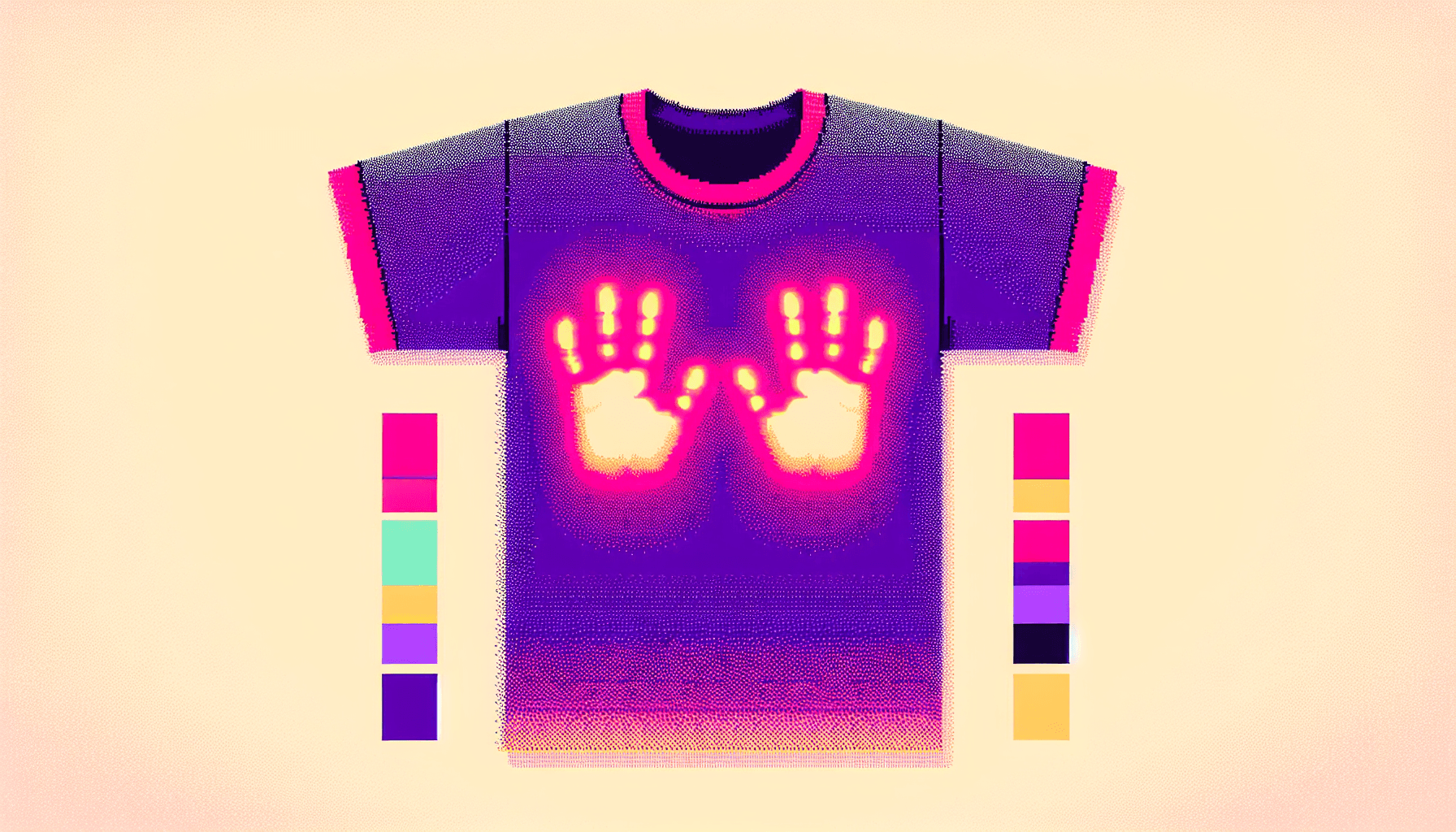
The first time someone hugged you while you were wearing one, you stepped back and saw two perfect pink handprints on your chest. Your friend's hands. Recorded, broadcast, glowing on your sternum like the world's slowest Polaroid. Everyone at the bus stop saw it. Your friend laughed. You laughed. Then you both looked down at the same time and noticed your armpits had gone the same color as the handprints.
The shirt was telling on you. It was telling on everyone.
Generra Sportswear called it Hypercolor. The packaging called it "color-changing." The ads called it the future. The gym teacher in second period called it "absolutely not, go change." And every kid who owned one called it, eventually, the shirt I had to throw away because mom washed it on hot.
How It Actually Worked
The technology was real, which somehow made it worse. The dye was something called a leuco dye, suspended in tiny capsules embedded in the fabric. Below about 85 degrees Fahrenheit, the molecules sat in a configuration that absorbed one wavelength of light - say, purple. Above 85, the molecules rearranged themselves and started absorbing a different wavelength - say, pink. Your skin was around 90. Your hand pressed against a friend's chest was around 88. Your armpit was a small inferno that hovered around 94 even when you were sitting still.
The shirt could read all of this. It read it instantly. It read it whether you wanted it to or not.
The dye didn't know it was supposed to be a fashion statement. It was just doing physics. Physics, unfortunately, is a snitch.
What this meant in practice was that you, an eleven-year-old, were now wearing a real-time visualization of your body's surface temperature. A scientific instrument in t-shirt form. NASA had spent decades building thermal cameras. Generra had bottled the same idea and sold it at JCPenney for $19.99.
The Armpit Problem
We need to talk about the armpits.
Here is the central, unsolvable design flaw of the Hypercolor t-shirt: the parts of your body that were always the warmest were the parts you most wanted to keep secret. Your armpits ran hot all the time. So did the small of your back, where your shirt touched your skin without any air between. So did the front of your stomach, after lunch. So did the back of your neck, especially during a math test.
The shirt didn't ask if it was a good time to declare any of this. The shirt just rendered it, in pink, on purple, in front of God and Mrs. Halverson and the kid you had a crush on.
Your armpits were the worst part, though. They were always on. Even when the rest of the shirt was its proper baseline color - that lurid Crayola purple, or the grape-soda blue, or the radioactive teal - your underarms had two halos of pink the size of grapefruits. Stationary. Permanent. There from the moment you put the shirt on. You could lift your arms and the rest of the class would see two color-shifted ovals on each side of your torso, glowing faintly, advertising the fact that you were a sweating person who lived inside a warm body.
What Heat Could Do To You
The shirt also responded to other people. This is where it became a social weapon.
A friend leaning against your shoulder during a movie. A handprint, lingering for ninety seconds, then fading like a bruise. Someone slapping the back of your shirt to get your attention. A whole pink palm visible across the room until thermal equilibrium reasserted itself. Your own forearm pressed against your stomach during a yawn. A streak.
The school bus seat would leave a giant pink rectangle across your back, exactly the size and shape of the bus seat, that lasted until you'd been standing in the parking lot for two minutes. You could not see this. Everyone behind you could.
The Hypercolor shirt was an unflattering historical record. It documented who had touched you, when, and how hard. It documented the chair you'd been sitting in. It documented the kid in the desk behind you who had quietly, idly, pressed one finger against your shoulder blade for forty seconds during silent reading time and now had a perfect pink fingertip on your back announcing it.
You couldn't keep secrets in a Hypercolor shirt. Other people could keep secrets on it.
The School Dance Was a Disaster
I don't want to talk about the school dance, but I have to. Because the school dance was where Hypercolor met its true purpose, which was to humiliate every adolescent simultaneously.
A gym full of kids in 1991. Half of them in Hypercolor. The slow song comes on. You step closer to someone. Your hands go to their waist. Their hands go to your shoulders. Sixty seconds of "(Everything I Do) I Do It For You" later, you separate, and you are both wearing the entire history of those sixty seconds in two-tone fabric. Their shirt has your handprints. Your shirt has theirs. Both of you have giant warm patches across the front from where your bodies were pressed together.
Mrs. Halverson, chaperoning, can see all of this from the bleachers. The lights come up. Forty kids slowly turn pink in unison. It looks like a heat map of regret.
The dance ended and we walked back into the hallway under fluorescent lights, our shirts slowly cooling, the ghost of the previous three minutes fading off our chests like a Polaroid in reverse.
How They Died
Hypercolor shirts had a lifespan of roughly four wears, depending on your mom.
The dye was alive, sort of. It was definitely fragile. Hot water killed it. Bleach killed it. The dryer killed it. Direct sunlight, over time, killed it. Ironing it killed it instantly and also probably released a chemical your seventh-grade self should not have been breathing.
What you were supposed to do was wash it cold, on delicate, by hand, and air-dry it indoors. What every mom in America actually did was throw it in the load with the towels because she had four kids and a job and was not going to maintain a separate laundry protocol for the shirt that made your armpits visible.
So the shirts died. They went into the wash one weekend a vivid grape, and they came out the next morning a kind of muted, lifeless mauve, and the magic was just gone. The hot water had ruptured the dye capsules. The molecules couldn't go back. You'd put the shirt on and rub it and breathe on it and put your hand inside it and nothing would happen. It was now just a t-shirt. The worst possible thing for a Hypercolor shirt to be.
By 1992, Generra had filed for bankruptcy. They'd had one of the most explosive fashion runs of the decade and they'd run out of money faster than the dye ran out of magic. Some of it was overproduction. Some of it was that everyone's parents had quietly stopped buying replacements after the first one died in the wash. The shirt was beautiful and clever and self-destructive, all in the same fabric.
What It Was, Actually
Here's the thing I keep coming back to.
The Hypercolor shirt was, in a real sense, the first wearable that gave you back data about yourself. A decade before Fitbit. Three decades before the Apple Watch. A weird purple t-shirt that visualized your skin temperature in real time and broadcast it to the room.
The difference is that nobody asked for it. Nobody wanted their thermal data on the outside of their body. Nobody, especially, wanted that data to include their armpits. The Hypercolor shirt was a wearable that worked correctly and was, for that reason, a public relations disaster. It did the thing. The thing turned out to be wildly inappropriate to do in front of other people.
There's something funny in there about wearables in general. Everything we put on our bodies that records something about our bodies has the potential to embarrass us. The watch knows your resting heart rate spiked when your ex texted. The ring knows you didn't sleep. The shirt, in 1991, knew your armpits were warm and showed everyone in homeroom. We just didn't have the vocabulary then to call it "biometric data." We called it "Mom, my shirt is doing the thing again."
The Last Pink Handprint
I had a teal one. I don't remember where I got it. I remember the day it died because my mom apologized about it later, which was rare, so it stuck.
Before that, though, I remember pressing my palm against the front of it and watching a perfect outline of my hand bloom out of the teal in a kind of warm coral pink. I remember holding my hand there until I could feel the heat transfer through, until the shirt was warmer than the room, and then pulling my hand away and watching the pink slowly retreat back into the teal in a way that felt almost magnetic. Like I had marked it. Like the shirt had remembered me, briefly.
That was the appeal. The shirt was a small surprise, every time. You'd forget you were wearing it and then you'd lean against a wall and walk away and there'd be a kid behind you yelling dude your back and you'd contort yourself trying to see what your back looked like and you'd just have to trust them about it. The shirt was always doing something. It made the act of being a body in a room slightly more visible than it usually was.
Which, depending on what kind of kid you were, was either thrilling or unbearable.
The Hypercolor shirt died because it told too much truth about your body. We replaced it, eventually, with phones that do the same thing in private. But for a few months in 1991, you could walk into school wearing a piece of fabric that told everyone, instantly and accurately, exactly how warm you were. And we all decided that was fine. Some of us, briefly, even thought it was cool.