Red. Blue. Yellow. Green.
Never brown. Never black. Never the color you actually needed. Four half-length wax stubs in a paper sleeve, dropped on the table by a server who had done this seven hundred times that shift, alongside a folded kids menu and a placemat with a hamburger on it. The hamburger had eyes. The hamburger was smiling. For some reason the hamburger seemed happy about the fact that it was about to be eaten.
You shook the sleeve open. You dumped the four crayons onto the placemat. You picked one up. It was broken.
The Sleeve
The sleeve was the size of a stick of gum.
It said RESTAURANT CRAYONS in a cheerful sans-serif on one side, or sometimes it just had a small picture of a crayon and nothing else, because whoever printed the sleeves had cut the design budget in half sometime around 1994. The sleeves were made by a company in Ohio that also supplied ketchup cups and paper coasters and those little folded receipt trays. Every restaurant in America got their crayons from the same place. That's why the crayons at Applebee's felt exactly like the crayons at the Country Kitchen next to the Best Western felt exactly like the crayons at the diner attached to your grandfather's bowling alley.
The four colors were always the same. Red, blue, yellow, green. The three primary colors of a color wheel that nobody had explained to you yet, plus one that wasn't primary but felt like it belonged. Nobody at the crayon factory had considered what a nine-year-old might actually need in order to color a hamburger. Nobody had considered anything. They had picked four because four fit in the sleeve, and they were right, because you had never demanded a fifth.
You held them like a small fan. You held them like tiny cigars. You held them wrong. It didn't matter, because they were about to be broken anyway.
The Placemat
The placemat was manila paper, or, at ambitious establishments, a saturated primary color that the crayons could barely register on.
At the top: the restaurant's logo, and the words FOR OUR YOUNGEST GUESTS in a font that had opinions. That was you. You were a youngest guest. You had reached the age at which the kids menu was becoming actively insulting - the age where you would still order chicken tenders but felt a little embarrassed about it - but the placemat said what it said, and you were nine, and you accepted the terms.
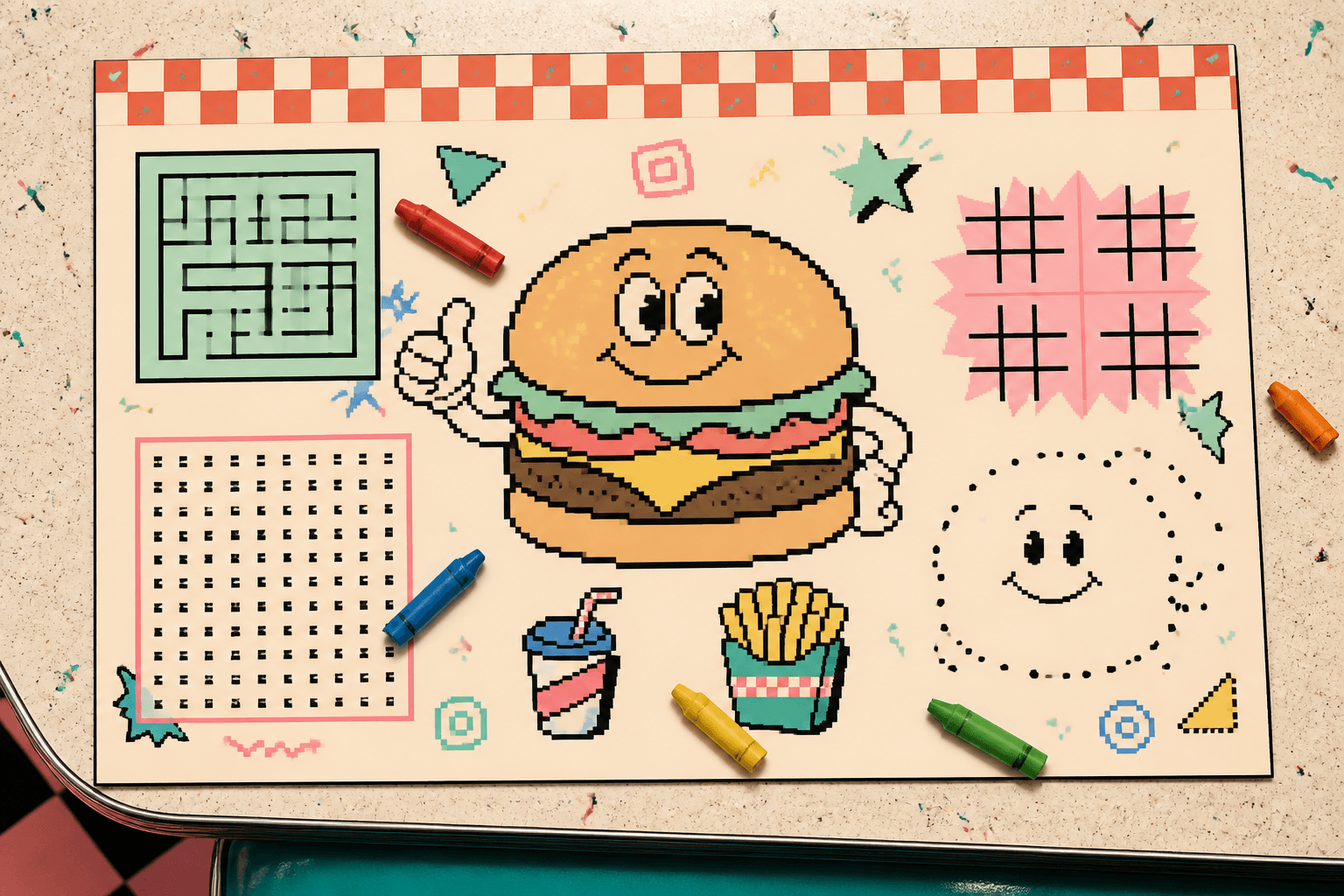
The rest of the placemat was divided into activities. There were always five. There has never been a documented case of a kids menu placemat with fewer than five activities or more than five. This is a national standard that has never been officially ratified but is nonetheless observed.
- The Maze. Guide the hamburger to the fries. Insultingly easy.
- The Word Search. Find BURGER, FRIES, SHAKE, MENU, SODA. No diagonals.
- Connect the Dots. Reveal the hidden picture. It's another cheeseburger.
- The Coloring. The hamburger with eyes. Sometimes arms.
- Tic-Tac-Toe. Three blank grids. All three end in draws.
You knew the layout before you sat down. Every placemat in America had these five things and they had them in more or less the same arrangement. This was learned once, at age three, and never updated. If a restaurant had put a sudoku on there you would have flipped the table.
The Maze
The maze was insultingly easy.
Fifteen decision points, maybe. Twelve of them were dead ends of two moves or less. The correct path snaked through in a shape that a five-year-old could reverse-engineer just by looking at the whole thing at once. The maze was for children who could not yet read. You were nine. You knew this. You did it anyway, because that was the deal, and because there was nothing else to do.
Eight seconds. Red crayon. Right, down, right, down, left, down, right. You were at the fries. The placemat was one-fifth done.
Fifty-two more minutes until the food came.
The Word Search
The word search had five words: BURGER, FRIES, SHAKE, MENU, SODA. All caps. Listed in a small box. Ten-by-ten grid of random letters.
BURGER was horizontal in row two. FRIES was vertical in column four. You found them all inside thirty seconds. There were never diagonal words. There were never backward words. The placemat did not respect you as a puzzle solver, and you did not resent it, because the placemat was not there to challenge you. The placemat was there to buy your parents a few minutes.
You circled each word with the blue crayon. That was the rule. Word search: blue. Maze: red. Coloring: whatever crayon still had a point on it. Connect the dots: yellow, because yellow barely showed up on manila paper, and if the picture was going to be hidden anyway, it might as well be hidden by a nearly invisible line.
Green was for tic-tac-toe. Green was always for tic-tac-toe. Nobody knew why.
The Coloring
The coloring section was a line drawing of a hamburger with eyes.
The hamburger was smiling. It was smiling at you. It had a small wedge cut out of its top bun, presumably to indicate that it was mid-eaten, which was a strange thing to be cheerful about. The hamburger was cheerful about its own consumption. It was your food, and it was happy to be your food, and you were about to color it in and hand the placemat to your mom.
The trouble was the four crayons.
A hamburger needs brown. It needs brown for the bun. It needs a slightly darker brown for the patty. It needs red for the tomato, green for the lettuce, yellow for the cheese. Five colors, minimum. You had four. You did not have brown. You did not have anything remotely resembling brown. Yellow plus red mixed together might get you a kind of orange-brown, but the crayons wouldn't blend; wax on manila paper just sat on top of itself in stripes.
So you made choices. Red for the bun. That was wrong, but it was closest. Yellow for the cheese, fine. Green for the lettuce, correct, but garish, because restaurant-crayon green was closer to lime than to romaine. Blue for the plate. The plate was blue now. The plate had never been blue on any real hamburger you had ever encountered.
A hamburger needs brown. You had red, blue, yellow, and green. You made the bun red. You made the plate blue. You handed it to your mom, and she said oh honey, that's beautiful, and she meant it.
She put it in her purse. It stayed there for three weeks. Then it went into a shoebox in the attic. It is still there. Somewhere, in a shoebox in an attic in the state where you grew up, there is a manila placemat with a hamburger with a red bun and a blue plate, and it is signed on the back in a shaky nine-year-old cursive with your first name and half of your last.
The Tic-Tac-Toe
The tic-tac-toe was three grids in a row.
Three, because the restaurant already knew you would play more than one game. You played with your sibling. You played with your cousin, if it was that kind of dinner. You played by yourself if you were an only child, drawing both X's and O's with the same green crayon and pretending to be surprised when one side won, which gave you the earliest available glimpse of the fact that adult life is largely composed of playing both sides of a game against yourself for no audience.
Your sibling always went first. Your sibling always played X. Your sibling always took the center. You took a corner. They took the opposite corner. You took a side. Four moves later the game was a draw. Tic-tac-toe is always a draw between two people who understand it, and you had both been understanding it since you were four, and there were three grids, and every one of them ended the same way.
You forgot you had been playing the instant the food arrived. So did they.
The Wait
Everything on the placemat took less than ten minutes.
The maze: eight seconds. The word search: thirty. The coloring: two minutes if you were careful, less than one if you weren't. Three games of tic-tac-toe: five minutes. Connect the dots: ninety seconds, and honestly you didn't always do connect the dots, because the hidden picture was always a cheeseburger and you already knew.
Total placemat time: under ten minutes. You had thirty more.
So you drew on the placemat freehand. You drew on the back of the placemat, which was blank. You drew on your napkin. You drew on the back of the menu, which the server would eventually come by and quietly remove. You drew on your own arm, which your mom would notice and quietly disapprove of. You broke a crayon in half on purpose to see if it would still work. It would. You broke it again. Now you had two blue crayons. Now you had one blue crayon and two pieces of blue crayon. Now you had unilaterally ended the placemat's economy.
Then the food came. The server slid a plate of chicken tenders onto the middle of your placemat and it covered the maze and part of the coloring and all of the connect the dots. There was a small ramekin of ranch on the plate. You didn't move the plate. The placemat was ruined. That was fine. That had always been the arc.
The whole apparatus was a diversion device. That is the honest word for it. It was engineered to keep a small human being at a table for forty minutes without a screen, without a phone, without complaining loud enough that the adjacent table looked over. Four crayons. Five activities. One rectangle of manila paper. Forty minutes of peace for the adults.
You didn't know you were being managed. You thought you were being entertained. You were nine, and the world was throwing free crayons at you, and you assumed the world was on your side.
The kids menu itself was another marvel of separate logic. Grilled cheese. Chicken tenders. Spaghetti with marinara. Hamburger. Four items, always, everywhere. The kids menu did not care what restaurant it was inside. The same four items in New Jersey, in a Cracker Barrel outside Nashville, in a hotel restaurant in Reno. On some level you knew this. On some level you understood that you were being processed by a national system. But then you got a Shirley Temple and forgot.
I think about this at dinner now, occasionally, with my own kid, who is sitting across from me holding a tablet. She is being managed by a different diversion device. It is more effective. It is more expensive. It does not come with four crayons and it is not going to end up in a shoebox in twenty years.
The placemat is in a shoebox. The hamburger with the red bun and the blue plate. My mom kept it. I don't remember drawing it. But I remember running out of brown. I remember running out of brown every single time.