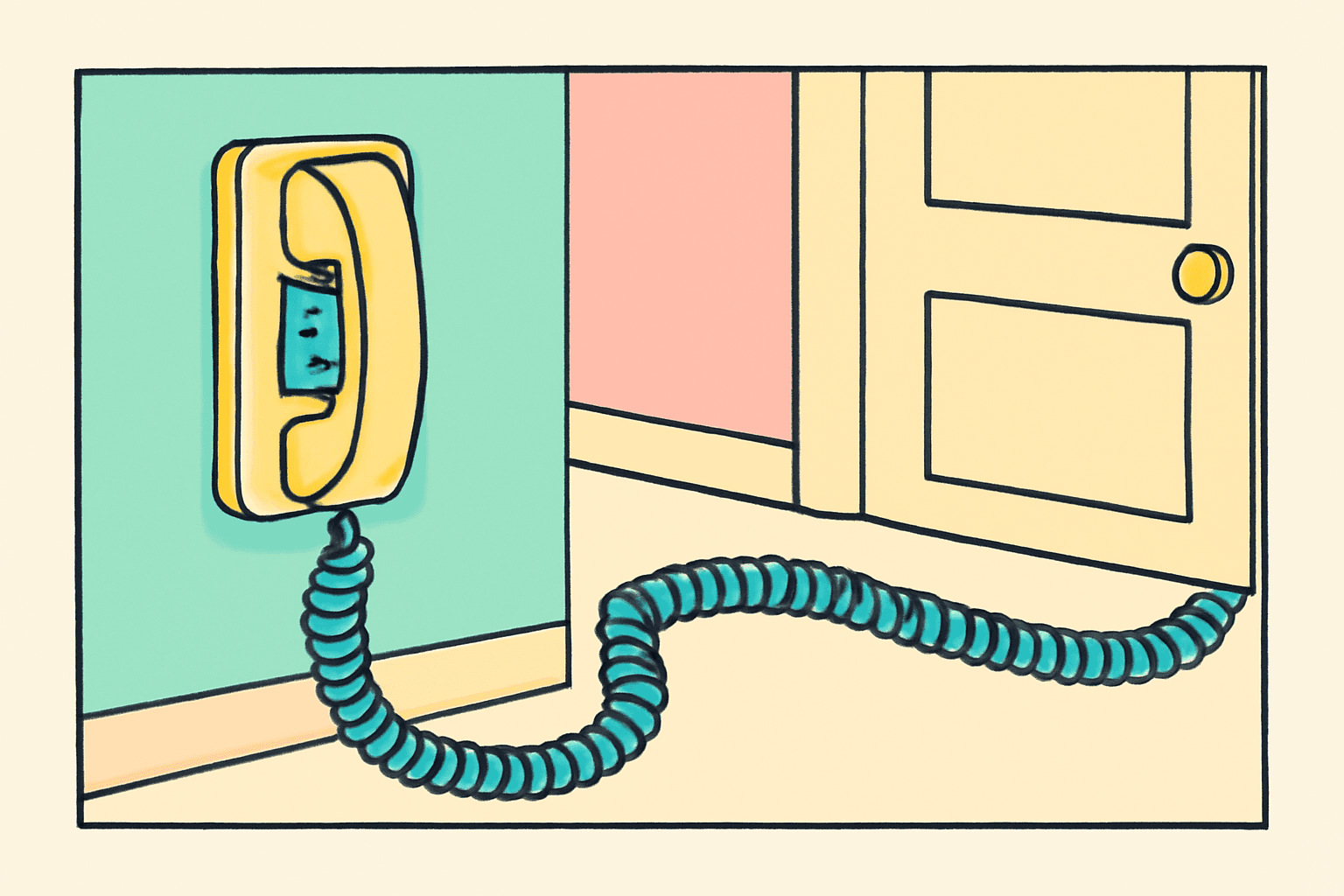
The cord on our kitchen phone reached the bathroom if you pulled it at the right angle. You had to go through the hallway, take a slight left past the linen closet, and close the bathroom door carefully - carefully - so the cord threaded through the gap without crimping. If you did it right, you could sit on the edge of the bathtub with the door shut and talk to whoever you needed to talk to in something approaching privacy. If you did it wrong, the handset ripped out of your hand and went skittering across the linoleum like a plastic hockey puck.
I did it wrong a lot.
The Archaeology of a Stretched Cord
Every household phone cord in America told a story if you knew how to read it. The coils closest to the wall jack were still tight and springy - those first couple of feet that never went anywhere. But as you moved toward the handset end, things changed. The coils got looser. Wider. Lazier. And somewhere around the middle, there was always a section - maybe eight inches, maybe a foot - where the cord had just given up entirely. Stretched straight. No coil left at all. Just a flat, slightly wavy piece of wire that had been pulled past its limit so many times it forgot what shape it was supposed to be.
That straight section was a fossil record. It was the exact point where the cord had absorbed the most tension, night after night, as someone leaned around a doorframe and stretched for those last few inches of distance from the kitchen.
Every stretched-out phone cord was a map of someone's need to not be overheard.
You could tell which direction someone usually walked by where the cord was most damaged. In our house, it stretched toward the hallway. In my friend Kevin's house, it stretched toward the basement stairs. In my cousin's apartment in Jersey, the cord went around a corner and into a coat closet, which I thought was genius until I tried it myself and realized you had to stand the whole time because there was no room to sit between the winter coats and the vacuum.
The Tangle
Nobody talks about the tangle enough. A phone cord, used regularly by multiple family members who each stretched it in different directions, would develop knots that seemed to violate the laws of physics. Not just twists. Architectural tangles. Three-dimensional puzzles of coiled wire that bunched up near the handset until you had a fist-sized lump of copper and plastic that made the effective length of your cord about nine inches.
The fix was a ritual. You held the handset up and let it dangle. Then you waited. The phone would spin slowly, unwinding itself, rotating in lazy circles like a hypnotist's pocket watch. You'd stand there in the kitchen, arm extended, watching the handset turn and turn and turn, and when it finally stopped you'd have a functional cord again for approximately forty-five minutes before someone twisted it right back up.
Cord Tangle Contributing Factors, Ranked:
- Switching the handset from one ear to the other mid-conversation
- Pacing while talking (the cord wraps around you without you noticing)
- Multiple family members stretching it in opposite directions
- Hanging up the phone with a twist instead of placing it straight down
- Your little brother using the cord as a jump rope (just me?)
Some families tried to manage this. My mom would periodically unplug the handset end, let the whole cord dangle and unspin, then plug it back in. It was phone cord maintenance. A chore nobody assigned but somebody always did.
The RadioShack Solution
At some point, somebody in your house decided the factory cord wasn't long enough. Maybe it was a parent who wanted to cook dinner while on the phone. Maybe it was a teenager who had discovered that the cord reached the hallway but not the bedroom. Whatever the reason, someone made a pilgrimage to RadioShack and came home with a replacement cord.
These cords were heroic. Twenty-five feet of coiled wire. Fifty feet. I swear I once saw one that claimed seventy-five feet on the packaging, which would have let you take a phone call from the kitchen to the garage. They came in beige, off-white, and a slightly different beige. They cost four dollars. And they changed the geometry of privacy in your household overnight.
With a long enough cord, you could actually close a door between yourself and your family. You could sit on your bed. You could whisper. You could have the kind of conversation that a fourteen-year-old needs to have - about who said what at lunch, about whether somebody likes you, about the thing your parents did that felt unfair - without your mom hearing every word from eight feet away at the kitchen counter.
The cord was the infrastructure of adolescent privacy. Every foot of it was earned, either through patient stretching or a $3.99 investment at the strip mall.
Privacy used to be a physical problem. You solved it with your feet, a long cord, and a closed door.
The Cordless Revolution
And then came the cordless phone. If the coiled cord was a leash, the cordless was liberation. A Panasonic or a VTech or an AT&T handset sitting in a charging cradle on the kitchen counter, and you could just pick it up and walk away. Any room. Any floor of the house. The backyard. You could take a phone call in your bedroom with the door locked and nobody could do a thing about it.
It felt like a miracle. For about six months.
Because cordless phones had problems the old cord never did. The battery died. It always died. You'd be twenty minutes into a conversation and the handset would start beeping - this pathetic little chirp every thirty seconds that meant you had maybe five minutes before the call dropped entirely. And the charging cradle only worked if someone actually put the phone back on it, which in a household with teenagers meant the phone was perpetually at eleven percent of whatever passed for battery life in 1998.
Cordless Phone Grievances:
- The handset was never on the cradle when you needed it
- You could hear static if you walked too far from the base station
- Your neighbor's baby monitor sometimes bled into your frequency
- The "page" button on the base that made the handset beep was the only way to find it, and half the time it was between couch cushions
- Rechargeable battery packs that cost $15 and lasted six months before they stopped holding a charge
The range was also a lie. The box said 300 feet. In practice, you got maybe two rooms away before the static started creeping in. Walk upstairs and around a corner and you sounded like you were calling from a submarine. The old cord was limited, sure, but within its range the audio was perfect. Crystal clear. You could hear someone breathing on a corded phone. The cordless gave you freedom but took away fidelity.
The Distance That Mattered
Here's what I keep thinking about. The coiled phone cord made privacy into a physical negotiation. You wanted to say something your parents couldn't hear? You had to work for it. You had to stretch the cord, find the room, close the door, accept the awkward posture, deal with the tangle afterward. Privacy was not a setting you toggled. It was a distance you traveled.
And everyone in the house understood what it meant when you stretched that cord around the corner. They knew you needed space. The visual was unmistakable - a teenager pulling a phone cord taut, leaning into the hallway, voice dropping to a murmur. It was a declaration. I need to not be heard right now. And most of the time, your family respected it. Not because they weren't curious. But because they could see the effort, and the effort meant it mattered.
Now privacy is invisible. It happens behind screens, inside apps, in encrypted messages that leave no trace. Nobody has to stretch anything to say something secret. A kid today can text from the kitchen table, three feet from their parents, and have a conversation more private than anything I ever managed with forty-seven feet of RadioShack cord and a locked bathroom door.
I don't know if that's better. I think it probably is, in most ways. But I miss the honesty of the cord. The way it made your need for privacy into something visible, something physical, something your family could see and choose to respect. The way it told the truth about how far you were willing to go to not be overheard.
Sometimes I think about our kitchen phone. The handset in its cradle. The cord hanging down with that one permanently straightened section in the middle, loose and tired, shaped by years of someone pulling it just a little farther than it wanted to go. A small record of every whispered conversation, every closed door, every secret that needed exactly twelve more inches of wire to stay safe.
Nobody measured those cords. But everybody knew exactly how far they reached.