There is a particular kind of nostalgia that doesn't quite have a name. It isn't simple longing - the warm, photogenic kind you can package into a playlist or a Netflix series. It's something closer to grief. The grief of having lived in one world and then watched, in real time, as it dissolved into something unrecognizable. If you were born in the 1990s, you know exactly what this feels like. You didn't just grow up. You witnessed a before and an after, and you were unlucky - or lucky - enough to straddle both.
We were, in the truest sense, the last analog children. We grew up before social media made every moment a performance, before smartphones turned every quiet minute into a scroll, before the internet reached into every corner of childhood and rearranged the furniture. We played outside not because our parents were enlightened about screen time, but because outside was simply where you went. There was nothing else. The street was the social network. Boredom was the algorithm.
- Calling a friend's house and talking to their dad
- Maps you had to fold wrong
- Saturday morning cartoons as appointment television
- Being unreachable
- Arguing about facts with no way to settle it
- Waiting a week for the next episode
- Rewinding the tape
- The sound of dial-up
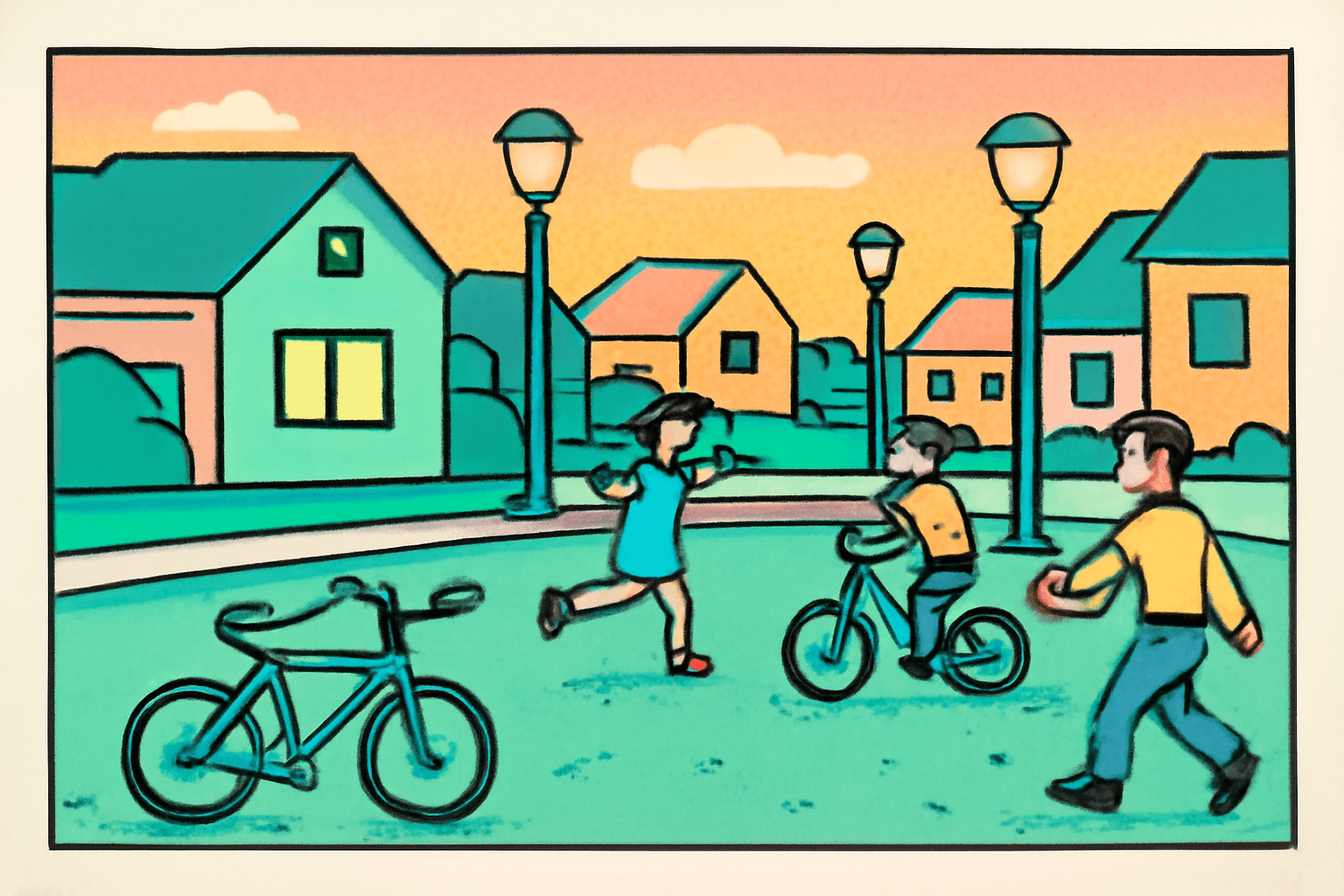
The strange thing is that we didn't know we were living in the last days of something. That's the nature of endings - they rarely announce themselves. We were just kids, riding bikes until the streetlights came on, memorising each other's phone numbers because we had no other choice, lying on the carpet watching cartoons at 7am on Saturday mornings like it was a sacred ritual. Which, in retrospect, it was.
The Geography of Then
To be a 90s child was to be embedded in place in a way that's almost impossible to explain to someone who grew up with a smartphone. Your world was your street, your school, your town. That was it. Your social life didn't extend beyond a five-mile radius, and somehow that wasn't a limitation - it was the whole texture of existence. You knew your neighbours. You knew which houses had dogs. You knew the particular dread of having to knock on someone's door and ask if so-and-so could come out to play.
Friction was everywhere, and friction was good. You had to physically go somewhere to know what was happening there. You had to show up, in person, with your actual body. Plans were made in advance and mostly honoured, because cancelling required calling the home number, and calling the home number meant potentially speaking to someone's mum, which was terrifying enough to make you keep your commitments.
We were the last generation for whom being lost was still possible - and being found still meant something.
We were also, and this feels important, the last generation who grew up without documentation. Nobody was photographing your birthday party on a device that would upload it to the cloud. Your childhood exists only in the memories of the people who were there, in a handful of blurry photographs, in the specific weight of a camcorder tape you're no longer sure anyone has. There is a privacy to that, an intimacy, that children born after us will simply never know. You were allowed to be awkward and strange and unformed without a record being kept.
The Particular Sadness of Being First
The 90s kids who were born toward the end of the decade - 1996, 1997, 1998 - had it slightly different from those born at its beginning. The early-decade kids remember a childhood almost entirely untouched by the internet. But those of us who arrived later got something stranger: we got to watch the transition happen. We got the before, and then we got the after, and we got to feel the exact moment the axis shifted.
I remember the first time the internet arrived in our house. I remember the sound of it - that shrieking, grinding handshake of dial-up, like the world's most reluctant door opening. I remember the slowness of it, the small marvel of a webpage loading one excruciating stripe at a time. And I remember that none of us understood what it was, not really. Not what it would become. We thought it was a tool, like a better encyclopedia. We did not understand it was a weather system.
By the time we were in secondary school, things had started to shift. MSN Messenger arrived and suddenly you could speak to people from your actual life through a screen, which felt miraculous and faintly illicit. Then came MySpace, then Facebook, then a cascade of things arriving faster and faster, each one reorganizing the social world just as we'd got used to the last one. We adapted, because teenagers always adapt. But something was different. Something that had felt stable - the clear separation between your online life and your real one - had begun to blur.
The generations after us never had that separation to lose. For them, the digital world has always been as real as any other kind. But for 90s kids, there is a persistent awareness of a seam - a place where one world ended and another began. We can feel it still. We carry it like a scar from a surgery we don't quite remember.
What the Internet Actually Took
It's too easy, and too wrong, to say the internet ruined everything. It didn't. It gave us things we couldn't have imagined - access, connection, the ability to find your people regardless of where you were born. For lonely kids in small towns, for queer teenagers, for anyone who never quite fit their immediate geography, the internet was a lifeline. It would be dishonest and unfair to pretend otherwise.
But it did take some things. It took boredom - actual, unmediated boredom, the kind that forces your brain to generate its own content. It took the small rituals of waiting: waiting for a letter, waiting for Saturday, waiting for the season finale, waiting for your friend to show up because they said they would and you had no way of confirming they were still coming. It took the experience of being fully somewhere, undistracted, without the low-grade anxiety that somewhere else might need your attention.
We knew how to be bored. And boredom, it turns out, was secretly the engine of everything.
It took, perhaps most importantly, a certain relationship to the self. When you are not being watched - not performing, not broadcasting, not building a personal brand at the age of eleven - you get to be incoherent in private. You get to try on identities that don't stick, hold opinions you later abandon, embarrass yourself in rooms where only the furniture will remember. The self that emerges from that process is, I think, a different creature from the one that emerges from constant documentation. Messier, maybe. But more genuinely its own.
The Grief Has No Clean Object
The hard thing about this particular nostalgia is that there's nobody to blame and nothing to demand back. Progress happened. The world changed. It was going to change regardless of what we wanted. And besides, we participated - eagerly, gratefully, often. We signed up for every new platform. We traded our phone numbers for screen names and thought it was a bargain.
But grief doesn't require fault. It just requires loss. And something was lost - something about pace, about presence, about the specific texture of a childhood lived in real time, in real space, with all its boredom and inconvenience and gorgeous, unrepeatable inefficiency.
When 90s kids meet each other and start talking about the things we remember - Saturday morning cartoons, Blockbuster Video on a Friday night, the thrill of a three-way call, the particular smell of a newly opened video game - there's always this flash of something underneath the laughter. A recognition. An acknowledgment of a shared inheritance that nobody else quite has. We are the generation that got to live in two different worlds and remember both of them. That's either a gift or a wound, depending on the day.
Most days, honestly, it's both.
The streetlights are coming on somewhere. Some child has ten more minutes. They don't know that yet either.