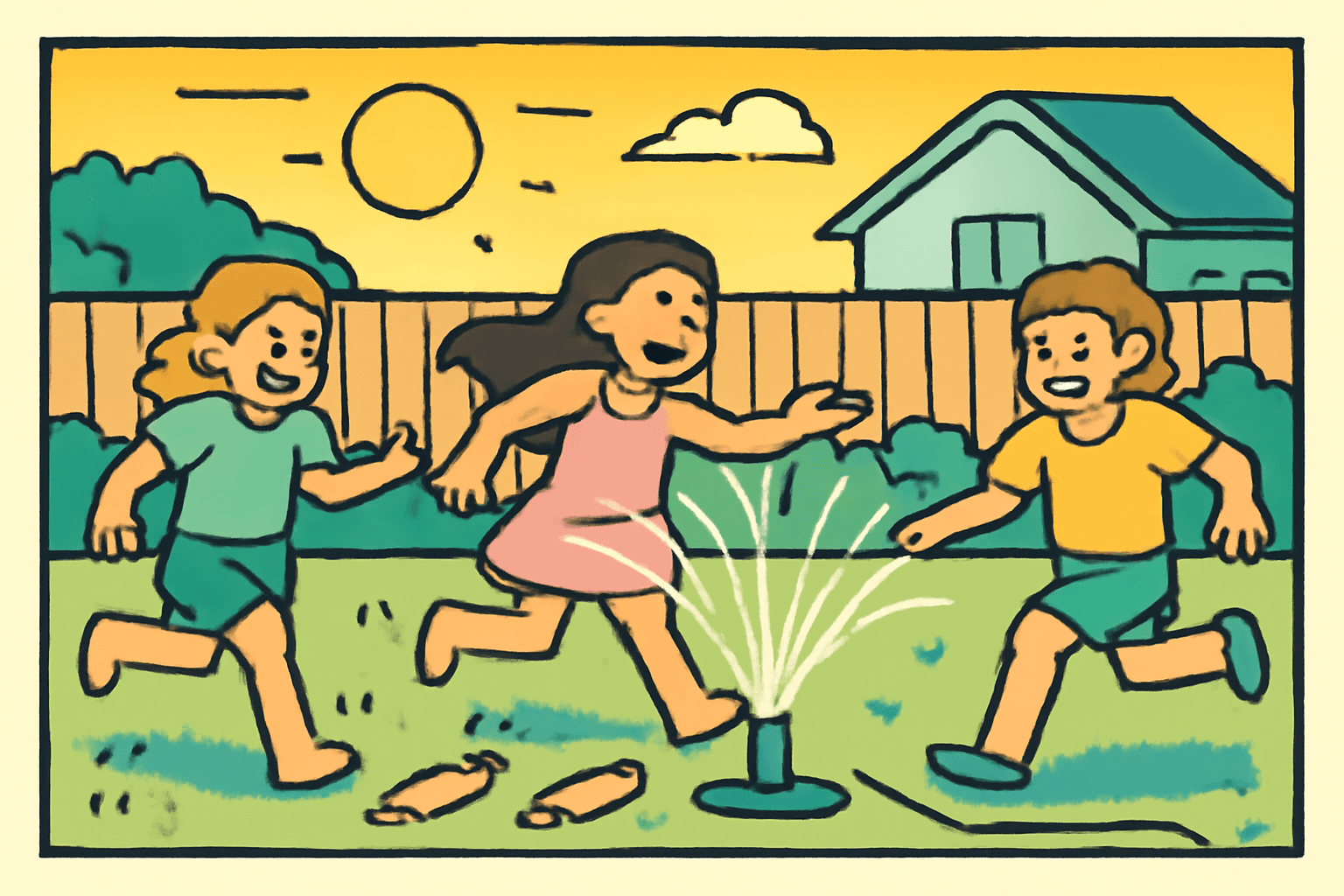
The ice cream truck had a busted speaker. You could hear it from three blocks away, playing a warped version of "Turkey in the Straw" that sounded like it was being transmitted from the bottom of a swimming pool. It didn't matter. The second that sound hit the air, kids materialized on lawns like they'd been summoned. Screen doors slapped shut across the neighborhood in a chain reaction. Someone was always running barefoot on asphalt and regretting it by the second step.
I'm trying to pinpoint the last summer this happened. The last summer that felt like that. Not the last summer anyone ate a Bomb Pop - those still exist - but the last summer where the ice cream truck was breaking news because you had no other way of knowing it was coming.
I think it was 2006. Maybe 2007.
The Year Everything Was Still Analog Enough
The iPhone came out in June 2007. That's the date everybody points to, and they're mostly right, but the truth is fuzzier. The first iPhone was expensive and rare. Your dad didn't have one. Your friend's cool older sister didn't have one. The real change crept in over the next two or three summers, as smartphones got cheaper and kids got younger and suddenly everyone had a rectangle in their pocket that could reach them at any time.
But in the summer of 2006, I was still getting bored. Genuinely, exquisitely, almost painfully bored. And that boredom was the engine of everything.
Boredom wasn't a problem to be solved. It was the raw material. Every good summer day started with nothing to do and ended with a story.
You'd wake up at 9 or 10, eat cereal in front of whatever was on Nickelodeon, and then your mom would say the sentence: "Go outside." That was the entire itinerary. No plan. No scheduled activity. No group text to coordinate. You just went outside with the vague hope that someone else had also been told to go outside, and you found each other the old-fashioned way - by riding your bike around until you spotted someone.
The Public Pool Was a Country
The public pool was the center of the universe from June to August. Ours was called Willowbrook, which made it sound peaceful and shady, but it was a concrete rectangle surrounded by chain-link fence where three hundred kids screamed continuously for eight hours a day.
You paid two dollars to get in. Two dollars. Your mom dropped you off at noon and picked you up at five, and in between you were feral. There was no checking in. No texting "come get me." You were just there, in the deep end or on the hot concrete or in the snack bar line for a Snickers ice cream bar that cost seventy-five cents, and the world outside the fence didn't exist.
- No running (everyone ran)
- No diving in the shallow end (everyone dove)
- No outside food (every mom packed sandwiches)
- Adult swim every hour for 15 minutes (the longest 15 minutes in human history)
- No chicken fights (there were always chicken fights)
The lifeguards were sixteen and sunburned and mostly reading magazines behind their sunglasses. Adult swim was enforced with a whistle that sounded like a war crime, and you'd sit on the edge with your feet in the water watching Mrs. Henderson do her slow laps, and those fifteen minutes lasted a geological era. You could feel yourself aging.
Then the whistle blew again and you were back in. Every single time, someone cannonballed within the first three seconds.
The Architecture of a Summer Day
Here's what I keep coming back to. A summer day in 2006 - or 1998 or 2002, they were all basically the same - had a specific shape. Morning was slow. Afternoon was the pool or the creek or someone's backyard. Late afternoon was bikes.
The bikes were everything. You could cover the whole town on a bike in the summer, and the town felt enormous. You'd ride to the gas station for Slurpees. You'd ride to the school parking lot to do tricks nobody could actually do. You'd ride to that one kid's house who had a trampoline, which was the highest-status backyard object in America from roughly 1993 to 2008.
Then evening. Evening was when summer got its hooks in you.
The light would go golden around seven o'clock and the heat would break just enough to make everything feel possible. Fireflies started showing up in the yard, and someone always had a mason jar. You could never catch as many as you thought you should. They'd light up in the grass and you'd lunge and grab air. But when you got one - when you cupped your hands and saw that glow pulsing between your fingers - it felt like holding a secret.
Staying out until dark. That was the luxury. Your mom yelled your name from the porch, or she flicked the porch light, and you had maybe ten more minutes. The rule wasn't a specific time. The rule was when the streetlights come on. And you'd push it. You always pushed it. Playing ghost in the graveyard or kick the can or just sitting on someone's front steps talking about nothing, watching the sky go purple, knowing the day wasn't officially over until you went inside.
Nobody was documenting any of this. That's the thing I can't stop thinking about.
The Compression
Here's what the smartphone did to summer. It didn't cancel it. It compressed it.
When every moment is photographable, postable, interruptible - when someone can reach you at any second and you can reach anyone - time changes. It stops pooling. It stops stretching out in that luxurious, almost unbearable way that made August feel like it would never end.
Summer used to be a place. Now it's a feed.
The unstructured hours are what I miss the most. Not the activities themselves - you can still go to a pool, still ride a bike, still catch fireflies if you can find them. What's gone is the blankness. The open white space of a day where nobody could find you and you had to figure it out yourself. Boredom was the starting condition, and from boredom came every invented game, every dumb adventure, every "let's go see what's in the woods behind Kyle's house" expedition that turned into a four-hour odyssey.
Now kids have the answer to boredom in their pocket. And the answer is always the same: the screen. I'm not saying that with judgment, exactly. I'd have looked at a screen too. Of course I would have. That's the whole problem. It's not that kids changed. It's that the option showed up, and once it showed up, you couldn't un-know it was there.
Summer Camp Knew Something
Summer camp was the last holdout, and maybe it still is. The good ones take your phone away. They know something that the rest of the world has forgotten: you have to be a little bored, a little uncomfortable, a little unreachable to actually have an experience.
I went to a camp in the Poconos for two weeks every July. You wrote letters home on paper. You played capture the flag until it was too dark to see the flags. You ate terrible food in a dining hall and it tasted incredible because you'd been swimming for six hours. Time moved differently there. A single day at camp contained more life than a week at home.
That's what unconnected summer felt like. Every day was a camp day.
The Thing About Endless
People say summer felt endless when they were kids, and they chalk it up to being young. Time moves differently for children, sure. But I don't think that's the whole story.
Summer felt endless because it was uninterrupted. No pings. No notifications. No checking to see what everyone else was doing. You were just inside your own day, fully, with no exits. The hours stacked up because you actually lived through every single one of them instead of skipping across the surface.
The last real summer. I keep trying to find it. It wasn't one year for everybody - it depended on when the phones showed up in your particular world. For me, it was 2006. I was at the pool. I was on my bike. I was catching fireflies I couldn't quite hold onto. I didn't take a single picture and I remember all of it.
The ones I documented, the later ones, those are the ones I've forgotten. There's something in that. Something I don't fully want to look at.
The streetlights are on. I should probably go inside.