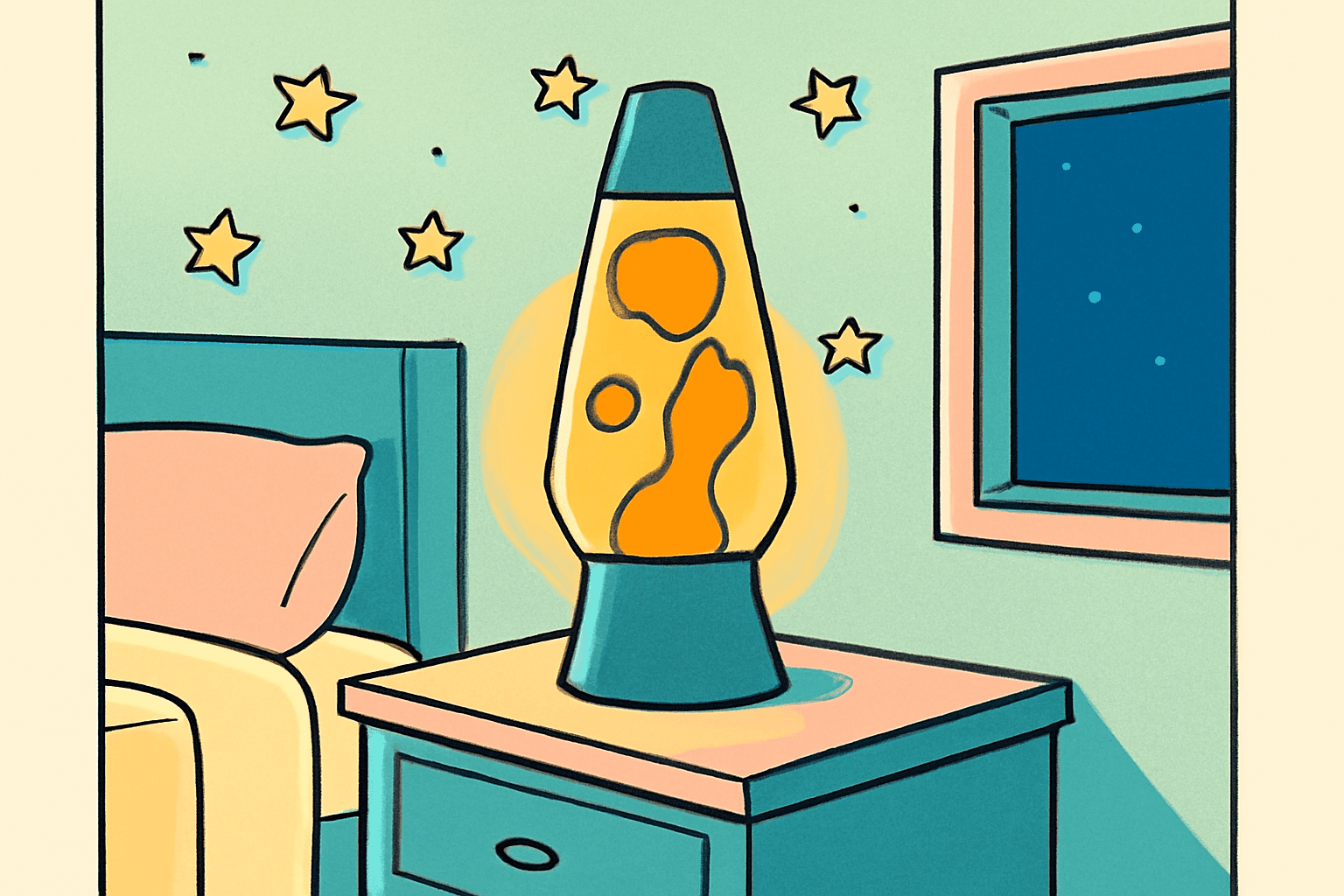
The first forty-five minutes were nothing. You plugged it in, flipped the little switch on the cord, and the base started to warm up, and the wax just sat there. A solid blob at the bottom of a glass cylinder full of slightly cloudy liquid, doing absolutely nothing. You'd check on it. Still nothing. You'd come back five minutes later. Maybe a slight softening at the edges, a hint that something was thinking about happening. But mostly just a lump of wax in a glass tube on your dresser, plugged into the same power strip as your alarm clock and your blacklight, drawing electricity for no visible reason.
You had to wait. There was no speeding it up. No hack, no shortcut, no way to skip ahead to the good part. The lava lamp operated on its own schedule, and that schedule started with three-quarters of an hour of nothing.
And then it started.
The Spencer's Gifts Origin Story
Every lava lamp in America in the mid-nineties came from the same place. Spencer's Gifts, in the mall, between the food court and wherever Sears was dying quietly. Spencer's was the store your parents didn't want you going into. The front section was novelty gags and rude birthday cards. The back section was - well, the back section was the back section. But somewhere in the middle, usually on a wall display with about fifteen of them running at once, were the lava lamps.
- Front: whoopee cushions, fake vomit, novelty mugs that said things your mom wouldn't like
- Middle: lava lamps, blacklight posters, fiber optic flowers, plasma globes
- Back: we don't need to get into this
- Soundtrack: whatever nu-metal was playing that month
- Smell: incense, rubber, and teenage desperation
That wall display was magnificent. Fifteen lava lamps in different colors, all at different stages of their cycle, all glowing against a dark backdrop. Purple wax in yellow liquid. Red wax in clear liquid. Blue wax in green liquid. The classic orange in white. Each one doing its own slow, unpredictable thing. You could stand there for ten minutes just watching them and nobody would bother you because the Spencer's employees were seventeen and did not care.
You'd pick one. You'd carry it to the register in its long, narrow box, and the cashier would ring it up for like twenty-five bucks, which in 1997 money was a significant investment for a teenager, and you'd take it home and set it up in your bedroom and wait forty-five minutes for it to do the thing you saw it doing at the store.
The Blobs
Once it got going, you couldn't look away.
The wax would start to lift off the bottom in slow, organic shapes. A dome forming, stretching upward, thinning into a stalk, and then - separation. A blob breaking free and rising. Not fast. Nothing about a lava lamp was fast. It rose like it had somewhere to be but wasn't in a rush to get there. It would drift to the top, flatten against the cap, cool slightly, and start to sink again. Meanwhile, new blobs were forming at the base, rising to meet the ones coming down.
Nobody told you to watch it. Nobody explained why it was interesting. It just was. Wax moved, and you stopped moving, and that was the whole transaction.
They merged and separated. Two blobs would collide in the middle of the cylinder and become one blob for a while, then split apart as if they'd decided they wanted different things. It was random. It was never the same twice. You could watch it for an hour and never see the same shape repeat, which is more than you can say for most things on television in 1996.
This was, without anyone naming it as such, meditation. You were staring at a thing that required nothing from you. No input, no reaction, no decision. Just observation. Your brain could go wherever it wanted while your eyes stayed locked on slowly rising wax. It was the nineties version of doomscrolling - hypnotic, pointless, impossible to stop - except it didn't leave you feeling hollowed out afterward. If anything, you felt calmer. You'd been watching blobs for forty minutes and somehow that was restorative.
The Light
Here's the thing that's hard to explain if you didn't have one. The lava lamp didn't just sit on your dresser. It transformed the room.
Every other light source in your bedroom was harsh. The overhead fixture. The desk lamp. Even the TV threw that cold blue flicker. But the lava lamp cast this warm, colored, constantly shifting glow that turned your walls into something from another world. A purple and yellow lava lamp made your bedroom feel like the inside of a sunset. A red one made it feel like a submarine. The blue and green one turned everything into an underwater cave.
You'd kill the overhead light, maybe turn on the blacklight if you had one, and let the lava lamp be the only real illumination. And suddenly your bedroom - your stupid thirteen-year-old bedroom with the unmade bed and the poster of a Lamborghini you'd never own and the carpet your mom kept telling you to vacuum - became somewhere else. It became a space that felt private in a way that locking the door never quite achieved. The light made it yours.
That glow was also warm in the literal sense. The lava lamp put out heat. Real, noticeable heat. The bulb in the base was basically a small spotlight cooking the wax, and after an hour or two, the glass was hot to the touch. Your bedroom would be two degrees warmer in the winter. In the summer, it was a genuinely bad idea to run it, but you did anyway because the blobs were worth the sweat.
The Counterculture Callback
We didn't know this at the time - or at least I didn't - but the lava lamp was a hand-me-down from a completely different era. Edward Craven Walker invented the thing in 1963 in England, and it became a fixture of sixties and seventies counterculture. Hippies. Head shops. The kind of apartment where people sat on floor cushions and talked about consciousness. It was a psychedelic artifact.
And then it disappeared for about fifteen years and came roaring back in the nineties because the nineties were obsessed with recycling the sixties and seventies. Bell-bottoms came back. Tie-dye came back. Volkswagen made a new Beetle. Austin Powers made the whole era into a punchline, and suddenly every kid in America wanted the props from the joke. The lava lamp was a relic being used as decor by a generation that didn't know the original context and didn't care.
- Bell-bottom jeans (rebranded as "flares")
- Tie-dye everything
- Platform shoes
- Volkswagen New Beetle (1998)
- Peace sign jewelry from Claire's
- That 70s Show (debuted 1998)
- Shag carpet in ironic doses
We just thought it looked cool. And it did. It did look cool. But there was something interesting about a generation of kids in suburban America putting a psychedelic artifact on their dressers next to their Discmans and their stacks of burned CDs. We were borrowing an aesthetic from a movement we didn't understand, and the lamp didn't mind. It just did its thing. Blobs up, blobs down.
The Color You Chose Said Something
You couldn't articulate it then, but the color of your lava lamp was a choice. Purple and yellow was the most popular. It was the safe pick, the one everyone had, the Honda Civic of lava lamps. Red and clear was more aggressive - it looked like something from a villain's lair in a Bond movie. Blue and green was rarer and felt slightly more sophisticated, like you'd thought about it. Orange and white was the retro purist's choice, closest to the original sixties design.
The color of your lava lamp was one of the first aesthetic decisions you made entirely for yourself, in a space that was entirely your own.
Some people had more than one. Two lava lamps in different colors was a power move. Three was excessive but respected. Your bedroom became a gallery of slow-moving color, and you'd lie on your bed with all of them going and your Walkman on and just exist for a while.
What It Really Was
I've been thinking about this, and I think the lava lamp was the last ambient object. The last thing we put in our rooms that existed purely to be looked at without asking anything in return. No notifications. No content. No algorithm. Just wax and heat and time.
Your phone is hypnotic too, but it's hypnotic in a way that takes. Every scroll, every tap, every minute of staring costs you something - attention, mood, time you can't name. The lava lamp gave. It gave light and warmth and something to rest your eyes on while your brain did its quiet work of being young and figuring things out.
It's probably in a closet somewhere now, or a box in the garage. The wax has likely settled into one solid mass at the bottom, the liquid gone cloudy from years of nothing. You could plug it in. Wait the forty-five minutes. See if the blobs still rise. But part of you knows it wouldn't be the same - not because the lamp has changed, but because you no longer have the kind of time that lets you watch wax move and call it an evening. You had it once, though. You had all the time in the world, and you spent it watching colored blobs drift up and down inside a glass tube, and it was perfect, and you didn't even know it.