The book was called Bunnicula and it had been on the shelf next to the window in Mrs. Halloran's fourth-grade classroom since roughly the Ford administration. The cover was laminated. The spine had a Dewey sticker peeling off it. You picked it up and flipped it over and opened the back cover and there it was.
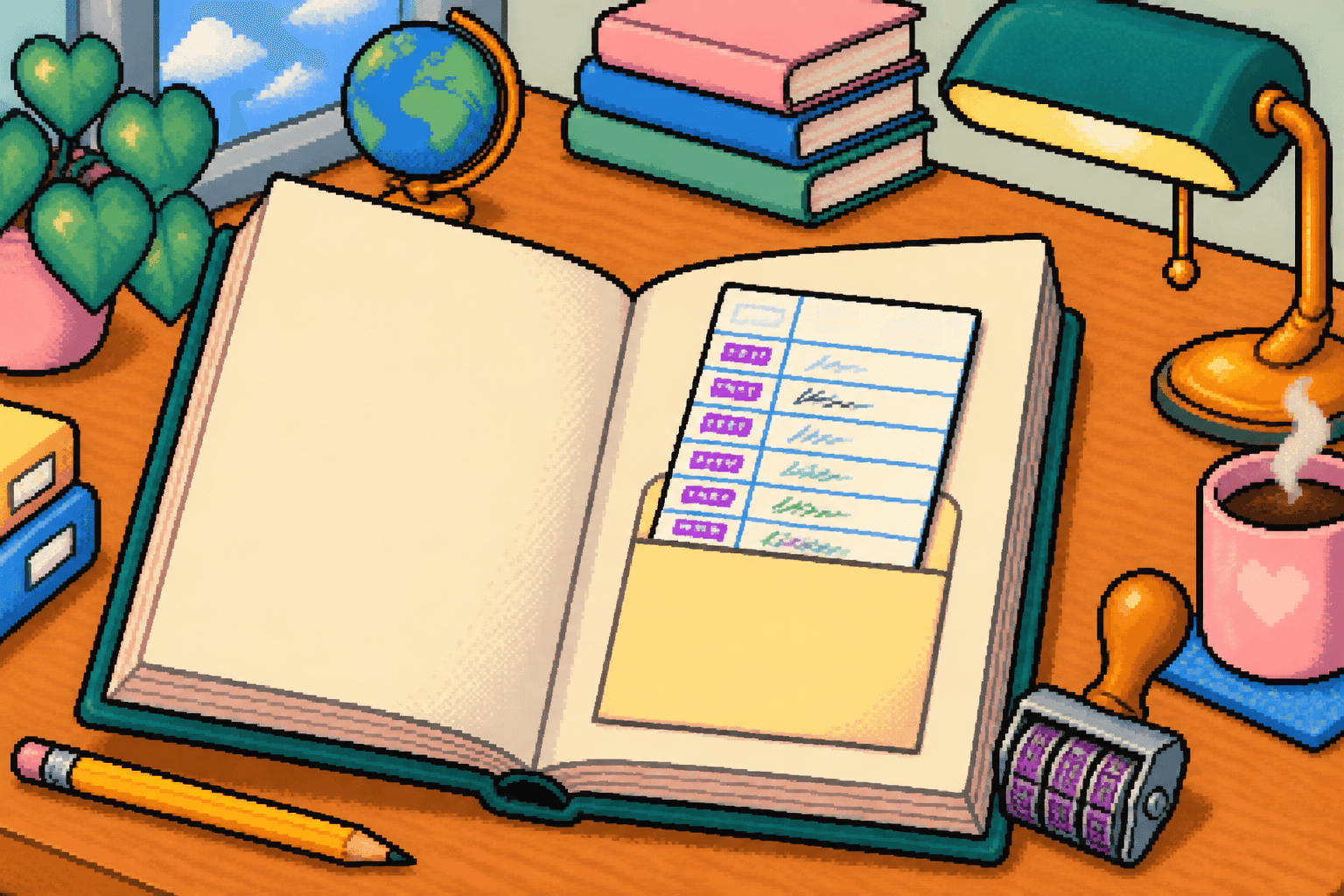
A little manila envelope, glued to the inside of the back cover. Slightly crooked. The corners lifting. And sticking out of the top, a small card, and on the card, in twelve different pens, the names of every kid who had checked this book out before you.
The Pocket
The pocket was a specific object.
It was a piece of stiff, tan, manila paper, roughly four inches wide by three inches tall, glued to the inside back cover of the book with the kind of yellow rubber cement that turned brown in ten years and stopped holding in fifteen. The top edge of the pocket was cut in a shallow curve, like the flap of an envelope that had never had a flap. The front of the pocket said, in small stamped block letters, either DATE DUE or DO NOT REMOVE FROM POCKET, or occasionally both, in a font that had been designed in 1932 and never revised.
Inside the pocket lived the card.
The Card
The card was cream-colored. Or it started cream-colored. By the time you got to it, it was closer to the color of an old tooth. It had ruled lines on it, printed in faded blue, dividing the card into two columns: Date Due on the left, Borrower's Name on the right. There were about fifteen lines. The lines were full.
You pulled the card out with two fingers. The top edge was slightly frayed from a hundred previous pulls. You held it up to the classroom light and you read the names.
The card was closer to the color of an old tooth. It had ruled lines on it in faded blue. The lines were full.
Try It
MAPLE ELEMENTARY SCHOOL LIBRARY
Return by date stamped opposite
- SEP 14 '88Mrs. Halloran
- OCT 03 '89Kevin M.
- JAN 22 '90Jennifer Reeves
- MAR 11 '91D. Alvarez
- NOV 08 '91Sarah W.
- APR 27 '92Michael Chen
- SEP 30 '93T. Robinson
- FEB 14 '94Amanda
- OCT 19 '94Josh (again)
- MAY 02 '95your sister
Pull the card out of the pocket. Read the list. Sign your name. Stamp the date. Slide it back.
The Names
The names were the whole thing.
They were written in every kind of pen a ten-year-old had ever put a hand to. Bic ballpoint, black. Bic ballpoint, blue. Bic ballpoint, blue, out of ink halfway through so the second half of the name was just a groove in the paper. A Papermate that skipped. A red felt-tip in one instance where the kid was, you had to assume, feeling something. A cursive from a teacher in the 1980s who had used what looked like a fountain pen and had signed the card Mrs. Halloran because she was the one who had taught the previous class and had checked the book out to demonstrate to a student how the pocket worked. A hard block-letter signature from a boy who had pressed so hard the pen had almost gone through the card and left a divot you could feel on the back.
And then, on the eighth line from the top, in a loopy cursive with a heart over the i, in purple gel pen, was your sister's name. From 1993. When she was in fourth grade. Reading the same book. In the same classroom. Assigned by the same teacher.
You did not know what to do with this information. You still don't.
On the eighth line from the top, in a loopy cursive with a heart over the i, in purple gel pen, was your sister's name. From 1993. When she was in fourth grade. Reading the same book.
The Stamp
The librarian had the stamp.
It was a rubber date stamp on a wooden handle. The date was set with three little wheels on the top - month, day, year - which she reset every morning, or forgot to reset every morning and then had to fix at 9:15 when a kid handed her a book and the card said SEP 30 '89 and she said hold on honey, and turned the wheels, and stamped it again in a slightly darker purple over the first, wrong, stamp, and you got a book with two due dates, one of them from before you were born.
The stamp pad lived in a shallow metal tin next to the checkout desk. It was purple. Or it had been purple. Now it was somewhere between purple and black, because the librarian had been re-inking it since 1978 and the pad had absorbed enough ink and dust and eraser rubber to become its own geological era.
She stamped the card. She stamped the slip in the pocket - a smaller piece of paper, glued lightly to the inside of the pocket, whose entire purpose was to be the thing you looked at when you got home. She wrote a small tick next to your name on the ledger she kept in a black binder. She handed you the book. She said back by the fourteenth, and she meant it.
- The teacher, 1988: full cursive signature, fountain pen, respectful
- A kid who couldn't spell his own last name: half-written, crossed out, restarted
- A girl who dotted her i with a heart: purple gel, obviously
- A boy who signed only his initials: felt he was above this system
- A kid who wrote "your mom": ballpoint, deniable
- A librarian correcting a stamped date: red pen, dated, initialed, professional
- A ghost from 1974: pencil, so faded it was closer to a suggestion
The Book Had a History
Here is what I want to say about the card.
The card meant the book was not new. The book was not just yours. Twelve kids had had it before you. In some cases, thirty. Each of them had, for two weeks, walked around with this exact book in a backpack, read it in a bedroom you did not know, spilled Kool-Aid on page 47, folded a corner over on page 82, left a Cheeto dust smudge inside the back cover, and then brought the book back and handed it to a librarian and gone back to their life. Now the book was in your backpack. Doing the same.
The card was not a bureaucratic instrument. The card was, functionally, the book's biography. Every name was a two-week story you would never know. Kevin M., April 1989: had he liked it? Had he returned it late? Was the reason Kevin M. was underlined on the card and Sarah W. was struck through because Sarah W. had renewed it and Kevin had not? Was one of these names, statistically, a kid who had died? A kid who had moved? A kid who was now, in the current year, a middle-aged accountant in Cleveland who had not thought about Bunnicula since?
You held all of that in your hand. Nobody had told you it was a thing you were holding. But you were.
The card was not a bureaucratic instrument. The card was the book's biography. Every name was a two-week story you would never know.
The Argument
I want to give the counter-argument, because it's not small.
The counter-argument is that the card was a privacy nightmare.
The card had, sitting in the back of a book on a shelf that any kid could walk up to, the name and checkout history of every child who had read that book. This was fine when the book was Bunnicula. It was less fine when the book was Are You There God, It's Me, Margaret, and every girl in the fifth grade could see who had checked it out, and every boy in the fifth grade could too, and everybody who checked it out did so knowing that the person after them would know. The card was a small quiet act of surveillance disguised as a stamp system, and the ALA had opinions about it long before the barcode showed up. By the late 90s, in most libraries, the card had been replaced by a barcode and a scanner and a database, and the reason was not efficiency. The reason was that the previous system had told every kid in your school what every other kid in your school was reading, and that was a problem that had been quietly wrong for about eighty years.
I am not going to pretend I didn't know about it, later. I am going to be honest: at ten, I loved the card because I could see who had read the book. At forty, I understand why we got rid of it. It was better for the kid who was quietly checking out a book about her body in fifth grade to have that be between her and a barcode.
The card was a small quiet act of surveillance disguised as a stamp system. It told every kid in your school what every other kid in your school was reading.
The Other Side
But here is the thing I want to hold onto.
The card was the first place I ever saw that a book had history. Not the history in the book. The history of the book, as an object, being moved from hand to hand, being read by a specific kid in a specific classroom in a specific year and being handed forward. The book was not a copy of a text. The book was a specific physical thing that had been in specific hands. Kevin M., April 1989, was a real fourth-grader with a real backpack and had held this exact book and now I was holding it. He was still, in a small way, in the book. His name was on the card. The card was in the pocket. The pocket was in the book. The book was in my hands.
I read Bunnicula in November. I had it two weeks. I got it back to the librarian on the thirteenth, one day early, because I was a nervous child. She stamped it back in. She said good. I wrote my name on the card in a ballpoint pen because it was what I had, and my handwriting at ten was terrible, and I pressed too hard, and I misspelled my own last name because I was rushing, and I crossed it out and restarted below it, which means somewhere in a landfill in eastern Pennsylvania there is a card with my mistake on it, and a hundred kids after me read a book with my mistake in the back, and one of them was maybe, someday, my niece.
What Replaced It
The card is gone.
School libraries switched to barcodes and scanners around 1996, 1997, 1998, depending on the district. Public libraries had switched earlier. The card came out of the pocket. The pocket came out of the book. The book got a barcode sticker on the inside back cover, sometimes covering the ghost of the glue that had held the pocket, and the barcode was scanned by a librarian with a wand, and the wand made a small beep, and the book was checked out.
The beep was faster. The beep was more private. The beep did not tell you that your sister had read this book in 1993. The beep did not tell you that Sarah W.'s name had been struck through. The beep did not tell you anything at all. The beep just did the checkout.
The librarian who had spent thirty years running a stamp pad had, by 2001, spent five years running a laser. She was fine. She had adjusted. She missed the stamp a little. Nobody had asked her.
The Book Is Still on a Shelf Somewhere
The last time I saw a card in the back of a book was 2004. I was helping my mom clean out my grandmother's basement, and there was a stack of children's books she had bought at a library sale in 1998, and one of them was a hardcover copy of Charlotte's Web that had come from the elementary school in Beaver Falls, Pennsylvania. I opened the back cover. The pocket was there. The card was in it. I pulled it out. There were twenty-two names on it. The earliest was from October 1962. The last was from May 1997, in a rushed print handwriting, kid pen. My grandmother had never checked the book out. Neither had my mom. Neither had I. The book had just moved, at some point, from a school library shelf to a garage sale to a basement to my hands, still carrying its list of twenty-two children, one of whom had died in Vietnam, one of whom I would go on to work with in 2011, and twenty of whom I would never find. I put the card back in the pocket. I closed the book. I did not throw it away.