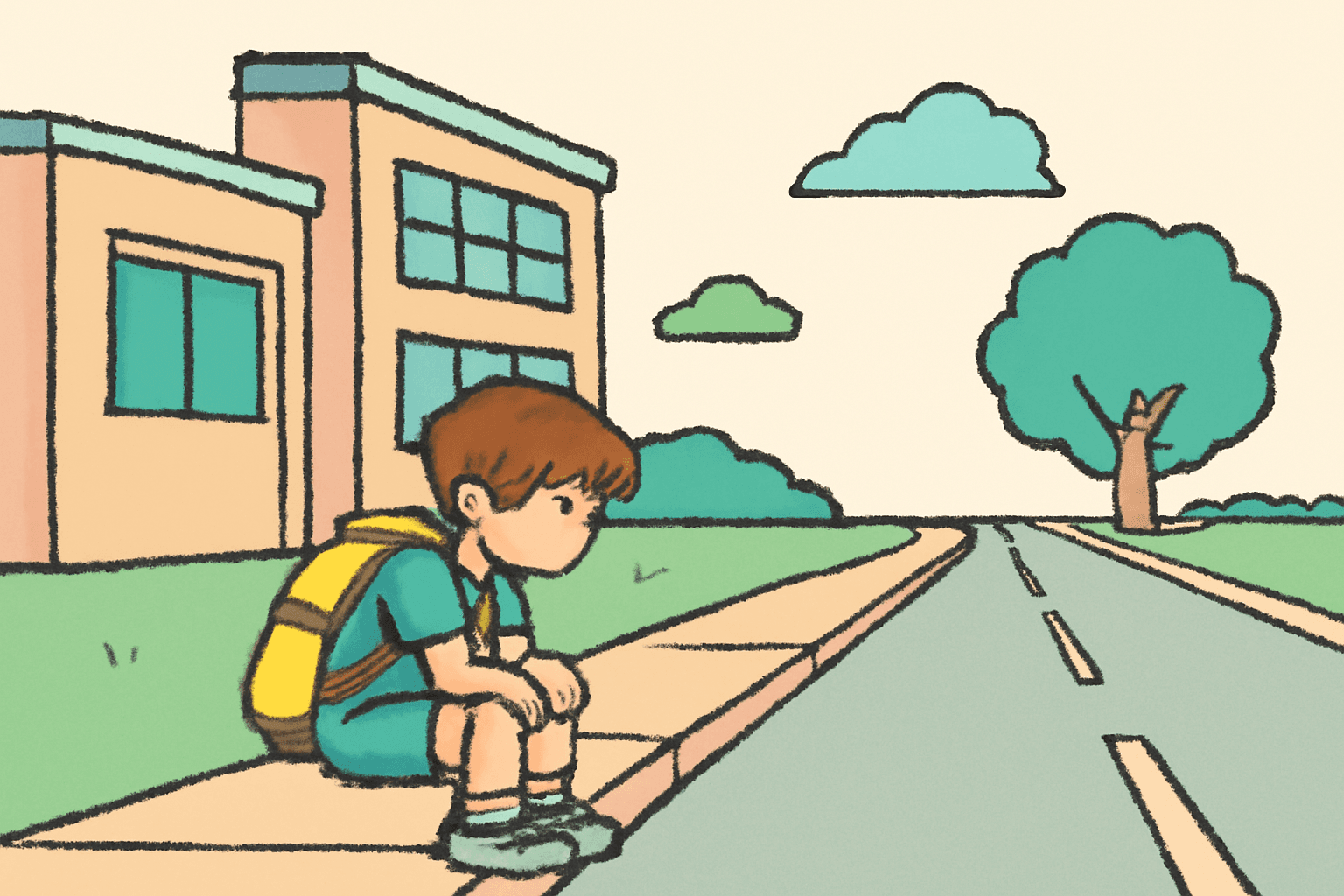
The parking lot at Westbrook Elementary cleared out fast. Like, suspiciously fast. The bell rang at 3:15 and by 3:25 the whole place was a ghost town of yellow curbs and candy wrappers. If your mom was there at 3:16, you were golden. You climbed in, the minivan smelled like whatever errand she'd been running, and you were home before the Animaniacs theme song started. But if she wasn't there at 3:16, you entered a different universe entirely. The universe of waiting.
I knew that universe well.
The Countdown Nobody Taught You
There was no manual for being the last kid in the pickup line. No one sat you down and explained the stages. But every kid who lived it developed the same internal clock, the same emotional math, without ever comparing notes.
The first five minutes were fine. You weren't even worried. You were just standing there, backpack on both shoulders like a dork, watching the efficient parents swoop in and extract their children with military precision. Caitlin's dad in the blue Taurus. The twins' mom in the Suburban that took up two spaces. Everything was orderly. Everything was fine.
The first five minutes were fine. After ten, the math changed.
At the ten-minute mark, you started to notice that the crowd had thinned. The teachers on pickup duty were shifting their weight, glancing at their watches - the kind with actual hands on them. A couple other kids were still there, and you made brief eye contact with them, the way strangers do in a hospital waiting room. A nod. A silent you too, huh.
By fifteen minutes, it was you and maybe one other kid. Twenty minutes, and the custodian was locking the front doors. You sat on the curb and started reading the back of your own backpack. Every zipper pocket. Every tag. The care instructions on the shoulder strap. You could have written a product review for JanSport based on those afternoons alone.
The Negotiation
Here's what nobody talks about: the internal bargaining. You developed this whole private system of worry thresholds, and it was remarkably sophisticated for a nine-year-old.
If she's not here by 3:35, something is wrong.
3:35 arrives. She's not here. You adjust.
Okay, 3:40. If she's not here by 3:40, something is actually wrong.
3:40. Nothing. A tumbleweed could have rolled past and it would've felt appropriate.
3:45. That's the real deadline. After 3:45 I should do something.
But what? What were you going to do? You were nine. You had no phone, no pager, no way to reach anyone. Your options were: keep sitting, or walk to the payphone by the gym and hope you had a quarter. That was it. Those were the two branches of your decision tree.
- The back of your backpack, including washing instructions
- Every car in the parking lot, ranked by coolness
- Cracks in the sidewalk, stepped on and otherwise
- The school marquee, which still said "SPRING PICTURE DAY - MARCH 8"
- Your own shoes, closely
- A single ant carrying something ambitious
And the thing is, you almost never called. The payphone was a nuclear option. Because calling home meant admitting something was wrong, and as long as you were just waiting, everything could still be fine. She could pull up any second. She was probably just stuck behind the train on Maple. She was probably at the store and lost track of time. Calling meant crossing a line from waiting into something more official, more scary. So you sat.
The Payphone Economy
When you did finally make the walk to the payphone - that chrome-and-grime monument bolted to the brick wall outside the gymnasium - you needed a quarter. One quarter. Twenty-five cents between you and contact with another human being.
Sometimes you had one. You'd been carrying it since Tuesday because you found it on the cafeteria floor and it lived in that tiny front pocket of your jeans that no adult-sized finger could ever fit into. You'd fish it out, warm from your leg, drop it in the slot, and dial your home number from memory. Because you had it memorized. Everyone had their home number memorized. That was just a thing your brain did back then.
The phone would ring. And ring. And ring. No answering machine pickup meant nobody was home, which meant they were on their way, which meant you could go back to the curb with renewed confidence. Or it meant something terrible, but you chose renewed confidence.
Twenty-five cents stood between you and the entire adult world. That was the exchange rate for reassurance in 1996.
Sometimes your mom answered, slightly out of breath, and said the words that every waiting kid lived for: "Oh shoot, I'm coming, I'm coming right now." And right now meant fifteen more minutes, but that was fine. Fifteen minutes with a promise behind it was a completely different experience than fifteen minutes in the void.
Sometimes you didn't have a quarter. And then you just sat back down.
The Trust Exercise Nobody Called a Trust Exercise
I think about this a lot now, in an era where I can track a pizza's journey from oven to doorstep in real time. The sheer amount of faith required to be a kid sitting on a curb in 1994. Faith that someone was coming. Faith that the system worked - that the adult world, which operated on mysterious principles you couldn't see or influence, would eventually produce your parent in a station wagon.
There was no tracking. No texting. No "Share My Location." You were just out there, a small person in a big parking lot, trusting the universe to deliver. And the universe almost always did. Late, sometimes. Flustered, often. Your mom pulling up with the window already down, saying "I am so sorry, the line at Kroger was insane" before you even got the door open.
You climbed in. She looked guilty. You were already over it. The whole ordeal - the bargaining, the sidewalk cracks, the quarter you didn't end up needing - dissolved the second you heard the click of your seatbelt. By the time you got home, it was just another afternoon.
What We Actually Learned
I don't want to oversell this. Being picked up late wasn't character-building in some grand way. It wasn't a rite of passage anyone would design on purpose. It was, honestly, kind of boring and kind of stressful and occasionally genuinely frightening, especially when the sky started getting dark and the parking lot lights buzzed on and you were really, truly alone.
But it taught you something that I'm not sure kids learn anymore. It taught you how to sit with uncertainty. How to be uncomfortable and not immediately fix it. How to entertain yourself with nothing - literally nothing - but your own thoughts and the printed text on a nylon backpack. It taught you that most of the time, things work out, just not on your schedule. And it taught you that worry is a renewable resource, and you don't have to spend it all at once.
It taught you how to wait.
Not wait for a loading bar or a push notification or a little car moving across a map on your screen. Just wait. With nothing. In the open air. With faith and a quarter you might not need.
Somewhere, right now, a kid is staring at a phone screen watching a blue dot inch closer along a cartoon road. They will never know the specific silence of an empty school parking lot at 3:45. I can't decide if they're lucky or not.