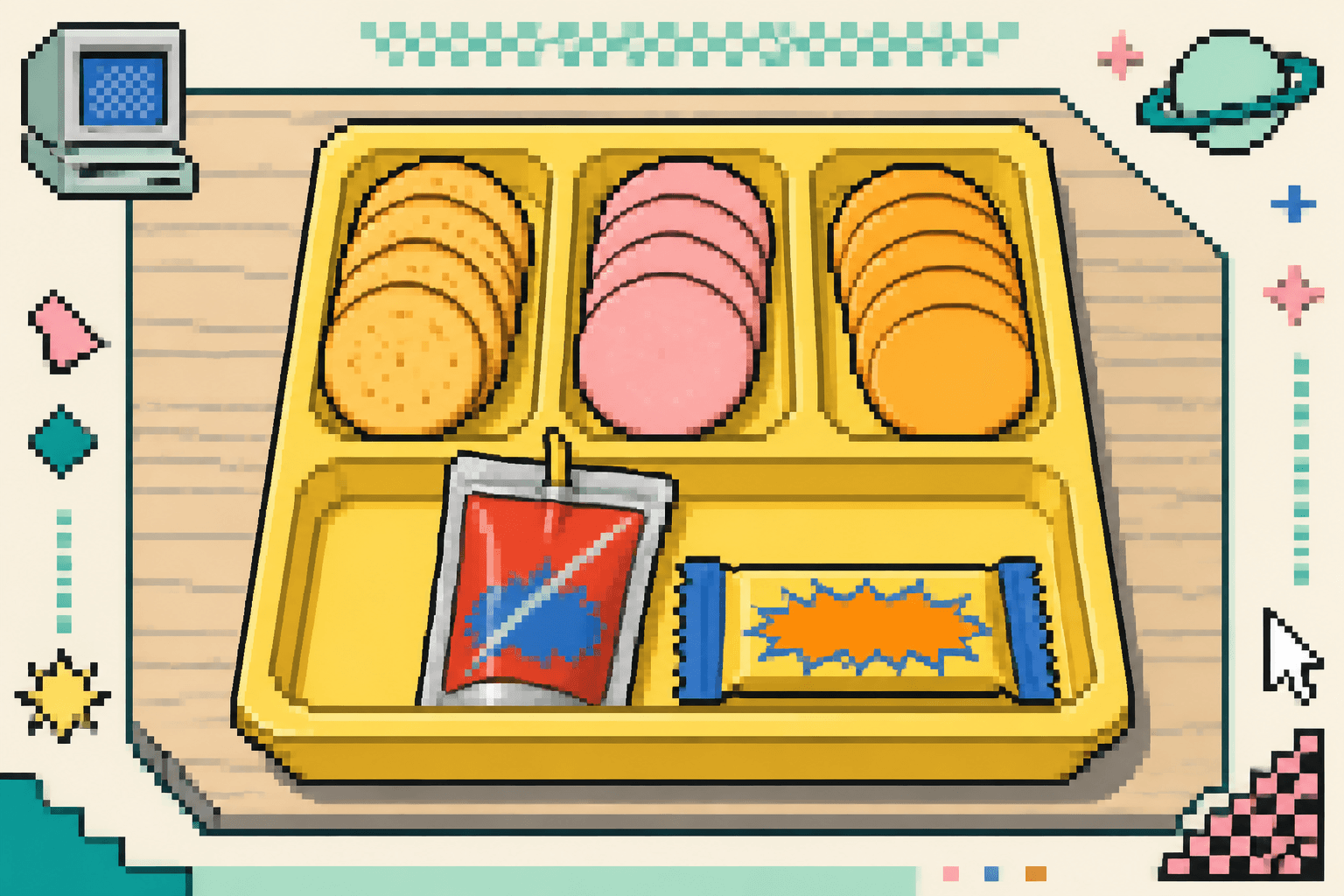
You pulled the corner tab. The film peeled back with a small sticky sound, releasing a specific smell that was equal parts refrigeration and processed meat and off-gassing plastic. Underneath was the tray. Yellow. Three compartments. Six crackers, six meat discs, six cheese squares, arranged like a color-coded lecture on your responsibilities for the next twelve minutes.
You had thirty minutes for lunch. You would spend twenty-two of them assembling.
The Tray
The Lunchable tray was a yellow molded piece of plastic that looked like it had been rejected by a slightly cheaper factory. It was too thin to hold its shape once you took it out of the box. It flexed if you pinched it. It had three shallow compartments separated by low ridges, and the ridges were exactly the wrong height - tall enough that a cracker couldn't slide across them, short enough that if you tipped the tray during transport, everything migrated into everything else, and you got there to open it and find one loose cheese square welded to a stack of crackers by refrigerator sweat.
It was yellow because Oscar Mayer had decided, at some point in the mid-eighties, that yellow was the color of engineered lunch. There was no other reason. The color did not correspond to any of the food items in the tray. The food was pink and orange and tan. The tray was the color of a school bus. This was a fine decision. Nobody at the lunch table complained.
The Cracker
There were six crackers. They were round. They were golden tan. They were slightly puffed in the middle in a way that suggested a bakery had briefly been involved. There was salt on top - not a lot, but enough that if you licked one first, you got a small sodium reward you hadn't fully signed up for.
The cracker was structurally load-bearing. It was, mechanically, the piece of the Lunchable that made the Lunchable a Lunchable. Without the cracker, you had two piles of cold protein and dairy, which is not a lunch. With the cracker, you had a small architecture project. The cracker was the plate. The cracker was the floor.
They were slightly stale, always. Not stale enough that anyone said anything. Just stale enough that the first bite made a soft crumbly noise instead of a snap, and you noticed, but you did not fully register that you had noticed, and you kept eating.
The Meat
The meat was pink. Not a pink you would find in nature. A specific manufactured pink, glossy on top, matte on the bottom, cold in a way that suggested it had been refrigerated for longer than any single Lunchable had been on Earth. It was labeled "ham" or "turkey" or "chicken," or, if it was the fall and your mom had bought the seasonal one, "smoked turkey," which was the same meat with a slightly stronger smell.
Each disc was about two inches across. You could see pale white fat marbling in some of the pieces, arranged in a way that looked mostly like it had been drawn by hand. Sometimes there was a small circular indent in the middle where the cutting machine had pressed down too hard.
The meat was slightly wet. It left a tiny halo of moisture in the compartment. If you left it in the tray during lunch and got called to the office for something, you came back and the meat had contributed a small pond to the plastic, and the cracker below it had absorbed part of that pond and was now soft.
The meat was pink in a specific manufactured way, glossy on top, matte on the bottom, cold in a way that suggested it had been refrigerated for longer than any single Lunchable had been on Earth.
The Cheese
The cheese was a small square. Orange. Sometimes yellow. Almost exactly the width of the round meat, which meant it did not fit on the meat, because a square inscribed in a circle leaves four small orange corners exposed to the world. This was fine. That is how a Lunchable looked.
It was labeled "American." That is not, technically, cheese. The FDA calls it "pasteurized process cheese product," which is a phrase you can read out loud at any lunch table in America and get zero reactions to, because everybody eating a Lunchable had already made peace with what they were eating. The word "cheese" on the outer box was doing a lot of quiet work.
It was slippery on top. It smelled faintly. It bent, when you picked it up, in a rubbery way that a real cheese does not bend. It had a specific mouthfeel that was more mouthfeel than flavor - a kind of cold slick that softened around the third chew and did not develop from there. You knew, on some level, that this was not really cheese. You were nine. You did not care.
The Assembly
Here is where the Lunchable became a Lunchable.
You had six pieces of each item. Six crackers. Six meat discs. Six cheese squares. That was, in theory, six perfect three-layer stacks, which you would eat over the course of your lunch period at a rate of one every two minutes, in order to fill exactly twelve minutes with food, leaving you eight minutes to negotiate a trade for a Fruit Roll-Up.
That is not how anyone ate them.
The correct order was cracker, then meat, then cheese. The cracker was the base. The meat was the middle. The cheese was on top. Everybody agreed on this. Nobody had discussed this. It was one of those pieces of unwritten small-kid consensus that formed independently across every cafeteria in the country, in the way that all children eventually agree that the yellow crayon is disappointing.
Max 3 layers per bite.
But the order got broken. Somebody at your table was going to make theirs upside down. Cheese first, then meat, then cracker on top like a small hat. They were going to bite into it with the cracker facing their teeth, and it was going to snap, and the cheese and meat were going to shoot out both sides onto the table, and the kid was going to shrug and pick up the pieces and eat them separately. That kid was fine. That kid grew up and became an adult and probably has opinions about how to load a dishwasher. Let them.
The Extras
Every Lunchable came with two extras. Which two depended on the year and the specific kit, but there was almost always a Capri Sun in the corner slot and a small snack-sized candy on the other side. Very often the candy was a Butterfinger BB or a small square of Nestlé Crunch. Sometimes it was a Reese's cup. Once, in a very specific era, it was a small tube of Airheads Xtremes, which was six inches of green-and-blue sour ribbon that took the entire second half of lunch to work through.
The candy was the point. Everybody knew this. The candy was the reason the parent had bought the Lunchable. The parent had decided, at the checkout counter, that a small refrigerated tray of engineered meat and cheese represented "lunch," but the tiny Butterfinger square represented "the reason my child will accept the lunch," and this was a fair trade, and Oscar Mayer knew this too, which is why the candy was always the smallest possible unit of candy you could still legally call by that name.
The Capri Sun was pierced with the small straw that came in its own wrapper. If you missed on the first stab, juice sprayed onto your shirt and the sun on the front of the pouch collapsed inward slightly, and you got, for one moment, a very small and specific kind of nine-year-old shame.
- Butterfinger BB - one round bead, gone in two seconds.
- Nestlé Crunch square - crunch, quiet melt, small.
- Reese's mini - the best one. Traded for a whole other Lunchable.
- M&M pack - four M&Ms. Four.
- Airheads Xtremes strip - a full afternoon commitment.
- Capri Sun - fruit punch, or nothing.
The Trade
Lunch was a market.
The Lunchable was, in that market, a mid-tier currency. It was better than a peanut butter and jelly sandwich, which everybody had access to and nobody wanted. It was worse than the pizza Lunchable, which was the gold standard and was almost never traded, because the kid whose parents bought the pizza Lunchable was, by definition, at the top of the trade tree.
The nachos Lunchable was, briefly, the coolest one. Then everybody realized the cheese sauce packet was almost impossible to open and left an orange stripe across your finger for the rest of the day, and the nachos Lunchable lost its status. The pizza-and-Capri-Sun kit stayed on top forever. Nobody dislodged it.
You could trade a Butterfinger BB for a Fruit by the Foot. You could trade a whole cheese-and-crackers Lunchable for a pack of Gushers. You could not trade for anybody's homemade lunch, ever, because anybody with a homemade lunch had a parent who cared, and that parent had packed a full sandwich and a piece of fruit, and that parent had won the day, and their kid knew it, and their kid was not trading.
The Argument For
The Lunchable was, if you look at it from a certain angle, a small piece of respect.
It was pre-portioned. The company had thought about your lunch and had decided how much you should eat and had prepared it accordingly, and then it had trusted you to eat it. You were nine years old and a plastic tray was treating you like an adult who could operate three separate food items simultaneously. There was no parental fork. There was no parental note. It was your lunch. You built it. You ate it.
And it was, in its way, satisfying. There was a small pleasure in the assembly. You picked up the cracker. You laid the meat on top. You capped it with cheese. You bit down. You made a small object and then you unmade it in a single motion. Over the course of a twelve-minute lunch, you built and destroyed six small architectural models with your hands, and that is not nothing, in a life that mostly consisted of being told what to do.
The Argument Against
The Lunchable was food-shaped marketing.
The meat had ingredients you couldn't read out loud. The cheese was not cheese. The crackers had approximately the nutritional weight of a napkin. The whole thing came in a plastic tray that was going to outlive you by four hundred years in a landfill. It cost more than a homemade sandwich, contained less food, and had been designed by a marketing team to look like the packaging of a much more expensive product it wasn't.
Somebody, in an office building in Wisconsin in 1988, had figured out that if you took cold-storage meat products and put them in a small yellow container next to some crackers, you could get a kid to want it more than a real sandwich. And they were right. They were spectacularly right. Oscar Mayer sold enough Lunchables to reroute an entire generation of children's relationship with the middle of the day.
You should probably be a little annoyed about this. But you also, right now, if you saw one on the shelf, would be a small percentage more likely to reach for it than for the sandwich fixings next to it. That is what the marketing team did. It is still working, thirty years later.
Somebody in an office building in Wisconsin in 1988 figured out that if you took cold-storage meat products and put them in a small yellow container next to some crackers, you could get a kid to want it more than a real sandwich. They were right. Spectacularly right.
I saw one in the store last month. My nephew is seven. He looked at me. I looked at the shelf. There were nine of them there. There is a pizza one still. There is a ham and cheese one. There is a new one, apparently, that involves a small container of frosting and pretzel sticks, which is presumably lunch in the sense that a person could eat it during the middle of the day.
I bought a ham and cheese one. I did not tell his mom. I opened it in the car with him after karate. He peeled the film back. He looked at the compartments. He didn't know the order. I told him: cracker, meat, cheese. He said okay. He built one. He bit it. He said this is cold. I said yes, that's how they are.
He built five more. He gave me one. I ate it. It was worse than I remembered and also exactly what I remembered, which is a thing that only happens with foods you loved before you could vote.
He asked if we could get one again next week. I said maybe. He said the meat was weird. I said yes, that's true. He said he liked it anyway. I said yes, that's also true. He drank the Capri Sun in one go and crumpled the pouch and threw it into the back seat, and it landed somewhere back there and I am pretty sure it is still there.