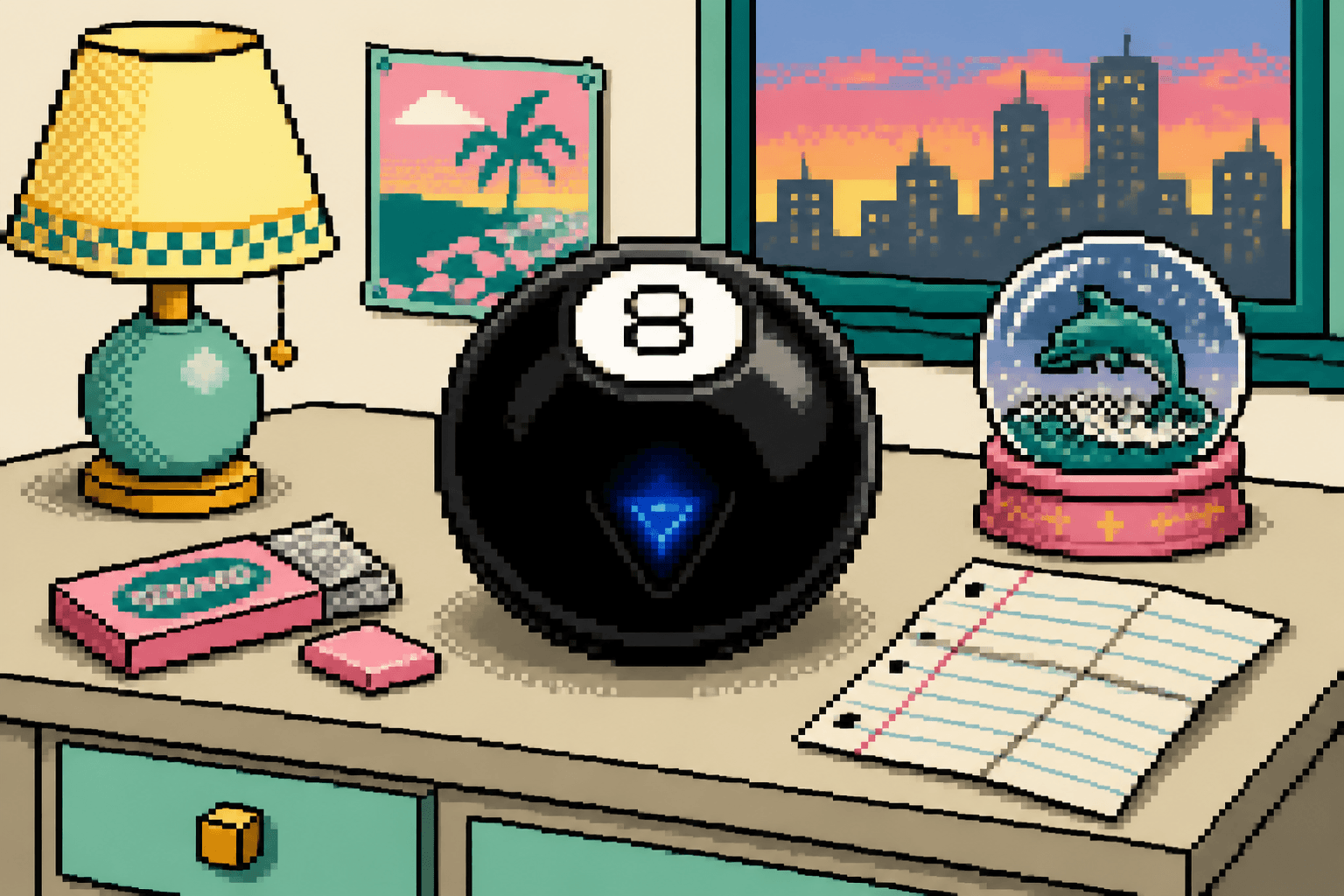
It was sitting on the top of the dresser, between a snow globe and a half-pack of Bubble Yum. The Magic 8 Ball. Black plastic the size of a softball, heavier than it had any right to be. The white circle on the front had the number 8 printed on it in a font that was already, in 1996, sort of out of date. You knew this ball. You'd had this ball since third grade and you would have it for another nineteen years until your mom donated it during a basement clean-out, and you would find out about it from a text that just said tossed your old 8 ball, ok?
It was, technically, a toy. Practically, it was a confessional.
The Ball
The ball had heft. That was the first thing about it. You picked it up expecting hollow plastic and you got something closer to a bocce ball with a head injury. Tilting it slightly produced a soft thunk - the icosahedron inside hitting the wall of the inner chamber, suspended in dark blue dye-water that nobody ever stopped to wonder about until they were twenty-four and reading a Wikipedia article in the bathroom.
The window was at the bottom. White outline, blue interior, the size of a quarter. When you held the ball with the window pointing down and shook it - really shook it, two-handed, like you were trying to mix paint - the icosahedron tumbled around inside and one of its twenty faces would eventually settle against the inside of the glass. The face had words on it. You flipped the ball over. You read the words.
You did this in the bathroom because it was private. You did this in the closet because it was private. You did this under your blanket because the dim light made the answer look more like a vision and less like a piece of plastic doing exactly what it was designed to do.
The Twenty
There were exactly twenty answers. The same twenty. Forever. You knew them.
Ten were Yes. It is certain. It is decidedly so. Without a doubt. Yes definitely. You may rely on it. As I see it, yes. Most likely. Outlook good. Yes. Signs point to yes. The Yeses were a rainbow of agreement, from the casual to the legal-document, and they were the answers you were hoping for.
Five were No. Don't count on it. My reply is no. My sources say no. Outlook not so good. Very doubtful. The Nos didn't soften. My sources say no was a particular favorite because it implied the ball had a network. Outlook not so good was the meteorological version of disappointment. Very doubtful was what your grandmother said when you asked if you could have another cookie.
Five were the middle. Reply hazy, try again. Ask again later. Better not tell you now. Cannot predict now. Concentrate and ask again. These were the answers that were not answers. These were what the ball said when it was, in some quiet way, asking you to slow down.
The Yeses were a rainbow of agreement. The Nos didn't soften. The middle five were the ball asking if you were sure.
The Trick
You did not ask the Magic 8 Ball easy questions. You did not ask it should I do my homework. You did not ask it will I get an A on the book report. You asked it the questions that mattered.
Does she like me back.
Am I going to be famous.
Are my parents going to get a divorce.
You whispered the question to the ball, holding it cupped in both hands like you were warming an egg, and then you shook it. Harder than you needed to. You flipped it over. You read the answer.
If the answer was a Yes, you stopped. The ritual was complete. You put the ball back on the dresser. You felt good for an hour.
If the answer was a No, you shook it again.
If the answer was Concentrate and ask again, you closed your eyes, made the question more specific - Does she like me back the way I like her back, like for real, not just as a friend - and shook it again.
You did not put the ball down until it told you yes.
This was not cheating. This was, in some very specific way, the design.
The Math
There were twenty answers. Ten were Yes. Five were No. Five were Maybe. If you asked the ball a single question and accepted the first answer, you had a fifty percent chance of a Yes.
If you re-shook on Maybes - which everyone did, because the Maybes weren't answers, they were retries - your effective Yes rate climbed to about sixty-six percent. If you re-shook on Nos - which everyone did, because the No felt like an insult - your effective Yes rate climbed to about eighty-five percent. By the time you'd shaken the ball five times for the same question, the math was on your side. The ball was on your side. The ball had always been on your side.
The Magic 8 Ball was not a fortune teller. The Magic 8 Ball was a permission slip with a one-in-five false negative rate.
The Argument
I want to defend the ball, because the ball was a good thing.
We had decisions we needed to make. We did not have the language for them. We did not have a therapist, because we were nine. We did not have a journal, because we were nine. We had a parent, who was watching the news, and a younger sibling, who could not be trusted, and a friend on the other end of a landline, which was being used by the parent. We had nobody. We had a black ball with twenty fortunes inside it.
The ball, asked the question, would surface what we already knew. It would tell us yes, because we wanted yes. It would say no, and we would shake it again, and we would learn something about ourselves in the gap between the no we got and the yes we needed.
That gap was the whole point. That gap was where the answer actually lived.
The ball would tell us yes because we wanted yes. We learned something in the gap between the no we got and the yes we needed.
The Cheat
The icosahedron sometimes got stuck. You'd shake the ball and a corner of two answers would be visible at once, half a Yes definitely and half a Concentrate and ask again, and you'd flip the ball gently to one side to settle it, and the answer would slide. You'd done this. We all did this. We did not consider it cheating, because the ball was not refereeing.
Sometimes the window was just bubbles. You'd shake the ball and the whole thing would be full of foamy blue, like the inside of a washing machine. You had to put the ball down and wait twenty seconds for the foam to clear. The bubbles were a non-answer. The bubbles were the ball saying I'm thinking.
You waited.
The Aftermath
Mattel still makes it. The same twenty answers. The same icosahedron. The same blue water. You can buy one at Target for twelve dollars. You can also ask any large language model literally any question and get back a thoughtful, calibrated, three-paragraph response that takes into account context, history, and best practices. You can ask it whether she likes you back and it will gently suggest you have a real conversation. It is far more helpful than the Magic 8 Ball ever was.
It is also far less useful.
The 8 Ball did one thing. It said yes, or no, or try again, and it did this with the seriousness of a coin flip and the gravity of a sacrament. It did not give you advice. It did not consider your feelings. It did not have opinions about whether your question was healthy. It told you yes. You stopped asking. You went outside.
I asked an LLM, last week, should I send this email. It gave me four hundred words. It listed pros and cons. It asked clarifying questions. It suggested I consider the recipient's perspective. It did not, at any point, tell me yes.
I miss the ball.
I picked up a Magic 8 Ball at a Cracker Barrel last summer, on a road trip, and I held it for a second in the gift shop. I felt the heft I remembered. I shook it - a small shake, embarrassed, hoping no one was watching - and the triangle window filled with Outlook good.
I had not asked a question.
The ball was being generous. The ball was telling me, unprompted, that the outlook was good. The ball had decided on my behalf.
I put it down. I bought a candy stick. I drove the rest of the way to my parents' house.
The outlook, as it turned out, was good.