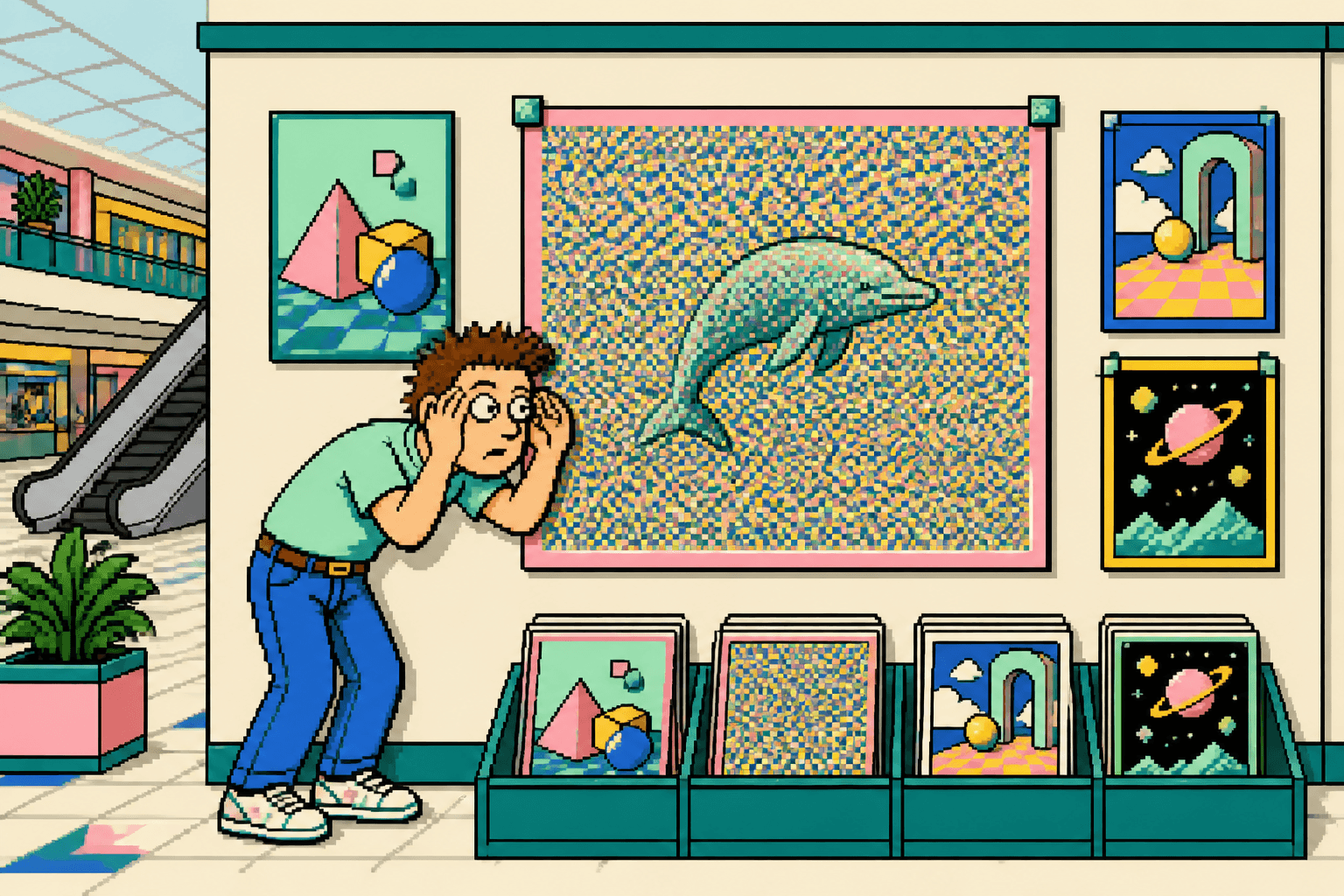
The poster was in the mall hallway between Sam Goody and the Orange Julius. It was three feet by two feet, framed in matte black aluminum, lit by a tube of fluorescent light bolted to a kiosk that also sold those framed photos of beaches you'd never been to. The poster itself was a chaotic mess of confetti. Hot pink dots, electric green smears, purple speckle. No image you could see. A caption at the bottom said 3D HIDDEN PICTURE - CAN YOU SEE IT?
You stopped. You stared. You let your eyes go soft. You tilted your head. You moved closer until your nose almost touched the glass, and then slowly walked backwards, the way the kiosk guy had told a different family to do five minutes earlier. You squinted. You unsquinted. You waited.
Nothing happened.
The other kid would say I see it. Then whoa. Then they'd describe it in too much detail. A dolphin jumping over a pyramid. Three sailboats and a sun. A dragon eating its own tail. You would say yeah I see it too, and you would not see it, and you would walk away from the mall kiosk pretending you'd just had a transcendent visual experience that you had, in fact, not had.
That was the deal.
The Object
The proper name for the thing was an autostereogram. The proper company was N.E. Thing Enterprises, which sounds like a fake company and was, in fact, a real company. They published Magic Eye books starting in 1993 and went on to sell about twenty million of them, which is, depending on how you count, more copies than the entire His Dark Materials trilogy. People did not read these books. People bought these books and put them on the coffee table and forced their relatives to look at them.
A Magic Eye image was generated, mathematically, by taking a 3D depth map - a grayscale heightfield where light meant closer and dark meant further - and overlaying a horizontally-repeating pattern that subtly shifted in tile width based on the depth at each point. Your left eye and right eye, normally focused on the same point, were tricked into locking onto different repetitions of the tile, and your brain - your poor, suggestible, very pattern-hungry brain - did the rest. It interpreted the offset as parallax. Parallax meant depth. Depth meant 3D.
The dolphin emerged.
If you were one of the people for whom the dolphin emerged.
Your brain - your poor, suggestible, very pattern-hungry brain - did the rest. The dolphin emerged. If you were one of the people for whom the dolphin emerged.
The Method
There was a script for how to look at it. The teacher in the back of the Magic Eye book had a five-paragraph monologue about it.
Hold the page up to your face. Make sure your nose is touching the paper. Stare through the paper - not at it, through it - as if there's a fly on the wall behind it, and you're focused on the fly. Slowly pull the paper away from your face without breaking focus. Do not blink. Do not adjust. If you've done it right, the pattern will snap and the hidden image will rise out of the page, three-dimensional, holographic, undeniable.
This was, depending on the kid, either a transformative ritual or pure gibberish.
The kids for whom it worked described it the same way every time. It just clicked. The pattern popped. The dolphin was right there. They could move their eyes around the image, they could see different depths, they could see the dolphin's nose closer than the dolphin's tail. They were, you suspected, lying about some of this. They were not lying.
The kids for whom it did not work tried for forty minutes. They tried with one eye closed, with their head sideways, with the book at arm's length, with the book in a bathroom mirror, with the book backlit by a lamp. They got headaches. They claimed to see the dolphin and could not describe the dolphin. They put the book down and never picked it up again.
I was, depending on the day, both of those kids.
The Books
The first Magic Eye book had a beige cover with a single autostereogram on it. Almost the entire pre-order run sold through Walden Books and B. Dalton and the racks at Spencer's Gifts. By 1994 they were syndicated in the Sunday funny pages, between Cathy and the bridge column. Your grandparents had one in their bathroom, balanced on the back of the toilet, between a Reader's Digest and a basket of seashell-shaped soaps that nobody was allowed to use.
The second book sold. The third book sold. By 1995 they were a category. Hidden Worlds. 3D Adventures. Magic Eye for Kids. There was a calendar. There was a Magic Eye puzzle. There was a small clear keychain you could buy at Spencer's that had a Magic Eye in it that you could not, no matter what, see, because it was the size of a dime.
The kiosks were the upgrade product. The kiosk had the full-size posters, glossy, two feet across, framed and ready to hang. Forty dollars. Forty dollars. You went home and put it on your bedroom wall and told your friends about the dolphin and the pyramid and the dragon, and your friends came over, and your friends stared at it, and roughly half of them said whoa and roughly half of them said I just see colors, and the dolphin remained yours alone, which was sort of the whole appeal.
The Skeptics
There was always a kid who could not see them and would not pretend.
This kid - and there was one in every class - would stand in front of the poster, arms crossed, and say there's nothing there. You're making it up. They would say this with full confidence and with no sense of social cost. They were, in retrospect, correct about the social cost. The dolphin was, to them, not real. The dolphin was a mass hallucination being conducted by their peers, who were either lying outright or had simply convinced themselves of a sailboat that wasn't there. This kid had a point.
This kid was, also, almost certainly the kid who could not get their eyes to diverge correctly. Some percentage of the population - maybe five, maybe ten, the studies are vague - simply cannot fuse a parallel-view autostereogram. Their eyes don't unlock that way. It's not effort. It's not patience. It's wiring. They could stare at the page until they fainted and there would still be no dolphin.
Nobody told them this. Nobody knew. The position of the playground was try harder. The position of the playground was you're doing it wrong. The position of the playground was that you, specifically, were the kid who couldn't see the dolphin, and the dolphin was a thing that existed, and the failure was in you.
The position of the playground was that you, specifically, were the kid who couldn't see the dolphin. The dolphin was real. The failure was in you.
This was, I now think, the first time many of us encountered something that worked for most people and did not work for us and was reported on as if it worked for everyone. We'd see it again. We'd see it later, with caffeine, and with cilantro, and with the kind of music that was supposed to make you cry. We'd see it again, with whatever Tuesday morning meditation app was supposed to just click, and we'd lie about it the same way, automatically, before we even thought about it. I see it. I feel it. Whoa.
We had been trained.
The Seinfeld Episode
In November 1995 a Seinfeld episode aired in which Mr. Pitt, the network executive George works for, becomes obsessed with a Magic Eye poster and is shown standing in his office staring at it for the entire episode, unable to see the image. It's the B plot. It's not played for sympathy. He stares. He grimaces. He fails. At the end of the episode he finally sees it - a spaceship - and is briefly euphoric.
The joke worked because everyone watching knew which kid they were. There was, in the audience, a percentage of people who had been Mr. Pitt for two years and were waiting for permission to be the punchline.
The episode aired during the absolute peak of the Magic Eye thing. Two and a half years later the books were already off the front table at Borders and being marked down on the discount rack near the puzzle calendars. By 1998 the kiosk in the mall was selling laser-print photographs of waterfalls instead. By 2001 the only place you saw a Magic Eye was in a doctor's waiting room, the poster yellowed at the corners, hung crooked, with the caption CAN YOU SEE THE DOLPHIN? faded to CAN YOU SEE THE DOLPH
The Math
The thing nobody talked about at the time was that the dolphin was, technically, just math.
A Magic Eye was generated by a program. The program took an input - a depth map of, say, a dolphin - and produced a pattern. There was no artistry in the pattern. The pattern was a random scatter of pixels with a precisely calculated horizontal shift. You could not look at the pattern and learn anything. The pattern was a delivery mechanism. The art was the depth map, which was a flat grayscale image of a dolphin, which you could also just look at.
So you bought a forty-dollar poster of a procedurally generated pattern that, when correctly viewed, resembled a flat picture of a dolphin. You could have bought the flat picture of the dolphin for, like, two dollars. You did not buy the flat picture of the dolphin. You bought the poster that hid the dolphin behind a wall of confetti and forced you to perform a small ocular ritual to access the dolphin.
The dolphin was not the product. The ritual was the product.
The dolphin was not the product. The ritual was the product. The forty dollars was for the experience of standing in front of the poster and unlocking it. The dolphin was the participation trophy.
The forty dollars was for the experience of standing in front of the poster and unlocking it. The forty dollars was for the moment the pattern snapped. The forty dollars was for the right to tell other people about the dolphin you had personally seen. The dolphin was the participation trophy.
This was, in retrospect, an extremely modern transaction. We paid for an experience that was time-bounded, performative, and not quite shareable. We paid for the kind of moment that doesn't survive being photographed. We paid for a thing that some people couldn't do and that some people felt smug about being able to do.
We paid forty dollars for content that didn't exist outside of our own eyes.
The Comeback That Didn't
People keep trying to bring Magic Eye back. There are coffee table books reissued for the holidays. There are Magic Eye apps. There is a Magic Eye Instagram account with a hundred thousand followers, posting one autostereogram a week, with captions like can you see it?, to which people in the comments reliably reply I see it! and I can't see anything! and omg I forgot these were a thing.
The thing that doesn't come back is the mall kiosk. The thing that doesn't come back is the friend leaning over your shoulder going no, like, through it. The thing that doesn't come back is the social pressure to lie about the dolphin in front of three other ten-year-olds at a sleepover.
You can see a Magic Eye now if you want to. You can see one in three seconds. You will not get a headache. You will not pretend. You will not need to.
That's not the version we had.
I tried one last week. I picked up an old Magic Eye book at a thrift store for ninety cents and I sat on the couch and I held it up to my face and I let my eyes go soft, the way the teacher in the back of the book taught me, the way the kiosk guy at the mall taught me, the way the kid next to me at the slumber party taught me. I waited. I stared through the paper. I focused on a fly on the wall behind the paper.
The pattern snapped. The dolphin was right there.
It was a sailboat. It was always a sailboat.
I had been looking at the same one for thirty years.