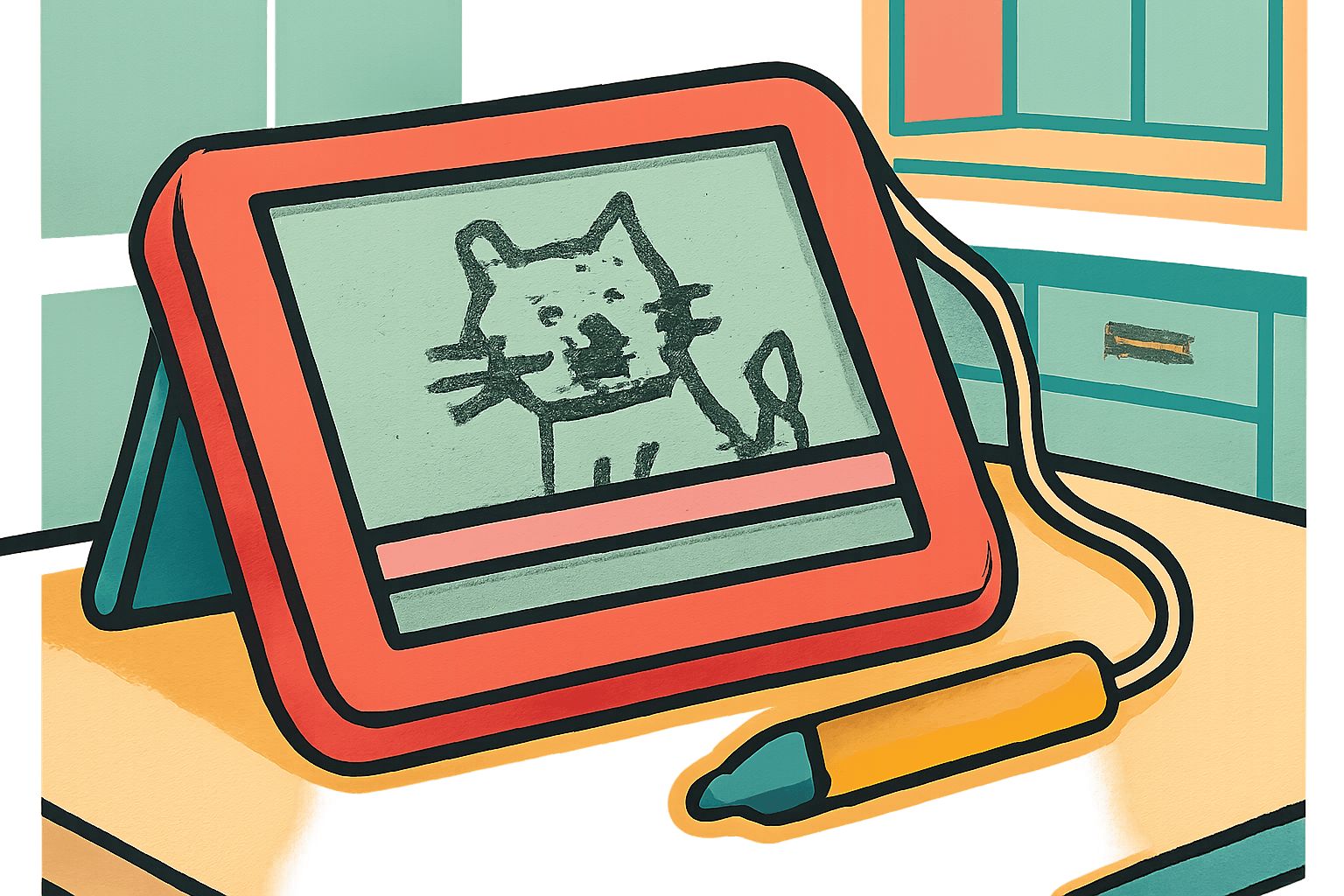
The first thing you noticed was that the screen was the wrong color. Not gray, not green, not white. A specific muddy gray-green that did not occur in nature and did not match anything else in your house. You pressed the pen to it and a chunky dark line appeared and you immediately knew, in the way kids know things without being able to say them, that this was not a normal toy. This was an appliance. This was a tablet.
You drew a horse. You showed your mom. You slid the bar down. The horse went away in one chalky pull, except for the small piece behind the horse's ear that wouldn't go, the piece that was now part of the screen forever.
What It Actually Was
Inside the Magna Doodle, behind the gray-green window, there was a thin layer of viscous liquid. Honey-thick, transparent, doing nothing visible. Suspended in the liquid were millions of tiny black iron particles. Iron filings, basically. They sat at the bottom, quiet, invisible from the front because the liquid was too dark and the back panel was too far away.
The pen had a magnet in it. Just a small one in the tip. When you pressed the pen against the screen, the magnet pulled the iron particles up against the front of the window, and they stuck there in a dense little clump. From the outside, this looked like a dark line. From the inside, it was a small migration. The particles weren't drawn on anything. They were just being held in place by physics, on the wrong side of the goo, until something stronger told them to go home.
The eraser bar was that something stronger. The bar had a wide flat magnet in it, oriented the other way. When you slid the bar across the screen, every iron particle in its path was yanked back down to the rear of the screen, where it belonged. The drawing didn't fade. The drawing was retrieved.
The drawing didn't fade. The drawing was retrieved. The pen was a kidnapping. The bar was the rescue.
This is, I want to be clear, an objectively incredible mechanism. There were no batteries. There was no electronics. There was a magnet and some iron and some gel, and a child could draw a face on it. The whole toy was a science demo someone had figured out how to put a handle on.
The Pen on the String
The pen was on a string. The string was about ten inches long. This was, in theory, so the pen wouldn't get lost.
The string did not work. The pen got lost. Every Magna Doodle in America lost its pen within the first six weeks of ownership. The string would fray, and then it would knot, and then it would snap, and then the pen was a free agent. It would migrate. It would end up in the silverware drawer. It would end up under the seat of the car. It would end up in your sister's room, found later, accusations made.
Here is the thing about a Magna Doodle without a pen: it is useless. The toy required a magnet of a very specific strength, and the only thing in your house that had a magnet of that strength was the pen that had come with it. You'd test the refrigerator magnets. The refrigerator magnets did nothing. You'd test the magnetic letters on the fridge. They did nothing. You'd test the magnet you'd unscrewed from the back of the speaker that summer your dad let you take apart the broken stereo. That one did too much - it was a hard drive magnet, it had no business being in a child's hand, and when you pressed it to the screen it made a black smear the size of your fist that took twenty bar-pulls to undo.
Eventually you'd find the pen. It would have escaped to the bottom of the toybox or the lining of a sleeping bag or, the one time, the stomach of the dog. But for the eighteen days the pen was missing, the toy was a small flat brick with a slot for nothing.
The Shapes
The Magna Doodle came with stamps. Four little plastic geometric shapes, each one with its own embedded magnet, each one designed to leave a perfect circle or square or triangle on the screen when you pressed it down.
The shapes were, in theory, a feature. In practice, they were a confession. The toy was admitting that you could not draw a circle. The toy was right. You could not draw a circle. Your circles came out as ovals with a flat side. Your squares came out as parallelograms with one corner that wandered off. The shapes were a kindness. They let you stamp a perfect circle and then surround it with your bad squiggles, and from a distance the whole composition looked sort of intentional.
The shapes were also the first things that got lost. They were small, hard, magnetic, and irresistible to the gap between the couch cushions. They lived there now. They lived there with the Lite-Brite pegs and the Polly Pocket dolls and the third die from your Yahtzee box. The shapes were gone within a week and you weren't going to admit it, so you started drawing your own bad circles around your bad cats and the toy stopped being about geometry.
The Ghost Line
I want to talk about the ghost line, because nobody talks about the ghost line.
When you slid the eraser bar across the screen, ninety-eight percent of the drawing went away. Two percent did not. There was always a faint, residual smear where the densest parts of the drawing had been. A signature. A horse. A name. The bar would do its best, you'd run it back and forth a few times, and the smear would fade some, but it would never go entirely.
This was the gel resisting. The iron particles closest to the front window had been pulled there hardest, packed tightest, and a few of them stuck to the window through static or surface tension or sheer enthusiasm even after the bar had passed. They did not go home. They stayed. Over the months, the screen accumulated a kind of palimpsest of every drawing it had ever held, all faded and overlapping, a gray haze of past dolphins and stick figures and the word POOP you had written when you were seven and never quite scrubbed out.
The ghost line was the toy admitting it had a memory. You had been told, repeatedly, that the Magna Doodle erased everything. The Magna Doodle did not erase everything. The Magna Doodle remembered, faintly and forever, every line you had ever pulled across it. By the time the toy was a year old, the screen looked like a chalkboard at the end of the school year - cleaned but not clean, full of evidence.
The toy was admitting it had a memory. You had been told it erased everything. It did not erase everything. It remembered, faintly and forever.
The Slide Was the Whole Thing
If you ask me to describe the Magna Doodle now, decades later, I cannot tell you a single drawing I ever made on it. I can describe, with photographic clarity, the slide.
You'd grip the eraser bar at one end, between thumb and index finger. The bar had a small black handle that protruded from the side of the toy, a little nub. You'd pull, and there would be the lightest resistance - the magnet meeting the gel, doing its work - and then a satisfying drag as the bar moved across the screen and the drawing peeled away behind it. The motion was about a second long. Sometimes a little less. The screen behind the bar went from busy to clean in real time, like a car wash, like a wave taking footprints off a beach.
When the bar got to the end, it would thunk into the stop, a small plastic seat at the right side of the toy. Then you'd push it back. The push didn't erase. The push was empty. You were just resetting the bar so you could erase the next thing.
The slide was the dopamine. The drawing was the prerequisite. You drew so you could erase. The Magna Doodle had figured out, at the level of its physics, that the most satisfying thing in the toy was the undo button.
This is, I think, why the Magna Doodle was a good road-trip toy and a bad sit-down-at-a-table toy. In the back of the station wagon you didn't care what you were drawing. You cared that you could fill the screen with squiggles and then, in one motion, vaporize them. Squiggle. Slide. Squiggle. Slide. Three hundred miles of Pennsylvania and the only thing on the screen was the ghost of itself.
Why the Pen Worked Like That
Here's the part I love about the Magna Doodle, in retrospect.
It worked because someone had thought, very specifically, about what kind of magnetic field would pull iron particles forward through gel without pulling them sideways too much. The pen needed enough magnetism to make a clean line but not so much that the line bled outward. The bar needed a wide, flat field that pulled everything backward but didn't tear up the gel. The gel itself had to be thick enough that the particles stayed put after the pen left, but thin enough that the bar could pull them back.
This is, in actual physics-paper terms, a published 1974 patent. Pilot Pen Corporation in Japan, an inventor named Jerry Woo. The whole thing was assembled out of laboratory chemistry and practical magnetism and run through the wringer until it was a $14 toy. By the time it landed in your hands at FAO Schwarz or Toys R Us or wherever your aunt panic-bought a birthday present, it had been refined to the point that a four-year-old could operate it with no instruction.
You did not know any of this. You knew that the line went black when you pressed and went away when you slid. The toy hid all of its cleverness. It pretended to be dumb so you could use it. This is, I think, the highest compliment you can pay a piece of design.
- Your name - 28%
- Your name with a heart - 14%
- A house with a triangle roof and a sun in the corner - 12%
- A cat - 10%
- A face that looked like a potato - 9%
- The word HI - 7%
- A sword, badly - 6%
- An attempt at a 3D cube - 5%
- The word POOP, then the slide bar, fast - 5%
- Something you actually meant - 4%
The Argument the Toy Was Making
The Magna Doodle was selling impermanence. You could not keep what you made. There was no save. There was no print. The drawing existed for the time you were looking at it and then, by your own hand, it was gone. The toy was structured around its own erasure.
This was, weirdly, fine. You did not feel sad about the lost horse. You did not feel sad about the lost dolphin. The toy was honest about what it was. It told you, up front, with the giant black bar across the top of the screen, that nothing on this surface was going to last. You drew anyway. You drew because it wouldn't last, in fact. There was something liberating about a drawing surface that had no expectations of you and would forget what you'd done within thirty seconds.
I think about this when I look at the camera roll on my phone. I have eleven thousand photographs. Most of them I will never look at. Most of them I cannot delete, because there's no slide bar - there's just a swipe and a confirmation and a thirty-day recovery folder, and even then they're somewhere in iCloud, hanging around. The phone is the opposite of the Magna Doodle. It saves everything by default. It saves things I didn't even mean to save. It assumes I want a record.
The Magna Doodle assumed I didn't. The Magna Doodle was right about half the time.
The Toy Outside Time
Magna Doodles still exist. You can buy one tomorrow. The mechanism hasn't changed, because the mechanism was already correct in 1974. They've added some cup holders. They've made a smaller travel version. They've put characters on the frame - Disney, Frozen, whatever the children want this year. The screen is the same screen. The bar is the same bar. The pen is still on a string. The string is still going to break.
Mine is in a closet at my parents' house. The frame is still red. The pen is missing. The screen has the ghost of a name written on it, possibly mine, possibly my sister's, faded to almost nothing but still there if you tilt it under a lamp. The shapes are gone. The string has been knotted three times. The gel has held up surprisingly well, which I appreciate. The magnetism is still in working order, when I find a magnet to test it with.
I am not going to throw it out. I'm also not going to bring it home. It belongs on the shelf in my parents' house, where the ghost lines from 1994 can keep faintly glowing under the dust.
The Magna Doodle promised that you could draw without consequence. It mostly kept the promise. The slide was clean. The screen went back to gray. But there was always that small residual smear at the corner where the drawing had been densest, a little patch of permanence the toy hadn't meant to make. It taught you, before you could spell the word, that erasing is not the same as forgetting, and that the surface remembers what the surface remembers, even when you swear it doesn't.