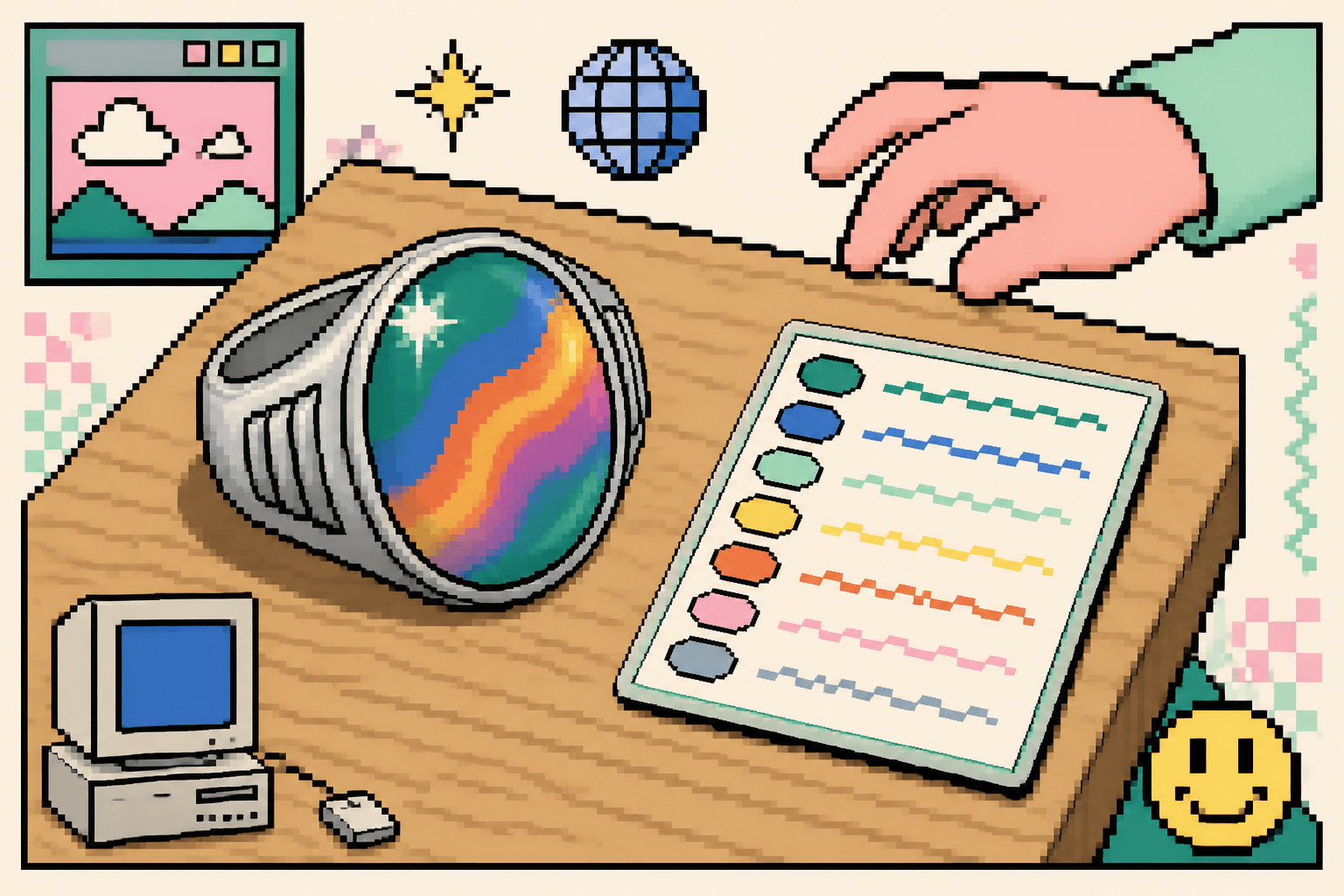
The kiosk was in the main aisle of the mall, between the Sunglass Hut and the place that sold airbrushed t-shirts to tourists. On the pegboard behind the counter were about four hundred rings, hanging from little hooks, each one with a laminated card tied to it by a piece of elastic. The cards all said the same thing. There was a column of colors on the left and a column of feelings on the right. Black: stressed, overworked. Green: average. Violet: passionate, in love. The chart was shrink-wrapped. The shrink-wrap had fingerprints on it.
The ring you wanted was silver, with an oval stone. The stone was black. All of them were black. Nobody had held one yet that morning.
You were twelve. You had four dollars and change. You asked the woman behind the counter if you could try one on.
The Chart
The chart was the whole product.
Without the chart, the ring was a cheap piece of silver-colored metal with a bubble of liquid crystal on top that changed color based on temperature. With the chart, the ring was a diagnostic device. The chart converted temperature into feeling, which was the alchemy that justified the price. Four ninety-nine, taped to a card the size of a business card, with seven colors in a vertical stripe and a sentence next to each one.
- Black. Stressed. Overworked. Anxious.
- Amber. Nervous. Unsettled. Mixed feelings.
- Green. Average. Not much going on.
- Blue-green. Calm. Charming. Somewhat relaxed.
- Blue. Happy. Content. Loved.
- Violet. Passionate. Romantic. Desired.
Nobody wanted green. Green was the default. Green was fine, and nobody was buying a ring to find out they were fine. The whole premise of the kiosk was that there was something more interesting going on inside you than you had suspected, and the ring was going to tell you what. You slid it on. You waited.
Nobody wanted green. Green was the default. The ring was supposed to tell you something you did not already know, which was the whole premise of handing over four ninety-nine.
The Wait
The waiting was the ritual.
You put the ring on and you had to hold still. If you moved too much, or if your hand was cold from the air conditioning, the stone would stay dark. You'd rest your palm against the counter and you would wait. The woman behind the counter would not look at you. She had seen a thousand twelve-year-olds wait for the stone to turn purple. She was texting someone on a Nokia.
The stone would start to shift. First it would go from black to a kind of murky olive. Then it would brighten into a real green. Then, if you kept it on long enough, and if the mall was warm enough, and if your blood was doing whatever it was doing that day, the green would deepen toward teal. If you were patient, teal became blue. Blue was the color you were waiting for. Blue meant happy. Blue meant you were a person it was possible to be happy as.
Nobody got violet. Violet was theoretical. Violet was on the chart to make you believe. If you ever got violet it meant you had wrapped your palm around the stone and squeezed, or stepped out of a hot shower, or run up a flight of stairs, and even then it was more of a dusty mauve than the royal shade on the laminated card. The card lied about violet.
The Science
Here is what was actually happening.
Inside the oval stone was a thin disc of thermotropic liquid crystals, which are a real thing with a real patent, developed in the 1960s for things like temperature strips in hospitals and thermometers you can read on the side of a fish tank. These crystals have a molecular structure that pitches at different angles depending on how warm they are, and the angle they are pitched at determines what wavelength of light they reflect, which is why they appear to change color. They are, essentially, a very precise thermometer that happens to be beautiful.
The ring took the temperature of your finger. That is all it did. The temperature of your finger is not your mood. The temperature of your finger is a combination of the ambient temperature, how recently you ate, how cold your hands run constitutionally, and whether you just took them out of a sweatshirt pocket. People with cold hands always got black. People with warm hands always got blue. The ring was running on a thermal gradient between about 70°F and 95°F and translating it into feelings via a card that somebody had made up at a kitchen table in 1975.
The ring took the temperature of your finger. That is all it did. The temperature of your finger is not your mood.
Try One
Hover the stone to warm it up. Watch the chart. The chart will tell you, with absolute confidence, that you are currently passionate and desired, when what has in fact happened is that you have held your cursor over an SVG for ninety seconds.
That is also what the real thing did.
The Argument
Here is where I want to argue with myself.
The counter-argument is that mood rings were nonsense. They were a trick dressed up as a diagnostic, sold to teenagers at a kiosk by a woman who did not care. They taught a generation of kids to think of their inner life as a thing that could be read off a chart, and then taught them that the chart was in their jewelry, which is a bad thing to teach anyone. There is a line, probably, from mood rings to the self-tracking apps on your phone right now, and that line is not entirely a line of progress. We have been trying to turn feelings into color-coded data for fifty years, and it does not get much more honest when it has your heart rate.
I agree with most of this.
But also. The mood ring did one small useful thing, which was that it gave a twelve-year-old a reason to pay attention to the inside of her own hand. You sat still. You felt your own temperature. You noticed when you were nervous because your palms went cold and the stone went black, and you noticed when you had calmed down because the stone went green. The ring was wrong about what it was measuring, but it was teaching the right skill. It was teaching you that your body was giving off signals, and that if you held still and watched, you could sometimes tell what the signals were.
That is a lesson that most twelve-year-olds do not get a chance to learn. It got learned, at a kiosk, from a lie about violet.
The Finger
The band stained your finger.
Not every ring did this. The expensive ones, the ones with real silver backing and a sealed stone, were fine. But the four-ninety-nine kiosk ring was not real silver. The kiosk ring was pot metal plated with something that pretended to be silver, and after about three days the plating would start to come off on the inside of the band, and the inside of your finger would turn a dusty green. It was not dangerous. It was not permanent. It was just a stripe. You could rub it off with a thumb. It would come back by lunchtime.
The green stripe was more honest than the stone. The green stripe was telling you the exact truth about the ring, which was that it was cheap and the metal was contaminating your skin. The stone was telling you about your love life. One of these two was lying.
- Day 1 - stone is black at the kiosk. Turns green on the walk to the food court.
- Day 2 - at school. Teacher asks you to put your hands on your desk. You check the stone every eight minutes.
- Day 4 - a stripe of green has appeared on your finger. You wash it off.
- Day 6 - stone stops reaching blue. Something inside has settled.
- Day 10 - you put it in a shell dish on your dresser.
- Day 20 - the stone has clouded. Water got in. The crystals are dead.
- Day 21 - it still fits. You put it on anyway. It is black now, always.
- Day 100 - the shell dish moves to a drawer.
- Day 2000 - you are in a different house. The ring is somewhere.
The Cloudiness
The stone eventually clouded.
What happened was that the seal on the stone was not actually a seal. It was a dab of glue that was supposed to be a seal, and over time, especially if you got the ring wet, moisture would seep in between the top crystal layer and the little metal cup underneath. The water would stay there. It would not evaporate because the glue was mostly sealed, just not entirely. And slowly the crystals would die.
A dead mood ring stone has a specific look. It is sort of gray with brown edges. It does not change color anymore. It is permanently reading whatever its last temperature was, which is usually room temperature, which the chart would call average. You could not throw it out, because it was a ring, and rings had meaning, and this one had cost you four of your own dollars. So you put it in a shell dish. The shell dish is in the drawer with the other shell dish. The ring is in there, somewhere, telling anyone who looks at it that they are average, forever.
The Palm
Here is the thing I actually remember.
I remember sitting at a lunch table in sixth grade with my left hand palm-up on the table and the ring on my middle finger and three other girls doing exactly the same thing. We were trying to make the stones turn blue. We were holding very still. Nobody was eating. We had decided, collectively, without discussing it, that we were going to sit through lunch and will the rings into blue, and if any of us got blue, we were going to tell everyone that it had worked and that one of us was in love.
Mine stayed green. Katie's got to teal and we all gasped. Jennifer's turned black halfway through and she looked briefly stricken, until somebody pointed out that she had been holding an ice-cold milk carton, which was a credible explanation and nobody wanted to dwell on it.
Nobody got blue. Lunch ended. We put the rings in our pockets and went to math.
We were sitting at a lunch table trying to will four pieces of jewelry into reporting that at least one of us was in love. Which, in retrospect, we partially were. The ring was not going to tell us.
The Chart Was Never The Point
I think the chart was never the point.
The chart was the pretext. The chart was the official reason you could sit at a lunch table holding your hand very still and staring at a piece of plastic on your finger, when what you were really doing was noticing yourself. The chart gave you cover. If somebody said what are you doing, you could point at the stone and say the ring is telling me I'm green and that was enough. You weren't being weird. You were doing science.
But the science was not science. The science was six twelve-year-olds, in a cafeteria, under fluorescent lights, holding still and feeling their own blood move. We were practicing something. We were practicing the thing adults do when they say check in with yourself, which is a phrase we would not hear for fifteen more years, and which, when we heard it, would land as fluent, because we had done the lab work in sixth grade with a cheap ring and a laminated card.
The ring did not know what it was teaching. The ring was pot metal and liquid crystal. But it got the hand onto the table, and it got the eyes onto the hand, and it ran the warmth of a palm through a chart of colors and told us this is what you are right now, and we believed it, mostly because we wanted to, and partly because the stone had actually, physically, changed color.
That part was real. The color was real. The feeling was separate.
The stone is in a drawer. The chart is long gone. The green stripe on my finger washed off before 1998 and never came back. The ring, if I found it, would be black now, permanently, because the crystals are dead and there is nothing left for the heat of my hand to warm. I would still put it on. I would still hold it up to the light and wait. The waiting is the part that doesn't need the stone to work.