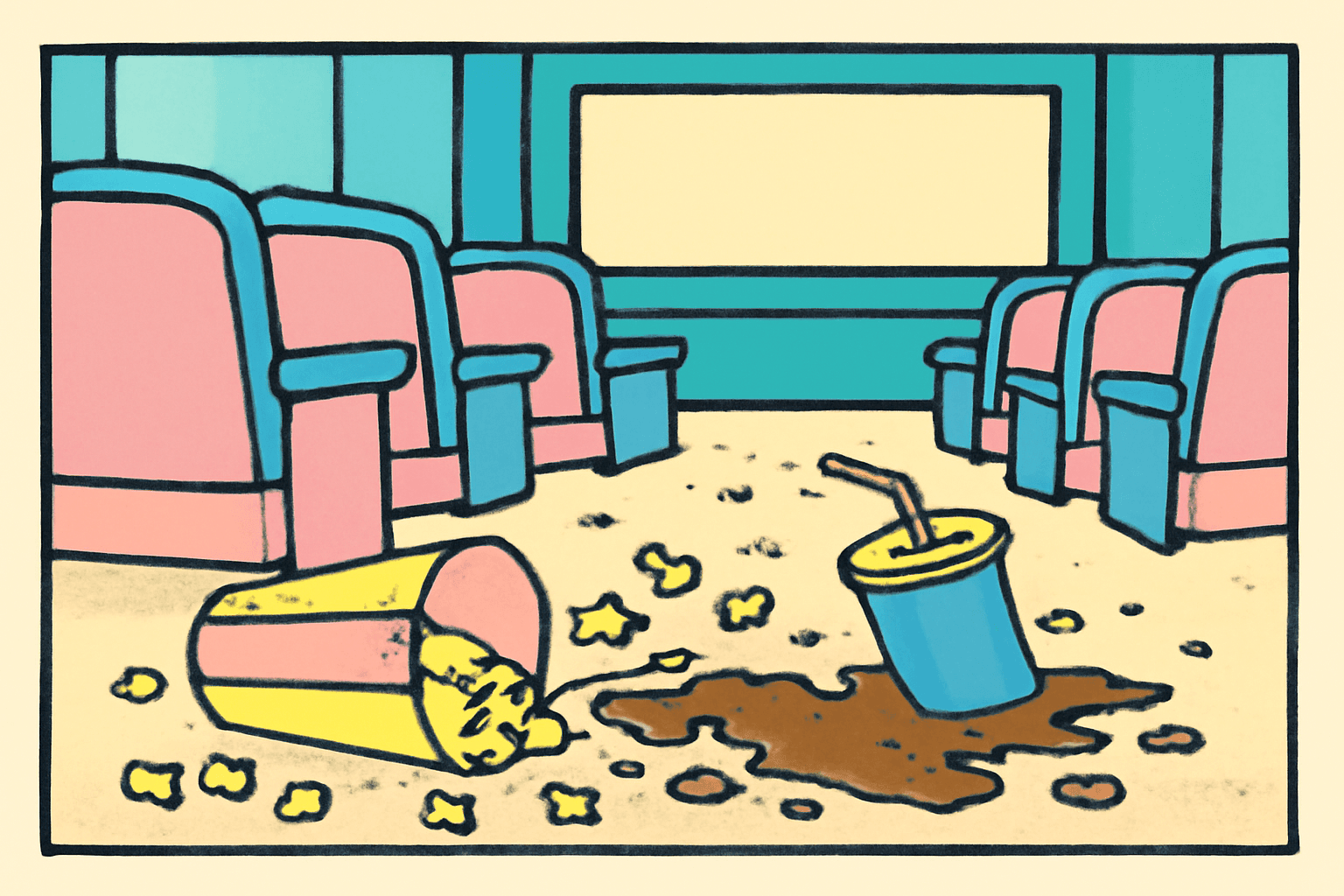
The first thing you noticed wasn't the smell or the darkness. It was the sound. That wet, sucking adhesion of your sneaker sole lifting off the floor with every step. Shhhk. Shhhk. Shhhk. A rhythm that followed you from the lobby to your seat, a sound so specific to the 90s movie theater that hearing it now would teleport you back instantly. You didn't know what you were walking through. You didn't want to know. You just accepted it, the way you accepted everything about the moviegoing experience - as a package deal of wonder and mild biohazard.
The floor of a 90s movie theater was an archaeological record. Layers of Coca-Cola and Sprite and whatever orange drink they were pushing that summer, dried and re-wetted and dried again over months, maybe years. Popcorn ground into a paste by ten thousand shoes. Gummy Bears that had fused with the concrete at a molecular level. Junior Mints that had rolled under seats during the Clinton administration and would remain there, fossilizing, until the building was eventually demolished and converted into a CVS.
Nobody cleaned that floor. Not really. I'm sure someone ran a mop over it at closing time, but that mop was fighting a war it could never win. The stickiness wasn't a problem to be solved. It was a condition. It was permanent. The floor of a movie theater wasn't dirty the way your kitchen gets dirty. It was dirty the way a swamp is dirty - fundamentally, essentially, as a core part of its identity.
The floor of a 90s movie theater wasn't dirty. It was geologically sticky. It had layers. It had history. It had probably achieved some form of sentience.
The Concession Economy
Before you even got to the sticky floor, you had to survive the concession stand. And the concession stand was where you learned that capitalism was not always rational.
A small popcorn cost four dollars. A ticket to the matinee cost three-fifty. This math did not add up. This math was never going to add up. But there you were, standing in line, looking up at the backlit menu board with its snap-in letters - some of them crooked, some missing entirely - trying to figure out what combination of items you could afford with the ten-dollar bill your mom gave you.
The answer was usually: a ticket and nothing. Or a ticket and a small drink, which came in a wax-coated cup the size of a thimble and was ninety percent ice. The large was only fifty cents more, the cashier would tell you, and you'd look at your remaining funds and think well, I'm already making terrible financial decisions today, and you'd upgrade. This is how they got you. This is how they always got you.


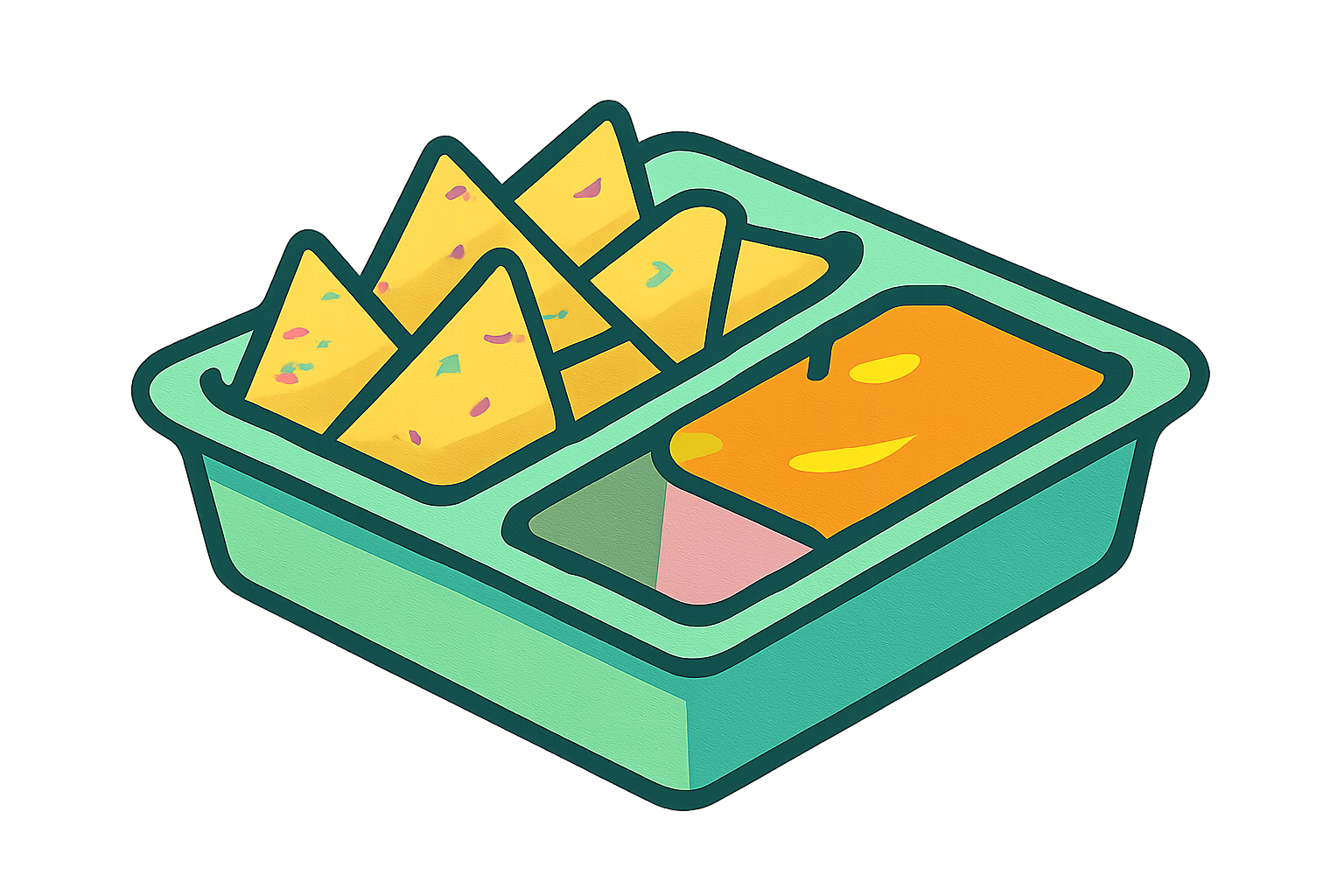

The nachos were a particular act of faith. They came in a flimsy plastic tray with a compartment of warm, orange, cheese-adjacent liquid that bore no resemblance to anything found in nature. You'd pump it yourself from a dispenser that looked like it hadn't been cleaned since the Reagan administration. The chips were always stale. The cheese was always the temperature of lava for exactly ninety seconds before cooling into a rubbery skin. You ate them anyway. They were great.
The Smuggling Operation
This is where your mom's purse entered the picture.
Every family had a system. Ours involved my mom's enormous handbag - a cavernous leather thing that could have held a Thanksgiving turkey - loaded with boxes of candy from the Walgreens next door. Milk Duds. Sour Patch Kids. Maybe a can of Coke wrapped in a sweater so it wouldn't clink. The whole family would walk past the ticket-taker with the casual confidence of people who were definitely not committing snack fraud.
Everyone did this. Everyone. The theater employees knew. They had to know. A woman walks in with a purse the size of a duffel bag, and it's making crinkling sounds with every step? They knew. But they were making seven dollars an hour and they did not care. God bless every sixteen-year-old in a maroon vest who looked the other way while my mother smuggled in an entire bag of fun-size Snickers. You were the real heroes.
The Seats
The seats in a pre-stadium-seating movie theater were a marvel of hostile design. They folded up when you stood, which sounds reasonable until you remember that the hinge mechanism was essentially a spring-loaded trap waiting to snap shut on your fingers. Every kid learned this once. You'd reach down to flip the seat back and wham - it would bite you, catching the soft pad of your finger between the seat and the armrest. A blood blister was practically a rite of passage.
The armrests were shared, which meant they were contested. You and the stranger next to you would engage in a silent, hours-long territorial dispute over fourteen inches of padded plastic. There was a cup holder, theoretically, but it was designed in 1978 for a cup size that no longer existed. Your large drink - the one you upgraded for only fifty cents more - would sit in it at a precarious angle, threatening to topple with every explosion on screen.
And the fabric. Oh, the fabric. That rough, industrial upholstery in dark red or dark blue, chosen specifically because it wouldn't show stains. Think about why they needed fabric that wouldn't show stains. Think about that for a second and then stop thinking about it, because the alternative is never sitting in a movie theater again.
The armrest cup holder was built for a cup from 1978. Your 1996 large drink sat in it like a skyscraper balanced on a thimble.
The Tall Person Problem
Before stadium seating saved us all, watching a movie was an act of physical negotiation. The seats were on a flat floor or - if you were lucky - a gentle slope that did approximately nothing. Which meant your entire experience depended on who sat in front of you.
You'd get settled. Popcorn on lap. Drink wedged into the useless cup holder. Lights dimming. And then some six-foot-two guy in a baseball cap would sit down directly in your line of sight. Dead center. You'd lean left. He'd shift left. You'd lean right. His head would follow, like some kind of terrible dance. You'd spend the entire movie watching it through a two-inch gap between his head and the head of the person next to him, your neck twisted at an angle that would require chiropractic intervention.
Nobody said anything. Nobody ever said anything. You just dealt with it. Asking someone to remove their hat was theoretically possible but felt, in the social dynamics of the 90s, roughly equivalent to challenging them to a duel.
The Dollar Theater
And then there was the dollar theater. Every town had one. Ours was a sad little two-screen building near the highway that played movies three months after they left the real theaters. The carpet was older. The seats were worse. The sticky floor had achieved a level of adhesion that suggested it could be used to mount tiles on the space shuttle.
The dollar theater went by many names. The cheap theater. The second-run theater. The "that one by the Taco Bell." It smelled like a bowling alley. It was wonderful.
But the ticket was a dollar. Sometimes a dollar-fifty. And the concession prices were merely outrageous instead of criminal. So you went. You saw movies there that you'd missed the first time around - movies that were already out on video, technically, but seeing them on a big screen still felt like something. The projector was a little dim. The sound was a little muddy. Someone's kid was always running up and down the aisle. It didn't matter.
The dollar theater was where movies went to die, and there was something beautiful about that. One last showing before they disappeared into the Blockbuster shelf forever. A final curtain call in a building that smelled like old butter and broken dreams.
I took my kids to a movie last year. One of those new AMC locations with the reclining leather seats and the reserved seating and the app where you order food delivered to your chair. The floor was clean. The cup holders worked. The seats didn't try to eat your fingers. Nobody's head was in the way because the stadium seating was so steep you were practically looking down at the screen.
It was perfect. It was comfortable. It was a completely frictionless experience.
My shoes didn't make a single sound the entire time. I walked from the lobby to my seat in total silence, and I couldn't tell you why, but something about that felt like a loss. Not the stickiness itself. I don't miss being glued to a floor. But the way you had to work for the movie back then - the smuggled candy, the neck-craning, the financial ruin at the concession stand, the sensory assault of that floor - it made the lights going down feel like you'd earned something.
The previews started. The screen went wide. And for a second I was ten again, shoes stuck to the floor of a two-screen theater near the highway, watching something I'd already seen on video, sitting behind someone too tall, eating Milk Duds that came from my mom's purse. The sound of the movie drowning out the sound of the floor.
Shhhk. Shhhk. Shhhk.