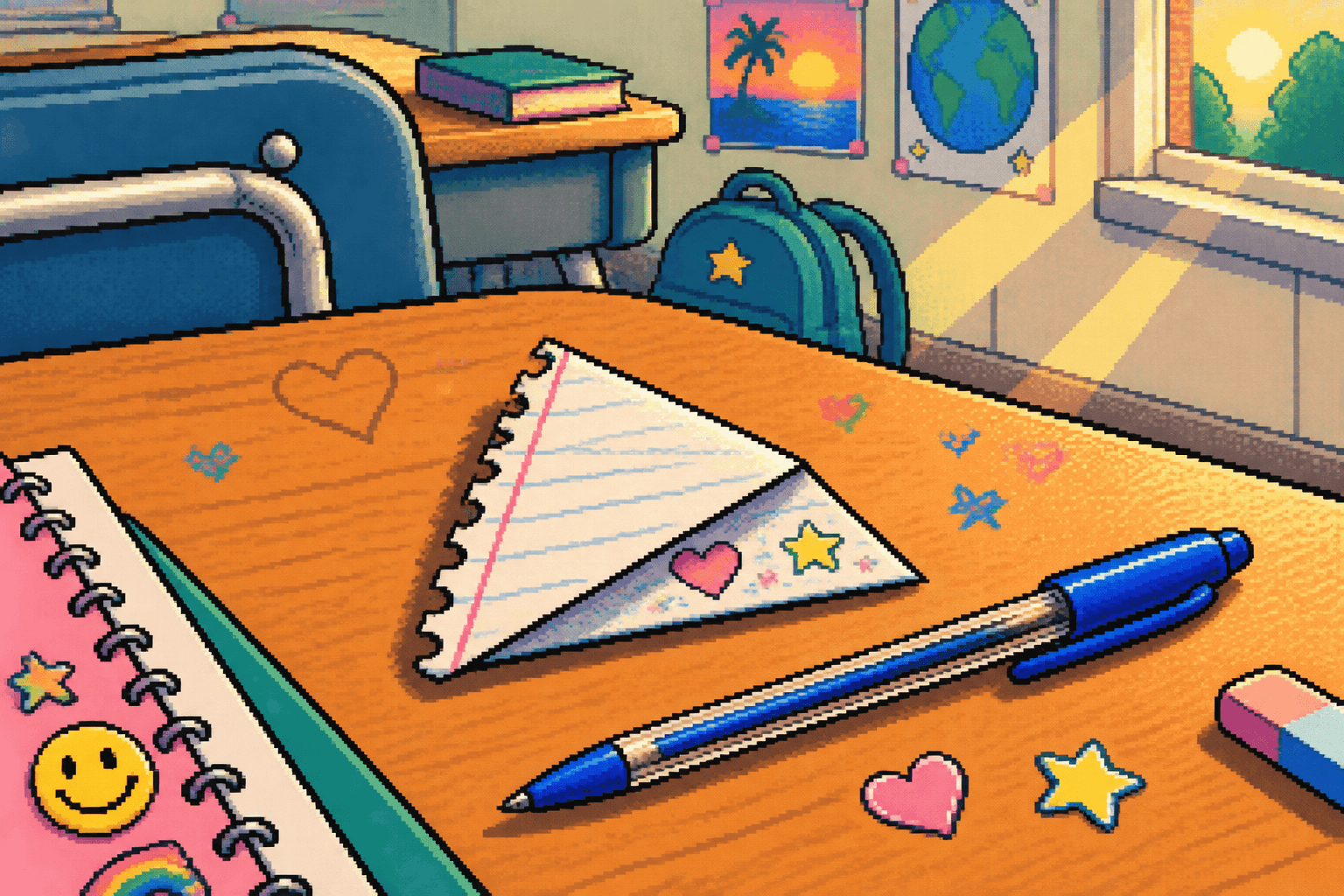
The paper came out of the back of a spiral notebook. The kind with the perforated edge that never tore clean. You ripped it off along the coil and half of it stayed behind, hanging in little curly tabs. You did not care. You had exactly one class period to write this.
Blue Bic. You wrote three words at the top.
Do you like me?
Under that, in a smaller hand, so it looked like a form:
[ ] Yes [ ] No [ ] Maybe
Then you folded it.
The Fold
The fold was a whole thing.
Not one fold. Not two. Not the origami you did with your grandpa on Thanksgiving. A specific, learned, culturally transmitted fold that every kid in America had figured out by fifth grade without ever being taught. Nobody had a class in it. The knowledge arrived through the air.
You had options.
- The Square. Bi-fold in half, then again, then again. A little pillow of a note. Practical. Boring. Used for gum requests.
- The Triangle. Corner to corner, fold, wrap, tuck. Ended up looking like a piece of Halloween candy in wax paper. The default.
- The Pull-Tab Envelope. The advanced one. A series of interlocking flaps and reverses that ended in a small paper tongue on the front that said PULL. The recipient pulled, and the note opened in a chain of unfolds like a firework. This one was showing off. This one was for a note to a girl.
You picked based on who it was for. A note to Kevin got a square. A note to Amanda got a triangle. A note to Sarah W. got the pull-tab, every time, and you practiced the fold at home the night before so you did not mess it up in class.
The knowledge arrived through the air. Nobody had a class in it. But every kid in America had figured out the fold by fifth grade.
The Passage
The note moved through the classroom like a small piece of contraband.
You wrote it in social studies while Ms. K. was drawing a map of Mesopotamia. You folded it under your desk with your left hand while your right hand pretended to be taking notes on the fertile crescent. When she turned to write on the board, you tapped Kevin on the shoulder with your knee and passed it back around your side, low, under the seat. Kevin took it. Kevin looked at the name on the outside. Kevin knew who it was for. Kevin passed it forward and up on the diagonal to Sarah, who passed it to Rachel, who passed it to Amanda, who held onto it for a full class period because Amanda was reading it.
Which was a violation.
The rules were clear. You passed it. You did not read it. Even if it was not sealed. Even if the fold was obvious. Even if the recipient's name was written on the outside in a color-coded way. You did not read it. You passed it. If you got caught, you were the one who got in trouble, and you were the one who had committed the moral crime of interception. But you were still not allowed to read it. The note was private mail. The classroom was the postal service. You were, at eleven, a federal employee.
Amanda read it anyway.
Try It
Write the note. Fold it. Pass it three desks up. Wait for it to come back.
Do You Like Me
Here is the specific note. Let me be exact.
Do you like me?
Under the question, three checkboxes. Sometimes four.
[ ] Yes [ ] No [ ] Maybe
And sometimes, in a slightly smaller hand added later:
[ ] As a friend
The fourth box was added by kids who had, at least once, been on the receiving end of a Yes and then discovered a week later that the Yes had been marked casually, in the way you might tick a box on a Scantron. As a friend was a way to leave a door open without pretending it was the door you had been asking about.
The genius of the box was that it was multiple choice. You did not have to write anything. You did not have to spell reciprocated or however or I am not sure I feel the same way but I appreciate you asking. You just checked a box. You checked the box with the same Bic pen you had in your desk. You folded it back. You passed it back. The whole ordeal, from initial writing to final answer, took thirty-seven minutes of a fifty-minute class period, and the answer was, statistically, Maybe.
Maybe was the most common answer. Maybe was safe. Maybe meant nobody had to be right. Maybe meant you got to have another two weeks of not knowing.
Maybe was the most common answer. Maybe was safe. Maybe meant nobody had to be right. Maybe meant you got to have another two weeks of not knowing.
The Interception
The nightmare was Ms. K.
You were passing the note at exactly the wrong second. She was writing on the board and then she wasn't. She turned around. She saw. She walked over. She held out her hand.
You put the note in it.
She unfolded it in front of the class. She did not read it aloud, mercifully, because she was a professional and it was 1996 and she had been a middle-schooler once too. But she saw the checkboxes. She saw the name on the outside. She looked at you. She looked at the recipient across the room. She put the note in her top desk drawer, and it stayed in her top desk drawer for the rest of the year, and every time you saw her open that drawer to get a stapler you felt a small internal collapse.
Some teachers read them aloud. This was the nuclear option. It was extremely rare, and it destroyed the kid who wrote it, and in retrospect it was a bad thing that a professional adult did to a child. I remember the one time it happened in my school, in seventh grade, and the kid transferred districts the next fall, and I do not think it was unrelated.
Most teachers just took the note and threw it away. That was the deal. You wrote the note. You got the note taken. The teacher threw the note away. You did not get to know what the answer was going to be. You started a new note in your head for tomorrow.
The Note Was Also a Newspaper
The other kind of note was not romantic. The other kind of note was information.
She said she doesn't like him anymore.
Are you going to the mall Friday.
He is being weird at lunch.
Do you have gum.
These notes were not folded ceremonially. These notes were folded in half, or crumpled, or written on the torn corner of a page with a jagged edge. They moved horizontally across the classroom, not diagonally. They went to the person next to you. They went to the person two seats over. They were the classroom's private Twitter, decades before Twitter, and they carried the same three or four topics on repeat.
You would write do you have gum and pass it to Amanda. Amanda would open it, break off half a stick of Bubble Yum under her desk, wrap the half-stick in the note itself, refold it, and pass it back. Now the note was also a delivery system for contraband. Now the note was a small piece of infrastructure.
- The confession: do you like me / y / n / maybe
- The follow-up: did you mean the y
- The retraction: nvm forget I said that
- The gossip: she said WHAT
- The logistics: are you going to the mall friday
- The request: do you have gum
- The insult, folded: passed to the wrong person on purpose
- The blank one: unfolded to reveal nothing, sent as a joke
- The one with gum in it: contraband inside a paper wrapper
The Argument
I want to give the counter-argument, because it's not small.
The counter-argument is that the note was a bullying instrument.
Every kid who ever passed a note was also, potentially, a kid who wrote a note about somebody. About her clothes. About his hair. About the smell of the kid nobody sat next to. The same folded triangle that carried do you like me could carry she thinks she's so cool to seven other kids in a chain, and it did, and everybody knew it, and there was no way to trace a note. Signed if signed. Otherwise anonymous mail. And anonymous mail is what people who are being cruel use. The note passed at fifth-period lunch about the girl with the eczema on her elbows was not a charming artifact of a lost era. It was the same instrument the confession used. The paper did not care what you wrote on it.
The other counter-argument is more boring, and it is that the whole system was inefficient in a specific way. Two people who liked each other in 1996 had to conduct a slow-motion diplomatic exchange over the course of six class periods, using folded paper, an unreliable delivery network, a Yes/No/Maybe checkbox, and a mutual friend named Kevin who had no reason to be involved. They could have just talked. But talking was not an option at eleven. Talking meant your face was there. The paper was a way of asking without asking. The paper let you write a sentence you could not say, and you sent it through Kevin, and Kevin was the buffer between your face and the answer.
That was the point, actually. The paper did the emotional labor you were not old enough to do yet. Take away the paper and you still had the feeling. Add a phone and the feeling had a place to go that did not require Kevin.
The paper did the emotional labor you were not old enough to do yet. Take away the paper and you still had the feeling.
The Other Side
But here is the thing I want to hold onto.
The note took time. It took the time to fold. It took the time to pass. It took the time to wait, three seats up, while somebody read it and thought about it and marked a box and folded it back and passed it back. There was a period, between the writing and the answer, during which you were sitting in social studies not knowing. The not-knowing had a shape. You could feel your pulse. You could hear the paper being unfolded four rows up. You could see, over your shoulder, when Amanda made a face and Rachel giggled and Sarah looked at you.
That whole experience - the pulse, the giggle, the not knowing for thirty minutes, the small tap on your shoulder when the note came back, the pause before you opened it, the check-mark in Bic pen, the feeling that a thing had actually happened in your life for once - all of that has been compressed by a text message into a three-second event.
You send hey. You wait for the read receipt. The read receipt shows up. The three dots appear. The three dots disappear. The three dots appear. A reply arrives. It has been seven seconds. You have felt everything the note used to make you feel, but in seven seconds instead of thirty minutes, and you have felt it seventeen times a day since you were twelve.
I am not saying the folded note was better. I am saying the folded note was longer.
What Replaced It
The note is gone.
Or, not entirely. Kids still pass notes. Kids will always pass notes. There will always be a middle schooler somewhere writing do you like me on a piece of loose-leaf and folding it into a triangle for a person sitting fifteen feet away. But the note is not the primary channel anymore. The primary channel is a phone in a backpack that the kid checks between classes, and the do you like me is a text, and the answer is a text, and the whole thing happens in the two minutes between fifth and sixth period. There is no folding. Kevin is not involved. Amanda does not get to hold it for a class period and read it first.
And if the note gets intercepted, it is not intercepted by Ms. K.
The folded note had a range of about twelve feet. The screenshot has a range of the internet. You wrote do you like me to one person and one person only, and the worst case scenario was that Ms. K. put it in her drawer for the year. The worst case scenario now is that everybody in ninth grade sees it before lunch. This is not a small change. Ms. K.'s drawer was, in retrospect, a very good place for a note to end up. She was going to throw it away in June. She was not going to forward it.
The Note Is Still Somewhere
The last time I passed a note was 1998. I was in seventh grade. I wrote it in pre-algebra. It said, in blue pen, do you like me y n maybe. I folded it into the pull-tab kind, because I had been practicing. I gave it to Kevin. Kevin gave it to Rachel. Rachel gave it to Amanda. Amanda held it for a full class period. Amanda handed it back to me at the end of the day, unopened, in the hall, and she said, that's not for me. I looked at the note. I had put the wrong name on the outside. It had gone to the wrong girl. The girl I meant to send it to was standing four feet away and had watched Amanda give it back to me. I put the note in my backpack. I threw it away at home. I did not send it again. Twenty-eight years later I remember the pull-tab and I remember Amanda's face and I do not, at all, remember the name of the girl the note was supposed to be for.