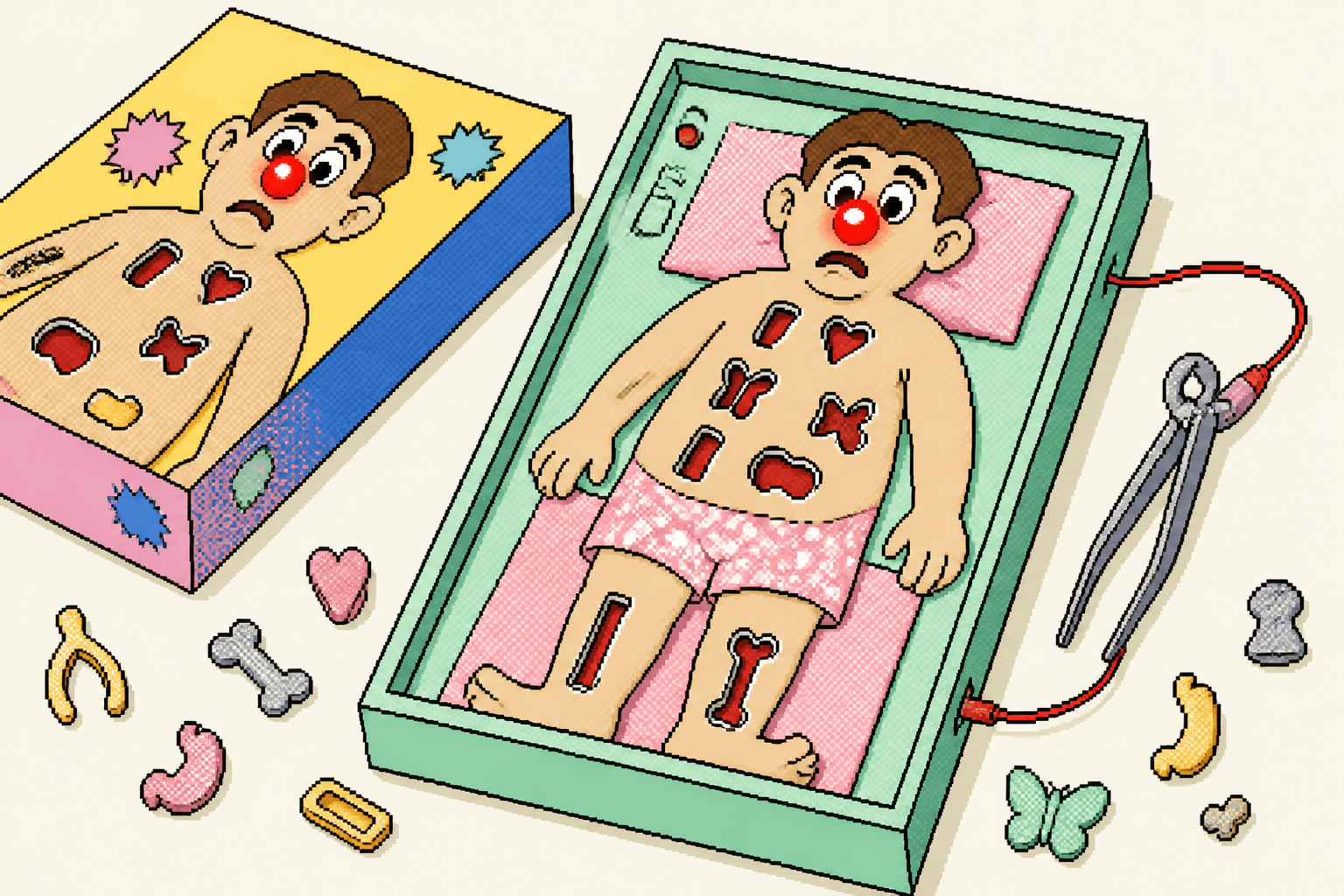
The box was yellow. The box had been sat on. On the front of the box was a man in a yellow bow tie, with a bulb nose, lying on an operating table with his skin flapped open and his insides visible, which were made of plastic. The caption said A Game Of Skill. The caption was lying.
Inside the box were, in approximate order of what mattered: a cardboard board the size of a small cafeteria tray, a pair of tweezers connected to the board by about four inches of red wire, twelve small plastic pieces each shaped like a joke, a thin instructions sheet nobody was going to read, and a battery compartment on the back that had been designed by somebody who hated children.
The game required two D batteries. Nobody had two D batteries. The D batteries were in the TV remote. You took them out of the TV remote. You put them in Cavity Sam. The TV would be fine. You were going to perform surgery.
The Patient
The patient was named Cavity Sam.
He was a cardboard man about the size of a dinner placemat, lying on a cardboard operating table, in a position I will describe as forcibly supine. His eyes were open. He looked like somebody who had seen the exact moment of his own death approaching and had been in that state since 1965. His bow tie was yellow. His nose was red and almost spherical and lit up from the inside, which was the only part of the game that was actually impressive.
Sam had holes in him. Ten holes. Through each hole you could see one of the plastic ailments. The ailments were puns, which is the whole reason the game existed. There was a wishbone. There was a bread basket. There was a charlie horse, which was a tiny plastic horse, in his thigh. There was a water on the knee, which was a bucket. There was a butterflies in the stomach, which was two actual plastic butterflies you could see fluttering, if you squinted and imagined, which you were six so you did.
The puns were the whole game. There was no narrative reason for any of them to be inside a man. They were there because somebody at Milton Bradley in 1964 had made a list of English idioms about the body and had decided it would be funny to make all of them literal, in plastic, on a card you could extract with tweezers for a dollar amount. This is also, approximately, how American medicine works. Nobody told you this at six. You just played the game.
The puns were the whole game. There was no narrative reason for any of them to be inside a man. They were there because somebody at Milton Bradley had made a list of English idioms about the body and had decided it would be funny to make all of them literal.
The Buzz
The buzz was the entire mechanic.
Here is what was actually happening inside Cavity Sam. The cardboard board was lined with a thin sheet of metal foil. Each cavity was a hole cut into the foil, with its own ring of exposed metal all the way around. The tweezers were metal. The red wire ran from the tweezers to the foil, through a circuit that included the two D batteries, Sam's red nose, and a small piezoelectric buzzer somebody had wired in sometime in the sixties with the specific intention of ruining your afternoon.
If the metal tweezers touched the metal rim of any cavity, the circuit closed. The nose lit up. The buzzer went off. The buzzer was not a buzz, exactly. The buzzer was a VRRRRRRRRRMMMMMM that you could feel in your sternum from three feet away. It was the sound of a doorbell that had been given bad news. It was the sound of a kazoo being electrocuted. It did not fade. It did not politely trail off. It stopped the second your hand moved away from the metal, which it had taken a half-second to realize it should do, and that half-second was the longest half-second in the history of a six-year-old at a kitchen table.
Everybody in the house heard the buzz. The dog heard the buzz. The dog left the room. A parent in another room would call out who hit it, not are you okay, because they already knew nobody was okay but also nobody was hurt, which is a distinction a parent learns to make within about six months of becoming a parent.
Try It
Press and hold on a cavity. Keep your pointer inside. Don't touch the sides. If you let go, if you drift, if your hand twitches at the wrong microsecond, the nose lights up and the buzzer sounds in a part of your brain that remembers it from a kitchen in 1996.
The buzzer was not a buzz. The buzzer was a VRRRRRRRRRMMMMMM you could feel in your sternum from three feet away. It was the sound of a kazoo being electrocuted.
The Tweezers
The tweezers were the problem.
The tweezers were plastic, with metal tips. They were about four inches long. They were connected to the board by a wire that was too short, which meant you could not sit back, you could not lean, you could not get leverage. You had to hunch over Cavity Sam like you were about to tell him a secret. Your elbow could not rest on anything, because the elbow-position-that-worked was floating in the air six inches above the board, which is not a position any arm is designed to maintain.
The tweezers also, and this was the real betrayal, were not very good tweezers. The tips were not aligned. If you squeezed too hard, they crossed. If you squeezed too soft, they slipped. The grip on the plastic was textured with these little diamond patterns that looked serious but did nothing. You were operating with surgical equipment designed by somebody who had seen a pair of tweezers once, at a distance, and had been working from memory.
I know now, as an adult, that this was deliberate. The tweezers were bad because the game needed them to be bad. If the tweezers were good, the game would be too easy, and the game existed to produce the buzz, and the buzz existed to produce the laugh of the kid who wasn't operating. The kid who wasn't operating always laughed when the buzzer went off. This was the social contract. If you buzzed, you handed the tweezers to the next kid, and now it was your turn to laugh.
The Pieces
Here is what you were trying to extract, in roughly the order a six-year-old ranked them.
- Wrench in the ankle - top tier. It was a wrench. It was a tool. The others were cosmic jokes and this one was a tool, and the tool was in a man.
- Butterflies - two pieces glued together. Pretty. Hard to grab. Worth $150.
- Broken heart - cracked plastic valentine. Easy, satisfying, you felt things about it.
- Charlie horse - a horse. In a thigh. The only piece that was shaped like an actual animal.
- Spare ribs - three white curves, like a tiny plastic rack of ribs. Fine.
- Writer's cramp - a tiny pencil fused to a hand. Mid-tier, kind of mean.
- Water on the knee - a bucket. A whole bucket. Nobody respected the bucket.
- Adam's apple - a red ball in the throat. Easy to grab, nobody wanted it, lowest status.
- Funny bone - a tiny bone in the elbow. Looked like the wishbone, wasn't the wishbone, caused arguments.
- Wishbone - the one everybody tried first. Hardest cavity. Caused the most buzzes.
The pieces had dollar amounts on them. The amounts were in dollars, which was already a strange thing to put on a kid's game. Writer's cramp was worth $200. Broken heart was worth $100. The wrench in the ankle was worth $750. The game was, officially, about billing. You were a surgeon, and the surgeon who extracted the wrench made more money, and this was the lesson.
Nobody played by the dollar amounts. Nobody tallied. Nobody kept the little cardboard money. The money got stuffed back in the box and forgotten within the first ten minutes of the first time you ever played. The money was a thing an adult had put in the box and nobody had asked anybody to care about.
Nobody played by the dollar amounts. Nobody tallied. The money got stuffed back in the box and forgotten within the first ten minutes.
The Argument
Here is where I argue with myself.
The counter-argument is that Operation was a bad game. It was a bad game in every measurable way. The tweezers were bad on purpose. The cavities were too small. The pieces were too small. The buzzer was too loud. The battery contacts corroded in a year and then nothing worked. The gameplay was try, buzz, hand it over, laugh, repeat, which is not a game loop so much as it is a hazing. The box said A Game Of Skill. There was no skill. There was holding your breath, and there was luck, and there was waiting for an older sibling to finally give you a turn because they had been hogging the tweezers for twenty minutes and had buzzed on literally every attempt.
I agree with most of this. Operation was a bad game.
But here is the thing. Operation did something no other game did, which was that it taught you about your own hand. You learned, at six, that your hand was not under your conscious control. You thought it was. You moved your hand to the butterflies and you thought steady, steady, steady, and your hand would move exactly the way you told it to, right up until the moment the tweezer tips were half an inch from the piece, at which point your hand would, with no input from you, begin to shake. Visibly. Impossibly. Your own hand, which had been obedient for six years, was suddenly a separate animal with its own ideas.
The buzz was your hand telling you something you had not been told anywhere else, which was that your body was not entirely yours. There was a layer of your nervous system underneath the part you controlled, and that layer had opinions, and that layer was going to make the tweezer tip touch the metal rim no matter how still you held your breath.
That is actually a useful lesson. You should know, at six, that your hand will not do what you tell it when you want it to the most. It is useful information. It is the whole reason adults drink coffee or don't, meditate or don't, learn to shoot free throws or play violin or thread a needle. The entire enterprise of a human body is a slow negotiation with the parts of it that will not listen. Operation introduced you to the negotiation.
Milton Bradley charged $9.99 for the lesson, and used it to sell a man with a bulb nose and a wrench in his ankle. That is, in retrospect, a fair deal.
The Nose
The nose was the best part.
The nose was a small plastic dome, red, slightly matte, about the size of a shelled grape. Underneath was a bulb. The bulb was wired through the same circuit as the buzzer. When you touched metal, the nose went from a dull red to a shocking red. It was not subtle. It was the exact red of a traffic light, except it was in the face of a cardboard man who did not want it to be there.
The nose was shame. The nose was the public record of your failure. You could not pretend you had not buzzed. The buzzer was loud but the buzzer was over, and the buzzer required another person to hear it and remember it. The nose was proof. The nose stayed lit for the exact moment of the buzz, and in that moment every eye in the kitchen was on the nose, and the nose was on you, and there was no plausible deniability. Six-year-olds have very few experiences of total accountability. The nose was one of them.
I think about this now. We built an entire adult culture around trying to escape the public visibility of our small failures. We delete the group text. We mute the room. We redo the take. Cavity Sam's nose went red when you missed, in front of your sister, in front of your mom, in front of the dog, and you had to just sit there and look at it until it stopped. It was character-building in the exact way we no longer offer children. We should bring back the nose.
- His eyes were open.
- His chest was open.
- His nose was separate from the rest of his head, electrically.
- He was a patient and he was conscious.
- He had a wrench in his ankle and nobody had asked why.
- He was reusable. You stuffed his wishbone back in and he was good as new. His memory did not retain the surgery.
- He had a face that said I have known this would happen since 1965.
- He was named Cavity Sam, which is a name for a man with cavities, which he did not have. His cavities were in his torso, his thigh, and his elbow. Nobody had named him Cavity Sam. The box had.
The Wishbone Problem
Nobody could get the wishbone.
The wishbone cavity was in Sam's chest, right at the sternum. The hole was shaped like a wishbone, as were the plastic piece inside. The hole was, by my own very scientific adult measurement, about three millimeters larger than the piece. There was no margin. There was no tolerance. There was no angle at which the tweezers could descend without touching the metal rim.
I have, as an adult, performed small operations with real tweezers. I have removed a splinter. I have swapped a battery under a magnifier. I have, once, extracted a tiny plastic figurine from the back of a radiator with a pair of chopsticks. The wishbone in Operation was harder than any of those. I believe this now. I believed it then. We all did.
The wishbone, in practice, could only be extracted by cheating. You rotated the board. You tilted it toward you. The piece slid, slightly, in the cavity, into a position where there was clearance on one side. Then you dove in from that side, held your breath, and prayed. Half the time you still buzzed. The other half, the wishbone came out, and whoever got it would hold it up like a hunting trophy, and the dollar amount did not matter, because the trophy was the whole point.
The End Of A Session
A game of Operation did not end. A game of Operation stopped.
What happened is this. You would play for twenty minutes. You would buzz, and your sister would buzz, and your mom would come in and buzz on the butterflies, which was the one piece she had wanted to prove she could get, and then you would all try the wishbone again, and eventually the battery contacts would warm up, and the nose would stay lit a little too long after each buzz, and then one time it would not light up at all, which meant one of the two D batteries had died.
The game was over. The game was over because the batteries were dead and nobody was going to go to the hardware store at eight o'clock on a Tuesday for D batteries. The pieces, half of which were still in Cavity Sam, were pried out with fingers, which was deeply satisfying and which also broke the whole point of the game, and dumped back into the plastic sorter tray that had been missing one compartment for years. The lid was put on the box. The box was put back in the closet. Sam went to sleep for another month.
The buzzer, I promise you, was still in your head after the batteries died. You could hear it when you blinked. You could hear it the next morning. The buzzer was the thing that stayed, and the nose, and the look on Sam's cardboard face, which was the look of a man who had known you were going to touch the sides.
The game is still manufactured. The design has changed, slightly. The nose is still red. The pieces have different puns now, some of them, because somebody realized "charlie horse" was running out of cultural purchase. The box is now blue, I'm told. I have not confirmed. Somewhere, in a parent's house that is not mine, there is a yellow box with a sat-on crease down the middle, and inside it is a cardboard man with his insides scattered, and the batteries, if you check, are still dead. He is waiting for you to come find him. His nose, I promise, is still red.