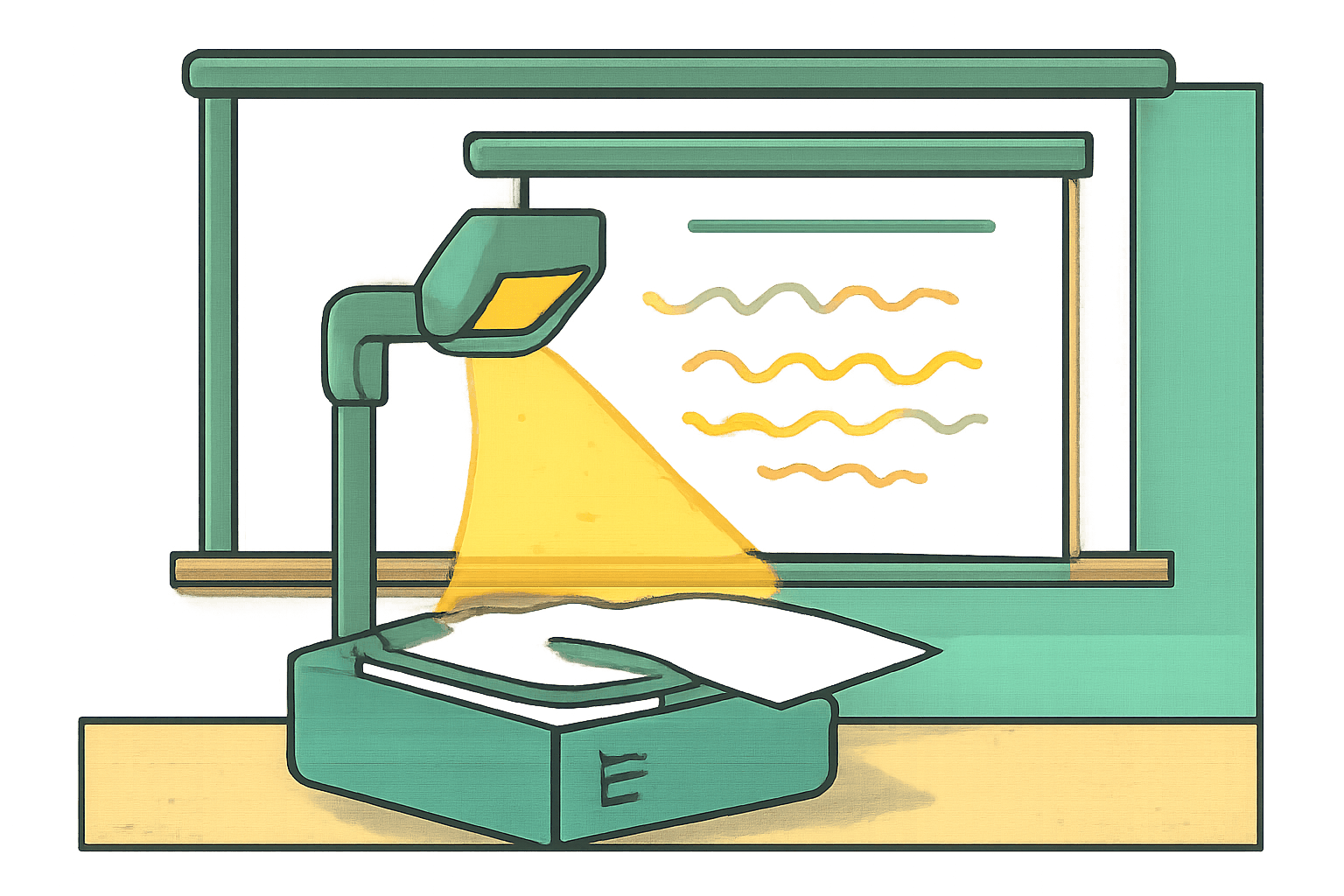
The first thing you noticed was the heat. Mrs. Kimball would wheel the overhead projector to the front of the room - always from the same corner, always trailing its power cord like a leash - and the second she flipped that switch, you could feel it. Not from your desk, not really, but you knew. That fan kicked on with a low, steady hum, and the bulb threw a rectangle of light onto the pull-down screen that was so bright it made the rest of the room disappear. The overhead projector was on. Class was about to get serious.
Or at least, Mrs. Kimball was about to get serious. The rest of us were mostly thinking about the light.
The Machine Itself
The overhead projector was an absurd piece of equipment. A metal box the size of a small suitcase, mounted on a cart that had one bad wheel. Always one bad wheel. The glass surface on top was warm to the touch within seconds - warm enough that you'd rest your hand on it if you were the kid standing nearby, which the teacher did not appreciate. Above the glass, a mirror on an adjustable arm angled the image toward the screen. The whole thing looked like it had been designed by someone who built medical equipment and pivoted to education without changing any of their instincts.
The overhead projector looked like it had been designed by someone who built medical equipment and pivoted to education without changing any of their instincts.
It weighed approximately one thousand pounds. Teachers moved it like they were moving furniture, and the AV kid who got asked to wheel it back to the storage closet walked with the gravity of someone entrusted with government property. Which, technically, he was.
The bulb was the projector's heart and its greatest vulnerability. When a bulb blew - and it always blew, mid-lesson, mid-sentence, mid-word - the teacher's face did something extraordinary. A micro-expression that contained disappointment, resignation, and the dawning realization that the rest of this lesson was going to be done on the chalkboard. Some projectors had a spare bulb built in, a little lever you could flip to switch to the backup, and the teacher who knew about that lever was prepared. That teacher had their life together. The rest just stood there in the dark.
The Transparency Sheet Economy
Transparency sheets were not paper. They were clear acetate film, slippery and strange, and they cost real money. You knew this because your teacher told you. Repeatedly. "These are expensive," Mrs. Kimball would say, laying one on the glass with the care of someone handling a deed to property. Teachers wrote on them with special markers - Vis-a-Vis wet-erase markers in four colors, always the same four colors: black, red, blue, green. The markers had a smell. Not good, not bad, just specific. A smell that existed nowhere else in your life except on top of an overhead projector.
- Black: The default. Lecture notes. Math problems. Serious business.
- Red: Corrections. Important warnings. The answer you got wrong.
- Blue: Diagrams. Labels. The calm, organizational color.
- Green: Existed mostly so there could be four colors. Occasionally used for emphasis by teachers who were feeling creative.
Some teachers had pre-made transparencies. Typed. Printed. Sometimes photocopied onto transparency film using a machine in the teachers' lounge that students were not allowed to see or acknowledge. These pre-made transparencies lived in manila folders, labeled by unit and chapter, and they represented investment. A teacher with a filing cabinet full of transparency sets was a teacher who had been doing this for fifteen years and was not about to switch to the chalkboard now.
Other teachers wrote live. Freehand. On the projector, in real time, while talking. This was the high-wire act. You'd watch them write a word and the whole class would see it appear on the screen, enormous and slightly wobbly, and if the teacher's handwriting was bad - and it was sometimes very bad - the transparency became a puzzle. "Is that an a or an o?" someone would ask, and the teacher would sigh, and you could hear in that sigh every choice that had led them to this career.
The Reveal Technique
The greatest overhead projector move was the piece of paper. A regular sheet of paper, laid on top of the transparency, covering the content. The teacher would slide it down, line by line, revealing each point as they discussed it. This was supposed to keep you from reading ahead. It was supposed to maintain suspense. It was a PowerPoint build animation performed by hand, in 1994, with a sheet of loose-leaf.
The piece of paper on the overhead projector was a PowerPoint build animation performed by hand, in 1994, with a sheet of loose-leaf.
And it worked. There was something genuinely compelling about watching the next line appear. Your brain wanted to know what was under that paper. Even if it was just the third property of multiplication, your brain treated it like a reveal. The teacher had accidentally invented content gating twenty years before the internet figured it out.
The advanced version was the overlay. Two transparencies, stacked. The base layer had the diagram - a map, a cell, a sentence - and the second layer added labels, or color, or the answer. The teacher would place the second sheet on top with the precision of someone defusing a device, lining up the corners, and the class would go "ohhh" like they'd just seen a magic trick. It was a magic trick. It was two pieces of plastic and a lightbulb and it felt like technology from the future.
The Shadow Puppet Problem
Someone always put their hand in the beam. Always. It was involuntary, like a reflex. The second that light hit the screen, some kid's hand would drift up - fingers spread, maybe a peace sign, maybe just a wave - and a giant shadow hand would appear on the screen behind whatever the teacher was trying to explain about the Louisiana Purchase.
This was funny exactly once. The teacher's tolerance for it was approximately zero point three seconds. "Hands down," they'd say, not even looking, because they'd been teaching long enough to know that a bright light and a room full of nine-year-olds was a combustible combination. The shadow puppet urge was universal and ungovernable. Some kids made dogs. Some kids made birds. One kid in my class made what he claimed was a butterfly but which looked like something else entirely, and he got sent to the hall.
The other thing about the beam was that it lit up everything that floated through it. Dust. Always dust. You'd see it swirling in the light, slow and random, and for a second you'd think about how dust was always there, in every room, all the time, and you just couldn't see it without the projector. This was either a science lesson or a minor existential crisis. Depended on the day.
The Kid Who Got to Write on It
Every now and then, the teacher would invite a student up to the overhead projector. To write an answer. To label a diagram. To demonstrate something. This was an honor on par with being line leader or getting to clap the erasers. You'd walk up there, and the whole class was watching the screen, which meant the whole class was watching your hand, enormous and magnified, trying to write the number seven in a way that didn't look like you'd never held a marker before.
The pressure was immense. The transparency was slippery. The marker tip was wider than you expected. Your handwriting, which was already a work in progress, became public. Projected. Broadcast. Every wobble, every hesitation, every poorly closed letter o - all of it, four feet tall on the screen behind you. You'd finish writing and step back and the teacher would say "good" in a tone that meant "adequate" and you'd return to your desk with the quiet relief of someone who had survived a live performance.
The Sound of It
Nobody talks about the sound. The overhead projector had a specific audio signature - the fan, mostly, a white noise hum that sat underneath everything. It was the sound of instruction. The sound of being talked to about important things. After enough years of school, that hum became Pavlovian. Fan noise meant pay attention. Fan noise meant notes. Fan noise meant this might be on the test.
When the teacher turned it off - click, hum winding down, light dying - the silence was enormous. The room got darker and somehow louder. Kids shifted in their seats. The spell broke. Whatever focused, captive-audience energy the projector had created just evaporated, and you were back in a regular classroom with fluorescent lights and a clock that moved too slowly.
The overhead projector is gone now. Replaced by document cameras and SMART Boards and laptops plugged into ceiling-mounted projectors that display whatever's on the screen in HD. It's better, obviously. Clearer, brighter, easier. No bulbs to blow. No transparencies to buy. No Vis-a-Vis markers drying out in a desk drawer because someone forgot to put the cap on.
But nothing in a modern classroom hums like that. Nothing throws that specific rectangle of warm, yellow-white light onto a pull-down screen. Nothing makes a kid want to put their hand in the beam, just to see themselves projected - enormous and temporary - on the wall of a room where they're supposed to be learning about the water cycle but are instead thinking about dust, and light, and why the teacher's handwriting is so much worse than they expected.
The overhead projector didn't display information. It performed it. Every lesson was a little show. And the teacher was up there, hand on the acetate, marker uncapped, performing. Every single day.