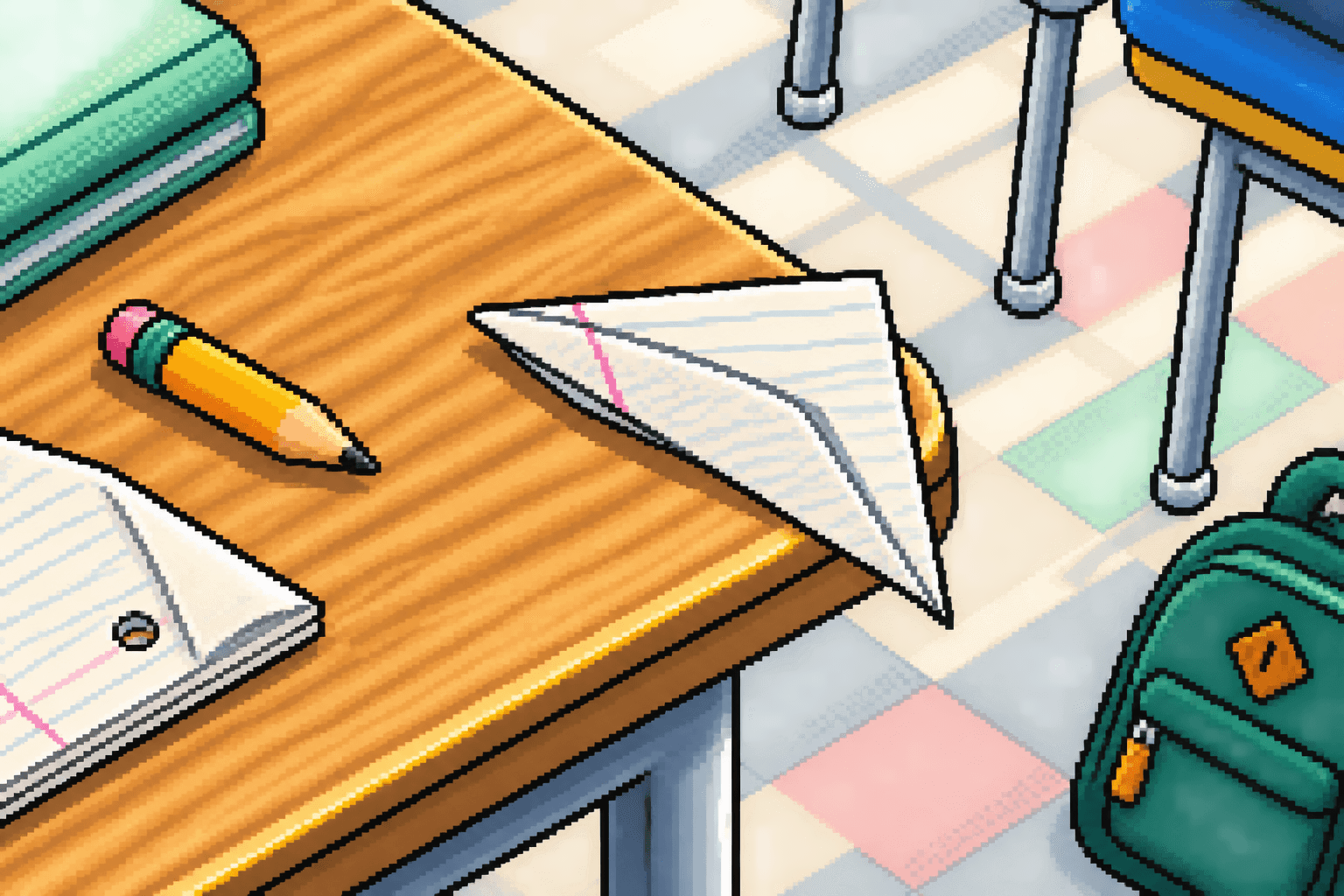
The bell for lunch rang at 11:47. By 11:49 there was a folded triangle of notebook paper sitting on the cafeteria table between me and Kevin Pistone, and we were bent over it like two chess players before a state final. The triangle was the size of a matchbook. It weighed maybe a gram. And we had, without ever saying so, agreed that it was the most important object in the building.
Every kid in America was doing this. In a hundred thousand cafeterias, on a hundred thousand orange plastic trays scooted aside, on desks that were never designed for anything but pencils. It was the only sport you could play sitting down. It was the only sport with equipment you had to make from your own homework.
The Fold
Nobody was ever taught how to fold a paper football. There was no unit on it. No adult ever demonstrated. It was passed, like a knot or a whistle, from one seven-year-old to the next in a way that never made the official curriculum and somehow reached everybody anyway.
You started with a piece of loose-leaf. Any piece. The margin from your math homework worked. A whole sheet was better because it made a heavier ball, which slid straighter. You folded it long ways into a strip about an inch and a half wide. Then you started at one end and folded a corner over into a triangle. Then you flipped and folded again. And again. Little triangle after little triangle, working your way down the strip, each fold tight against the one before. When you got to the end, you tucked the last flap into the little pocket the folds had made.
If you did it right, the ball had four flat sides. Three of them said nothing. The fourth said Bethany Cranshaw / period 3 / social studies, in blue Bic, because that's what you'd used.
Nobody was ever taught how to fold a paper football. It was passed, like a knot or a whistle, from one seven-year-old to the next.
Some kids over-folded and the ball became a hard little pellet. Some kids under-folded and it came apart on the second flick. There was a right density and you knew it the moment you held it. It should feel like a Tic Tac. Like something you could lose in the carpet and never find again.
The Game
The rules were unwritten and universal.
Two players sat across a flat surface. Any flat surface. A cafeteria table, a desk shoved against another desk, the back of a school bus seat. One player set the ball at their edge of the table, points touching the surface, and flicked it toward the other end. You flicked with a middle finger loaded against a thumb, or you flicked with an index finger like a paper airplane, or you did that flat-palm slap thing that made the ball go too far. Everyone had a style. Everyone thought their style was correct.
The goal was to get the ball to hang. To slide across the surface and come to rest with some part of it past the far edge and some part of it still on the table. Overshoot and the ball fell off the desk into somebody's Trapper Keeper, and that was a fumble. Undershoot and the other kid got to flick from wherever it stopped. You got four downs. If nobody scored, the ball turned over.
The touchdown was worth seven points, because touchdowns are always seven points, even though nobody had ever kicked an extra point in this version. Then came the field goal.
The field goal is the part everyone remembers. The scoring player set the ball on point at one end. The defending player made goalposts with their two hands - fists together, thumbs raised straight up, index fingers touching in a triangle underneath. The kicker flicked. The ball had to sail through the thumb uprights. Three points if it did. Nothing if it hit a thumb.
The rulebook was oral. Every school had bylaws.
- Was hitting the wall a fumble, or did the wall play?
- Did the goalposts have to touch the desk, or could you raise them into the air?
- Was there such a thing as a two-point conversion? (No. Kids who claimed there was were cheating.)
- If the ball landed on the edge, half on half off, but perfectly balanced - was that a touchdown or an incomplete pass? (Touchdown. Obviously. Show some respect.)
The Stakes
The stakes felt real. They were not real.
A win at lunch meant nothing at recess. A twenty-eight to nothing rout of Kevin Pistone at 11:53 was, by 12:15, back to being just Kevin Pistone and me climbing the same jungle gym. There was no ladder. There was no season. There was no ranking. And yet on the flick that mattered - fourth down, five points behind, one more chance to hang the ball off the edge - your palms sweat. You lined up like you were disarming a bomb. Everything else in your life, briefly, was less interesting than the geometry of a folded triangle and a laminate table edge.
On the flick that mattered, your palms sweat. Everything else in your life, briefly, was less interesting than the geometry of a folded triangle and a laminate table edge.
I don't want to make this bigger than it was. Nobody remembers who won any specific game. But I remember the feeling of the game more clearly than I remember most of what my teachers said that year. Which is either a beautiful observation about play or a damning one about how school works, and I've stopped trying to decide which.
The Confiscation
There was a version of the story where a teacher took the ball.
Ms. Karcher would walk past the table where we were playing, hold out her hand without breaking stride, and you'd put the ball in it like a criminal at a checkpoint. She never gave them back. There was a drawer in her desk that must have had two hundred of them by the end of the year, from various fourths and fifths and sixths, all folded a little differently, all with somebody's homework on one side. If a school district ever wanted to preserve a piece of 1994, it should have gone through Ms. Karcher's confiscation drawer.
The confiscation itself was not the punishment. The punishment was that you had to fold another one. Which took forty-five seconds. So really it wasn't a punishment at all. It was a small tax on visibility, and we paid it cheerfully.
Sometimes, if the ball was folded especially well, you'd catch her looking at it for a second longer than she needed to. Like she was appreciating a nice specimen. Then it went in the drawer.
What We Were Actually Doing
Here is the part where the essay is supposed to zoom out and tell you what it all meant.
I don't fully know. I know we were killing time. I know we were doing something with our hands during a stretch of the day the school hadn't scheduled for us. I know we were building a small structured world - with rules and a scoreboard and a moment of suspense - out of two objects, a piece of paper and a table edge, that were already going to be in front of us anyway.
We were building a small structured world - with rules and a scoreboard and a moment of suspense - out of two objects that were already going to be in front of us anyway.
I know that when I think about paper football now, I mostly think about how easy it was. Not the skill. The setup. Nobody bought anything. Nobody downloaded anything. Nobody signed in. Kevin Pistone tore a corner off his English worksheet and forty seconds later there was a whole sport happening. If you told a nine-year-old today that a piece of loose-leaf and a lunch tray could produce an hour of complete absorption they would ask you where the app was.
And then here comes the argument the blog is always having with itself: you can tell that story too romantically. The paper football also gave a lot of kids a small painful lesson about being bad at things in public. The kid who couldn't fold it right, the kid whose flick always went sideways, the kid who couldn't make the thumb goalposts steady enough - they were also part of this. Every low-stakes game is a stakes game for whoever is losing. I'm not sure we always noticed.
The End of Play
We stopped playing paper football sometime in middle school and I could not tell you when. There wasn't a last game. There was just, one day, a lunch table where nobody thought to fold one, and then another one, and then a whole year, and then it was gone, and none of us noticed.
That is how most childhood things end. Not with a decision. Not with a farewell. Just with a substitution you didn't realize you were making.
I could fold one right now. I know I could. My hands would remember it before my head did - the corner over, the flip, the tuck at the end. I'd hand it to somebody across a table and say okay, four downs, seven for a touchdown, hands up for the field goal. And they'd know exactly what I meant, even if they hadn't done it in twenty years, because everybody's hands remember this one. It got in early. It's still there.
I don't miss being nine. I miss being able to build a whole afternoon out of a piece of paper and the person sitting across from me. That was a good trick. Nobody told us we were doing it. Nobody said stop. And when I try to remember what any of the games actually were - what the score was, who won, whether it was a real touchdown or a lucky one - I can't. What I remember is the ball hanging off the edge of the desk. Not falling. Not landing. Just there. Held up by nothing but how carefully I'd flicked it. Which is a kind of prayer, if you think about it long enough, and I try not to.