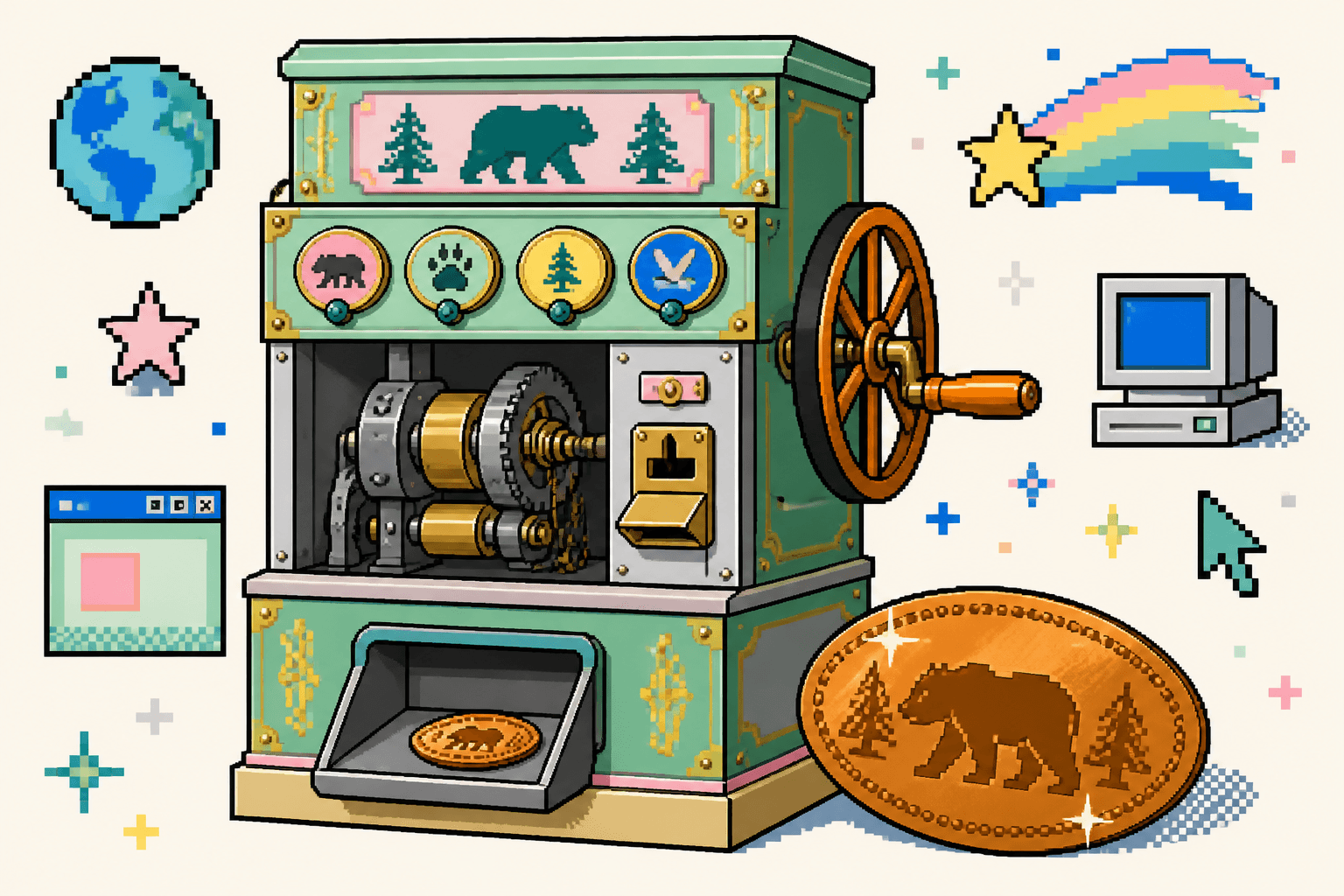
The machine was bolted to the floor by the gift shop exit. It was painted some shade of brass-or-trying-to-be-brass, with a peeling decal of an eagle or a state outline or the words SOUVENIR PENNY in a typeface designed by a man who retired in 1973. Mounted across the top was a little chrome strip with four design choices, each one a slightly different drawing of a place you had just paid eighteen dollars to be at. You picked one. You slid a quarter and another quarter and your penny into three little slots on the front. You grabbed the handle, which was always slightly sticky. You cranked.
It made a sound like a printing press fighting a coffee can. Teeth. Metal on metal. A long mechanical grinding noise you couldn't see the source of. You couldn't see the penny anymore. You couldn't see anything. You just turned the handle until something happened, and then you turned it some more because you weren't sure something had happened, and then a small chute opened at the bottom and a piece of warm copper fell into the tray.
Your penny.
Except it wasn't a penny anymore. It was an oval. It was longer than a coin had any right to be. The face of Abraham Lincoln, which you had handed to the machine ninety seconds ago, was now a vague suggestion underneath the embossed silhouette of a lighthouse or a moose or the Liberty Bell or whatever it was you'd chosen from the chrome strip on top. The edges were sharp. The penny was warm.
You held it in your hand and you did not know what to do with it.
The Economy Of Defacement
The transaction was, on paper, an act of vandalism. You had taken legal United States currency and you had paid a private business fifty cents to obliterate it. The penny that came out of the machine could no longer be spent. It would not satisfy any vending machine. It would not satisfy any cashier. It was, in every functional sense, worse than money.
This was the appeal.
You paid fifty-one cents for an object whose only purpose was to prove you had once been somewhere. A pressed penny was a receipt for being a person in a place.
Your dad always said something like I think this is technically a federal crime, you know. Your mom always said it's fine, let him do it. You were ten and you didn't care which one was right. You wanted the bear. You wanted to feed the machine the penny. You wanted to crank.
For the record, your mom was right. Defacing currency is only a crime if you intend to defraud, and you couldn't defraud a Coke machine with an oval, so the penny presses were legal. Your dad was wrong. He was always a little wrong about things like this. He was also the one who paid for it.
The Crank
The crank was the whole point. The good penny presses were mechanical. There was no motor. There was no button. The machine could not work without you putting your small child arm into the equation. You leaned into it with both hands and your full body weight, and you turned, and you turned, and at some point you started to wonder if you were doing it wrong because how many revolutions did this thing want from you. And then the resistance changed and something gave and the penny dropped and you'd done it.
The cranks had a rhythm. Thunk. Click. Grind. Thunk. Click. Grind. You could hear gears engaging somewhere inside the housing. You couldn't see them but you could hear them, and you could feel them, and at the top of each rotation there was a moment of relief where the handle went almost loose, and then you'd push it down and the resistance started again.
If you were tall, you could do it standing. If you were short, and you were short, you had to crank sideways, leaning into it like you were rowing a small boat across the lobby of an aquarium. Your shoulder ached afterward. You did not mention this. You did not want to admit weakness in front of the penny press.
The Four Designs
The four designs were always the same four designs.
There was the most-locally-relevant one. The state outline. The local landmark. The resident exotic mammal. There was the generic souvenir one, usually a banner with the name of the place in a font that suggested western without committing to it. There was the wildcard, often nautical even if you were in landlocked Wyoming. A ship. An anchor. A lighthouse standing alone for reasons nobody could quite explain. And then there was the one nobody picked, which was usually a flag, or the year, or just the cursive name of the place again, like the marketing department had run out of ideas at design number four.
- The local mammal (always first choice)
- The local landmark (acceptable substitute)
- The generic banner (chosen by indecisive children)
- The cursive name (chosen by no one, ever)
You always picked the local mammal. You did not need a penny stamped with the state of Idaho. You needed the bear. The bear was the point. You'd been driven hundreds of miles in a Dodge Caravan to be at a place where a bear lived, and now you were going to deface a piece of U.S. currency with a bear, and you were going to keep that piece of bear-currency forever. Or at least until you put it in your pocket and lost it in the laundry six days later. Whichever came first.
What Happened To The Pennies
Here is the thing about a pressed penny. You never had a plan for it.
The penny had no use case. You couldn't spend it. You couldn't display it. There were no penny-press display cases, not really, not unless your parents were Really Into It and had also bought you the little three-ring binder at the gift shop, which they had not, because the binder cost twelve dollars and they had Already Spent Enough Today. The penny went in your pocket. It rattled around with the dimes and the nickels and a Tic Tac you had been saving for some reason. It rode home in the cup holder of the minivan. It ended up in a drawer.
The pressed penny was a souvenir of itself. Proof that you had operated a machine. The bear was just the wrapper.
Sometimes you'd find one years later. You'd open a drawer looking for tape and there it would be, an oval of dulled copper, the bear barely visible now, the edges tarnished, a small piece of evidence that you had once been somewhere. You'd hold it for a second. You'd try to remember if it was Yellowstone or Yosemite or some petting zoo in central Pennsylvania. You would not be able to tell. The bear looked the same in every state. The bear was always the bear.
You'd put it back in the drawer.
The Honest Truth About The Souvenir
Let me say this carefully because I think it matters. The pressed penny was not really a souvenir of the place. The place was incidental. The pressed penny was a souvenir of the act of pressing the penny. The hand-crank. The waiting. The warm copper. The choice of bear.
You hadn't memorialized your visit to the aquarium. You'd memorialized the ninety seconds you spent at the penny press near the aquarium. The aquarium had cost forty-seven dollars and you couldn't really remember most of it. The penny had cost fifty-one cents and you remembered every single crank.
This is, I think, the secret of why these machines persist. They are not selling souvenirs. They are selling participation. A tiny mechanical ritual you perform with your own hands at the end of an experience you mostly endured. The pressed penny is a graduation certificate for surviving the gift shop.
The Persistence
Penny presses are still out there. Every aquarium. Every state park gift shop. Every roadside attraction whose entire economy depends on a sign visible from a state highway. They cost a dollar in some places. They take cards in some places, which feels wrong, which feels like missing the point entirely.
Some of them are electric now. You push a button. The penny just kind of happens. There is no crank, no grind, no shoulder strain. These are the saddest ones. They are penny presses in name only. They have removed the part of the penny press that was actually the penny press.
But the mechanical ones are still around. Still bolted to the floor by the exit. Still demanding two quarters and one penny and one tired arm. Still producing little ovals of copper that nobody knows what to do with and that everyone takes home anyway.
I pressed one last year. Forty-something, in a gift shop in Vermont, the only adult in line behind three children, all of them more decisive than me about which of the four designs they wanted. I picked the moose. I cranked. The penny came out warm and oval and embossed and slightly off-center, the way they always are. I held it. I looked at the moose. I put it in my pocket.
I lost it within the day. I don't remember where. I don't remember which day. I just know I don't have it anymore, which is, I think, what pressed pennies eventually do. They appear. They get carried for a while. They get lost. They make room for the next one.
The penny press doesn't care if you keep it. The penny press is just there. The penny press is just there to take your fifty-one cents and turn it into proof that you were somewhere once, briefly, with a tired arm and a warm oval and a moose in your hand.