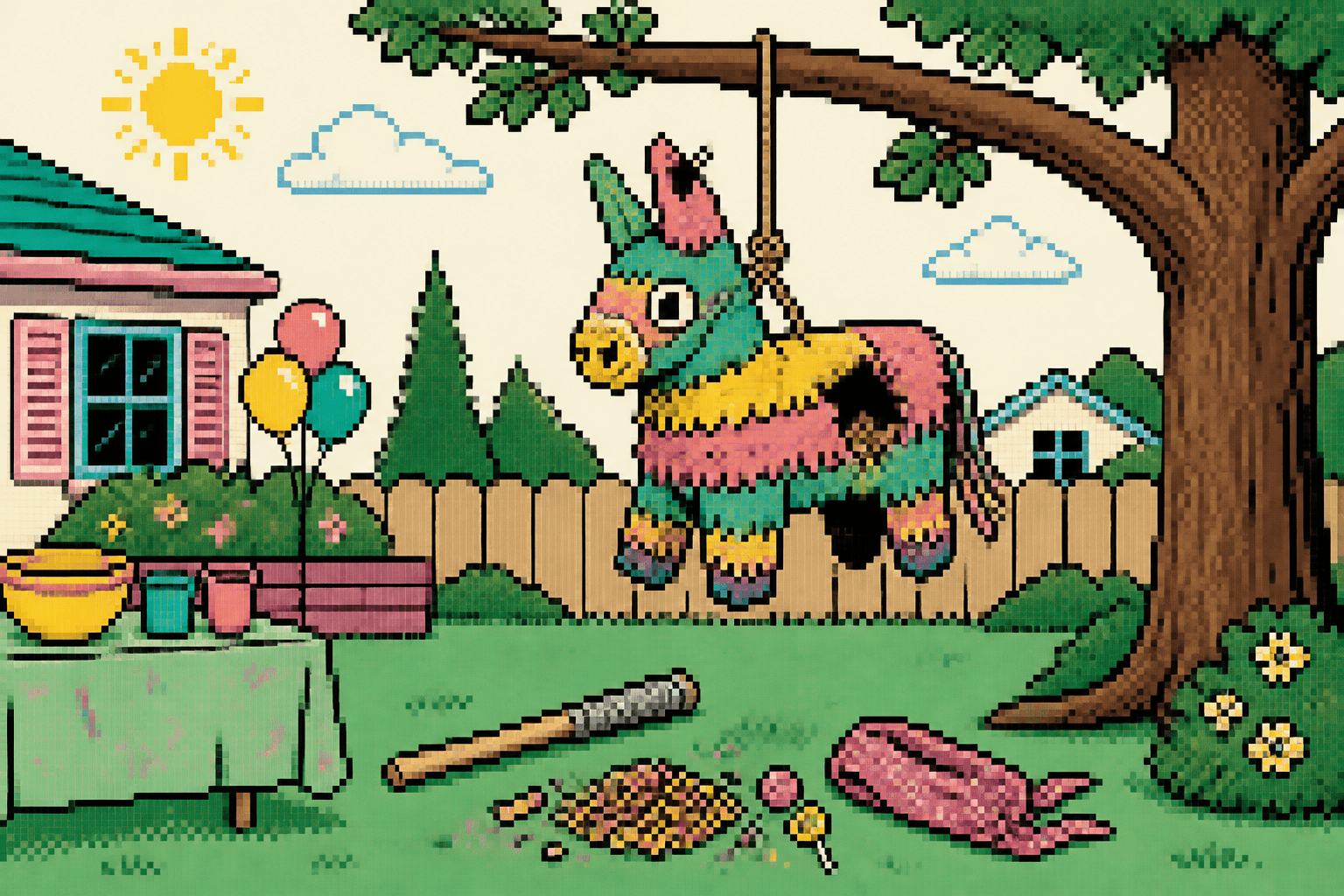
The piñata hung from the lowest branch of a maple tree. The rope was clothesline. The knot was a bowline somebody's dad had tied in the garage ten minutes earlier, with a kind of grim concentration, because tying knots was the one thing he was going to be definitely responsible for today.
The piñata was a donkey. It was always a donkey. There were other shapes available at the party store, I know this now, but at the party you were at, when you were eight, it was a donkey. Pink crepe paper. A head cocked slightly to one side. One ear already drooping before the party started, because the piñata had sat in the trunk of a Honda for six hours in July and the glue had given up on an ear.
The donkey did not look afraid. It should have.
The Construction
Here is what a piñata is made of.
A piñata is made of cardboard. Not corrugated cardboard, which would be dignified and strong. Thin cardboard. The kind you'd find in a cereal box, except shaped. There is a cardboard skeleton on the inside, which has been stapled together by a person in a factory who was not thinking about children. Over the cardboard there is a layer of newspaper, soaked in flour and water, pressed flat, dried overnight. Over the newspaper there is a layer of crepe paper fringe, glued on in strips, which is the part you can see. Over the crepe paper there is nothing. That is the whole thing.
By the physics of its materials this is a structure that should collapse if you look at it too hard. Three dried pastes and a staple. A sneeze would take it apart. One eight-year-old with a stick, you would think, could reduce the whole thing to confetti in under a minute.
By the physics of its materials this should collapse if you look at it too hard. Three dried pastes and a staple. A sneeze would take it apart.
This is not what happened. What happened is that the piñata, in defiance of every property its materials claimed to have, became in that moment the strongest object in the backyard. Stronger than the maple branch. Stronger than the clothesline. Stronger, measurably, than the broomstick, which split before the piñata did.
The Ritual
The ritual was fixed.
First, a kid was selected. The order was announced by somebody's mother off a crumpled list. You stood in a line. You did not question the order. The order was correct because the mother had the list.
Second, the kid was blindfolded. The blindfold was the dad's bandanna. The bandanna had been in the glove compartment of a car. The bandanna had a smell. The smell was man, a little, and leather, a little, and mostly dust. The bandanna was tied too tight. You could see nothing. You could see less than nothing, which was worse than closing your eyes, because when you close your eyes you at least know where your eyes are.
Third, the kid was spun. Three rotations, by convention, though the number varied depending on how much a dad felt like he was moving a child. Some dads did three slow turns. Some dads did five fast turns and let the kid stagger. The spinning was the part that made the whole thing not technically a bat-the-stationary-object-until-it-breaks exercise and more like a bat-the-air-until-you-hit-something exercise. You were going to be, by the end of the spin, so disoriented that the piñata was functionally in a different hemisphere.
Fourth, somebody put a stick in your hand. The stick was a broom handle. The broom head had been removed. Some dad had wrapped the business end in gray duct tape, as if the stick were the thing that needed reinforcement. The stick was going to be fine. The stick was going to outlive the party. The duct tape was ceremonial.
Fifth, you were told swing.
Try It
Swing the stick. Press space or click. The piñata does not want to break. It will take longer than you think. Each hit does damage. Each graze almost counts. Each whiff is still a swing. Keep going.
Keep going. The piñata is engineered against you. The piñata was always engineered against you.
The Failures
The failures were comprehensive.
The first kid swung and missed the piñata by three feet. The stick went into a bush. Everyone laughed. The kid said I didn't miss, which was not true. The dad spun him again. He swung again. He missed again, in a different direction.
The second kid connected, somewhere, with something, and the piñata moved. It swung away from the stick, which is what a thing on a rope is supposed to do, and the kid thought he had done damage. He had not. The piñata came back and hung there, looking exactly the same. One kid in the crowd said it's not even dented. The kid with the stick said it's dented. The piñata was not dented.
The third kid got a clean hit and we all cheered and the piñata still did not break.
The fourth kid cried.
The fifth kid cried, in a different way, because he thought it was the sixth kid's turn and he had been called early and he had wanted to be last and now he was fifth.
The sixth, seventh, and eighth kids swung in quick succession, because the mother with the list had sensed the crowd losing patience, and she had started moving the line faster, which did not improve anybody's aim.
By the ninth kid the piñata had three visible dents, one small tear on the flank, and the drooping ear had come fully off and was lying in the grass. The piñata was still, by any reasonable definition, intact.
- Swing 1 - stick in a bush. Everyone laughed.
- Swing 3 - first clean contact. Piñata swung. No damage.
- Swing 7 - the drooping ear fell off. Nobody counted it.
- Swing 11 - the first real dent. A crescent on the flank. A kid said there.
- Swing 14 - the piñata is spinning now. The spinning is making it harder, not easier.
- Swing 17 - a mom said we might need to just open it. A dad said no, we're close.
- Swing 19 - the broomstick cracked. A new broomstick was found. It was from a different broom.
- Swing 22 - the dad took the blindfold off and said just hit it. The kid hit it. It did not break.
- Swing 24 - the stick went through. Candy on the grass. The donkey was now two halves of a donkey.
The Breaking
The piñata broke on the twenty-fourth swing.
I remember the number specifically, because at a certain point one of the dads started counting, out loud, and by swing fifteen a kind of fatalism had set in across the entire adult half of the backyard. The dads had stopped acting like this was a party and started acting like this was a job. The moms had carried in the sheet cake. The ice cream was melting. The kids were drifting. The piñata, specifically, was winning.
And then on swing twenty-four a girl named Hannah, who had been placed deep in the lineup because her mother had assumed she would not be interested, hit the piñata exactly in the middle of its ribcage with a short, controlled stroke that did not look powerful, and the piñata split cleanly in half along a seam nobody had known was there.
Candy fell.
A lot of candy. Blow Pops, mostly. Jolly Ranchers. Some fun-size Snickers, which were worth more. A plastic ring that was not candy and that nobody wanted. A pencil, which had come with the piñata as filler and which also nobody wanted. And one, specifically one, piece of a candy that nobody recognized, in a yellow wrapper, which was later identified by a mom as that candy they only sell in Mexico and which three kids claimed and nobody got.
The scramble lasted eleven seconds. The scramble was not a party, it was a labor dispute. Children on their knees in the grass, grabbing with both hands, shoving candy into T-shirt hems, into pockets, into the gap between a sock and a sneaker. One kid got a Blow Pop stuck to his elbow because the grass had been watered that morning and the Blow Pop was now a wet Blow Pop.
By the time it was over, the piñata was two pieces of cardboard, a lot of torn crepe paper, and an ear in a different part of the yard.
The scramble lasted eleven seconds. The scramble was not a party, it was a labor dispute.
The Argument
Here is the counter-argument.
The counter-argument is that the piñata was bad. The piñata took forty-five minutes of a two-hour party. It required adult labor to hang, spin, administer, and eventually finish off. It produced candy that could have been handed out in a bag. It produced one injury (a kid got clipped by a broomstick, nothing serious, ice was involved). It produced three distinct episodes of crying. It did not break on the kid whose birthday it was. In most respects it was a failed activity.
I agree with all of this. The piñata was a bad activity by every standard a party-planning adult might apply. It would have been cheaper, faster, and kinder to the children involved to just put the candy on a plate.
But here is what the piñata did that the plate of candy would not have done. The piñata made the candy earned. Twenty-four kids swung a stick at a cardboard donkey in a backyard for forty-five minutes, in July, in Ohio, and when the candy came down it was not just candy. It was candy that had resisted. It was candy that had been fought for. The Jolly Rancher you grabbed off the grass tasted, I promise, exactly like a Jolly Rancher. But in your pocket, until you ate it, it was the proof of a battle. A battle the piñata had, in all honesty, mostly won.
The plate of candy would have been in a drawer by Monday. The Jolly Rancher from the piñata is still, in some part of my brain, lodged in the specific summer afternoon that produced it, with the sun through the maple, and the melted ice cream, and the kid crying because he thought he was going sixth, and the stick with the duct tape, and the mother with the list.
What Was Inside
I will tell you what was inside, because I think I know now.
A piñata is a container that is supposed to break. Everyone knows this. That is the whole category. But the piñatas that we had, the ones from the party store on Route 40 in brown paper bags, were not the piñatas from the country they came from. They were the piñatas that had been reverse-engineered to survive a Honda trunk in July, and a FedEx truck in May, and a cardboard shipping box, and a staple, and more staples, and a glue nobody wanted to litigate.
The piñatas in Mexico, I have been told by somebody who grew up with them, were made of clay pots. One hit. One good hit. Candy everywhere. A ten-second activity.
The piñatas on Route 40 were made of fear. Fear of a lawsuit. Fear of a child getting hit by candy at too high a velocity, by a kid who was too enthusiastic, by a piece of Starburst with sharp corners. The industrial piñata of the American 90s was reinforced the way an airline tray is reinforced. It had been engineered backward from the worst possible outcome, which was candy flying anywhere unintended, and the fix for that was do not let the candy fly.
So we beat on a cardboard donkey for forty-five minutes, and nobody got hurt, which is what the piñata had been built to make sure of, and the piñata, which was supposed to be the thing that broke, was in fact the thing that was holding the party together.
The remnants went into a trash bag at the end of the night. The clothesline was coiled back up and put in the garage. The broomstick, both of them, were leaned against a shed and forgotten. Hannah went home with a Blow Pop. The birthday kid went inside and ate cake. The maple branch is still there, I'm told, by somebody who drives past that house. The piñata is somewhere in a landfill, now, and I would bet money that it is still intact.